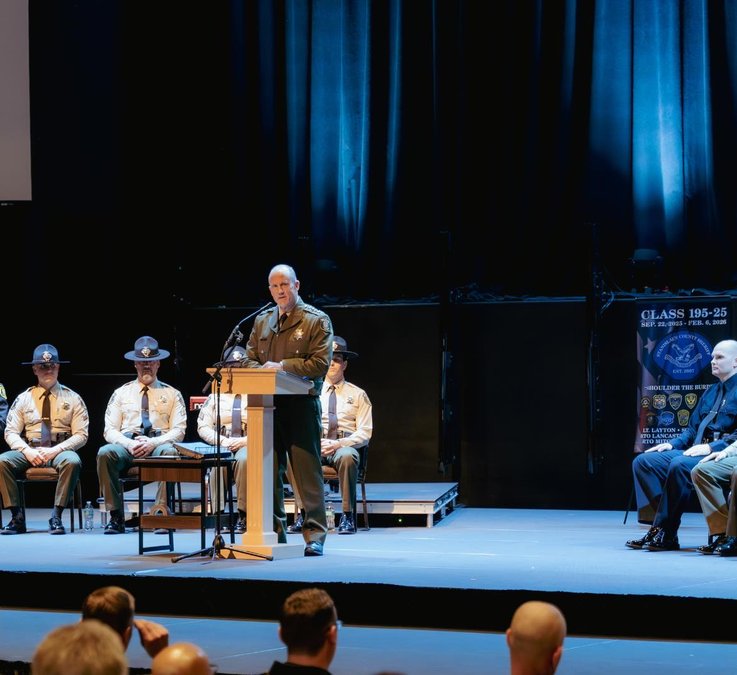
Turlock Journal reporter Joe Cortez recently sat down with Stanislaus County Sheriff Jeff Dirkse for a wide-ranging, two-hour interview at his office at the Stanislaus County Public Safety Center. Here is Part 2 of the Journal’s conversations with the sheriff:
Joe Cortez: OK, everything we talk about from this point forward will be for Part 2 in our series. Let’s start with an easy one. Will you be seeking reelection in 2028?
Jeff Dirkse: Yes. I was on the fence for a long time. I really was.
JC: Why were you on the fence?
JD: A few different reasons. I tell people all the time, “I think George Washington got it right the first time.” And I still believe that. I believe in term limits. Two terms could be a little light. Maybe three, if you’re talking four-year terms. And honestly, some of this dispatch stuff (mentioned in Part 1) has to get resolved. It’s been 25 years of this debacle.
JC: Did the Oracle situation factor into the decision?
JD: Absolutely. We’ve got to fix this problem. But the other thing that factored into it is, if I didn’t do this again, I wouldn’t do anything else in politics. I have no interest in going to Sacramento; I have no interest in flying to D.C. None, whatsoever. Period. Maybe a 1 percent interest in being a supervisor, at best. I would never say never, but I’m not interested in that. I have zero interest in politics. I’m jaded by politics. But my point is, I’m not just going to hang it up and do nothing. I’m way too young and way too energetic for that. So, I’m planning to run again, because stuff isn’t done, and we need to finish a few things. And I don’t know what else I would do. I hate that as an answer: “Oh, I don’t really have anything else to do, so I might as well run.” And I’m a relatively religious person. I keep it private, but it seems like this is what God wants me to do. I think I’m supposed to be doing this job, and He’s not indicating otherwise.”
JC: A few minutes ago, we stopped the recording to briefly talk off the record, and the subject of ego crept into that conversation. I don’t think I’m telling tales out of school by mentioning that. So, in keeping with that that theme of ego, take a moment to pat yourself on the back and tell us what you’re most proud of accomplishing during your tenure.
JD: One is the establishment of the STAC, which we talked a little bit about (Part 1), and our intel analysts network. And the work we’re doing statewide right now in getting them connected amongst all the other sheriffs’ offices; that’s huge. I think it’s the future of law enforcement in our region, and we are doing really well. I’m not going to necessarily compare us to other places, but we have a really strong intel apparatus, comparatively speaking. You go to Orange County, we look like amateurs, right? But it’s Orange County. They've got more money than they know what to do with.
I’m also very proud of our efforts against human trafficking. We definitively lead the region. We have really high arrest numbers around human trafficking, not because it's worse here, but because we are committed to investigating it here. We dedicate resources to it; we have a very aggressive team that investigates it; and they’ve done some tremendous work.
We’ve talked about this idea of intel and real-time response (Part 1). Well, we have probably the best drone unit in the region, hands down. We have a drone on duty 24/7/365. And we fly drones all the time, multiple times a day. They’re a tremendous asset.
We’ve also done some tremendous work in staff wellness. I had always wanted to focus more on physical fitness, but we’ve made progress on the emotional side. It’s very difficult to crack into. There are a lot of stigmas in this profession about, you know, “I'm having problems.” So, we’ve had to destigmatize it, and we’ve done a lot of work in that arena. We're not perfect, but I'm unaware of anybody in the state that does what we do.
Do you know Suzy Powell-Roos?
JC: I do. I covered her when she was a high school athlete at Downey High School, and I’ve gotten to know her a little bit in her post-Olympic life.
JD: We’ve been friends several years, and I distinctly remember my wife, Sandy, and I were driving to a conference, and I said, “I need to call Suzy; I’m looking for a wellness coordinator.” So, I’m picking her brain: “Here’s what we need; do you know anybody?” And we get off the phone Sandy said, “Maybe it ought to be Suzy.” So, she's our wellness coordinator now, and she does a phenomenal job. She is such a unique person that perfectly fits the department. Three-time Olympian, right? From a physical standpoint, she understands fitness, working out, discipline, all of that. But there's a lot of mental preparation that goes into that, too. You’re throwing a discus in front of the world and controlling your mind, like we would have to do on a critical incident. She also connects with female staff members who would be less inclined to go to a CrossFit dude or something. She’s a contractor; she’s only 10 hours a week or something like that. But she’s amazing.
JC: So, you recruited a three-time Olympic discus thrower to be your wellness coordinator. How is recruitment overall in the department?
JD: Recruitment is good.
JC: Where are you at as far as staffing?
JD: I don’t know that number. Ever (laughs). We have two different sets of numbers here, and we fight about this internally all the time. Tori (Hughes), my patrol captain, always counts butts in seats. “How many people do I have to deploy and actually get on the street?” (Undersheriff) Mickey (LaBarbera) and I track actual employees. We track people going in the training pipeline. And then we track people in the background, because I can't exceed my authorized numbers. So, we’re authorized for 208 ops deputies. And custodial deputies are like 320, 321. And then there’s sergeants and lieutenants on top of that. But we have 208 ops deputies.
Before I became Sheriff, we were losing 15 to 25 a year, laterally, to other agencies. We were just a training ground. But we created a Deputy Sheriff II — there’s Deputy Sheriff I and Deputy Sheriff II — and there's some training requirements around it. And if you meet those training requirements, it's an automatic pay bump of 10 percent more. That helped definitively, and the Board of Supervisors passed it, and it was great for the board to do that. At the time, I think 70 percent of our staff met the requirements, and they immediately got 10 percent more pay for, really, doing the same thing. So that was super helpful.
And then, you know, people leave a job. This is, technically, my eighth year. In my first seven years, we averaged about one true lateral move a year, with a little bit of a caveat: I don’t count what I call the change of lifestyle. People want to go live in the mountains. That’s a change of lifestyle, right? I can't help that. We've had people go to Texas, Idaho, Tennessee, you know, because they hate it here and they're getting out of California. Can’t help you with that one. Wish I could. So, you might be able to count about 20 cumulative laterals in seven years, but nothing like the 15 to 25 per year. It's been very stable. When I became sheriff, we had about 160, 165 deputies, and now we tend to average in the 185 to 200 range.
JC: We’re just about at the end of our time. Is there anything else you’d like our readers to know? Anything. Dealer’s choice.
JD: I think, Joe, at this point, we've probably covered it. My No. 1 emphasis right now is really in this intel space. The STAC, dispatch, it’s all interrelated, right? It's all intertwined and interconnected. It’s the future.
JC: Sheriff, thank you. I appreciate the time. You’ve been incredibly generous.
JD: Happy to do it.