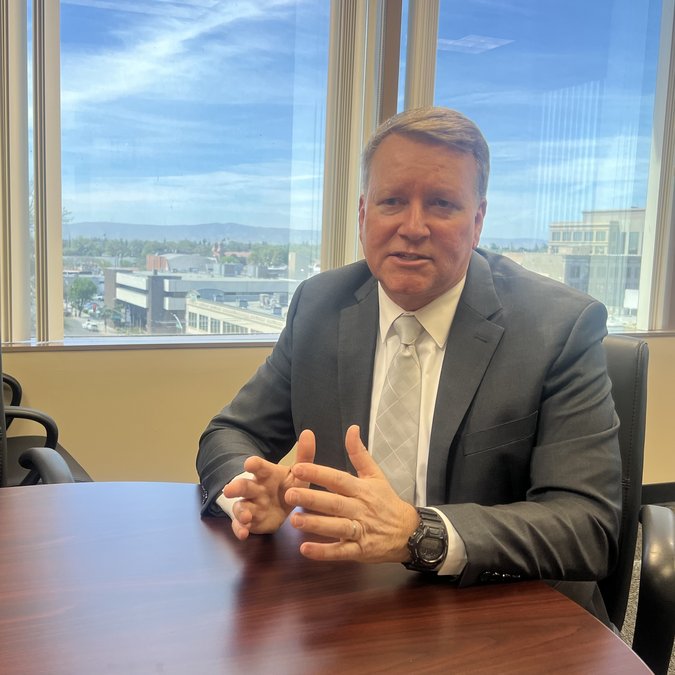
Turlock Journal reporter Joe Cortez sat down with Stanislaus County District Attorney Jeff Laugero last week in his Modesto office. Here is an edited version of that conversation:
Joe Cortez: Let’s start off by talking about crime in Stanislaus County. Generally speaking, how does your office measure success against crime?
Jeff Laugero: We look at what’s being reported. Is Turlock reporting a decrease in crime? Is the sheriff’s department reporting a decrease in crime? And then we look at our volume of cases. We get 400 to 450 new cases a week, which is up from about 350. But that can mean a lot of things. It could mean that that the agencies are out enforcing more crimes. We see trends in the number of cases that we're getting. We can look at the types of cases that we're getting, and then we can look at the number of trials that we're doing, which have increased. I think it was 92, and 60 or so of those were felonies. Before that, the year before, I think it 64 total. That’s a massive jump in the number cases actually going to trial. But we don't just measure it in terms of prosecutions. That's not the metric. Crime rates are a lot more difficult to measure because there's so many factors that are not within our control.
JC: Speaking of the agencies, how do you work with the sheriff and the chiefs of police? And by that, I don't mean, are your relationships cordial. What are the mechanics of your collaborations?
JL: One of the things I believe is that we need to communicate. That could be with federal partners, state partners, local partners, CSU Stanislaus, the MJC security team. I'm wanting to find out what support they need from my office. What are you seeing? What is your jurisdiction dealing with? And how can we use our resources to try and help. As you know, we basically have a police department here — our Bureau of Investigations. I would argue they're some of the most experienced investigators in the county. A lot of them have 20, 30 years with local agencies when they come to work for us. So, we don't lose that talent and that capability. Under Terry Seese, our chief investigator, he's put together a team that could step into a homicide investigation and integrate seamlessly with the agencies. And it's a force multiplier. We have jurisdictions that have really limited resources, but our guys can go out there and supplement them, or take over the investigation if they need to, and really be a beneficial resource to the other jurisdictions within the county. That’s just being a good partner. We also have to understand the bigger picture about what's going on in the county. The problems in Newman are not the same as the problems in Turlock or Modesto. So, I have prosecutors that are basically community prosecutors. I wanted to give the jurisdictions a point of contact within our office, so if there's an issue, they would have a prosecutor they could go to directly.
JC: So, you have a prosecutor here who's essentially on the Newman beat. Is that the right way to look at it?
JL: Yep. Newman can reach out to anybody in this office, of course, but I really want to create that ease of communication. You want to identify somebody so that they can build that relationship with them, and then they can bounce ideas off of them. The agency knows what's going on in its jurisdiction, and if they're saying this is a problem for our community, then we need to listen to that and do what we can to support that? We've tried to build those relationships with all the jurisdictions in the county.
JC: I’ve been in the newspaper business 40 years, as a sports reporter, news reporter, copy editor, etc.; others were on the crime beat or the ag beat or the business beat. Is that sort of how this office works? Do some prosecutors handle different ‘beats?’
JL: You need expertise in certain areas, right? And there's a recruitment and retention component of all of this, too. You want to make sure that people have a good career path, and that they're doing the kind of work they're passionate about. We have a Special Victims Unit, and traditionally that is not an easy billet to fill because people don't want to deal with crimes against children day-in and day-out. But we do have prosecutors that excel in that area because they recognize that they are going after some of the worst criminals that do the most damage. And they’re passionate about it.
JC: Much is made about law enforcement officers and their mental health. Rightfully so. Is mental health something you are concerned about in regard to your prosecutors?
JL: Yes, we have a well-being program here. And if you look at the training out there, and you look at the programs out there for prosecutors, specifically, whether it’s the California District Attorneys Association, the National District Attorneys Association, they are all recognizing the importance of that type of self-care and well-being, because they are dealing with things that most humans are not exposed to. Whether it's the photographs, or going to the crime scene, or actually having to present these horrific facts to a jury — we really look at that, and we want to make sure that they have the resources that they need. The sheriff's department has an award-winning program, and we just kind of piggybacked on what they were doing. It's shocking what a human being will do to another human being, whether it's because they're in a position of trust or power or authority, you name it, it can take a toll on people. We want to make sure that we're paying attention to it, because sometimes you can just get going with an assignment and you just grind and grind, right? And you don't realize you need to take a breather.
JC: I don’t know how you do it. While I was covering a preliminary hearing in the Brassart murder trial, I had to watch the video of the young girl drowning in the backyard swimming pool. I could hardly bring myself to look at the monitor. I was also in court when that video was played for the jury. As I was observing the jury’s reaction, I could tell they were struggling with it.
JL: You get yourself into the mindset that you have a job to do. This is my chosen profession, and my job is also to seek justice for that child, right? To do what's right and to bring some sort of sense and justice out of these horrific things that have happened. That kind of drives you through it a lot of times. Even as a police officer, you end up going to crime scenes and you're not supposed to see a lot of the things that you see. But you say, ‘This is my job, and I need to do these things in order to make sure that I've investigated properly to make sure we are doing what's right for the victim.’
JC: Let’s turn our attention to the cases of sexually violent predators Kevin Gray and Timothy Weathers, who were slated to be released from a state hospital into a residence outside of Turlock. Where do those cases stand at the moment?
JL: The hearing is continuing on Gray. It comes back April 3, and hopefully we’ll get a ruling. We're confident that that the facts are there to show that (North Central Avenue) is not suitable for Mr. Gray. There were just so many deficiencies in the site survey and the risks far outweigh any benefit to Mr. Gray's treatment that might come from being housed there. This whole process has opened up our understanding of the SVP process, the issues with it, and the problems. Our approach now is we challenge all of it, because we don't have any trust in the system.
JC: Are you running low on ammunition in this battle to keep these SVPs out of this proposed residence?
JL: I don't know that I would say we're running low. I think that we have expended our ammunition effectively.
JC: And Weathers? He might be released on transient status?
JL: I think Liberty Healthcare (overseer of the state’s conditional release program) understands that (North Central Avenue) is not going to work because where they wanted to place him wasn't permitted properly. Then Liberty came up with this transient release process that I don't think panned out the way that it was originally being presented. They were in court the other day, and county counsel was brought in and was basically told, ‘Where's the county property that they can park an RV on?’ The judge was letting the county know that it needs to give this consideration for placement on county property.
JC: I want to talk briefly about retail theft, because we just did a story last week about the success your office has had in prosecuting these cases …
JL: That was a great story, by the way. That was really good.
JC: Thank you. I’ll make sure that doesn’t get edited out (laughs). But why aren’t more counties prioritizing going after retail thieves?
JL: I think a lot of it has to do with resources. Jurisdictions that can, seem to have attacked the problem. It takes coordination and collaboration with your agencies. You have to make sure your agencies are staffed to do it, they recognize it as a problem that’s worth addressing, they understand what’s needed as far as the investigation goes and how to make sure they’ve got a case that can be presented to prosecutors and then presented to a jury. So, I think a lot of offices are managing resources right now and prioritizing where to put those resources.
JC: What’s the size of this office?
JL: Roughly 161-164 positions. And we supplement that with vendor contracts, with extra-help attorneys to try and offload some of the routine work off the shoulders of the attorneys who are in court. Cases come in – 400, 450 a week – and we have an issuance team, and they’re very experienced attorneys. It used to be those cases would come in, and an attorney would get an email while in court: “Hey, when you get back, I’ve got something else for you to do.” So, you’re trying to prep your cases, you’ve got a trial, you’ve got preliminary hearings, but you also have to issue 10 cases by the end of the week – it’s unsustainable. Especially, when you’re down one-fifth of your attorney force. The idea was to build it back up but also offload some of those things to more specialized units. … So, now I don’t have to crush the morale of our attorneys by saying, “Hey, before you leave on Friday, can you knock out 100 of these?” That’s the kind of stuff that just sucks the life out of people.
JC: You have 161-164 positions. That’s everybody?
JL: Across the board. Attorneys, clerical, investigators, management, everybody.
JC: How many deputy DA’s do you have?
JL: That’s a good question. I think we’re at 42. We’ve got 10 managers now because we added a layer of assistant chiefs that we pulled from the DDA ranks. That was another goal: to get our organizational structure right.
JC: Finally, what are you most proud of as the DA?
JL: The team that we have here is one of the things I’m most proud of. A lot of them are from the area, and several of our new attorneys have come through our attorney trainee program. We specifically went out looking for kids in law school who were from the area, and we started to try to identify those we might bring back here and give them a job as a prosecutor. So, internships, trainee positions, building that pool of attorneys that we could bring in here to fill out our ranks. We’ve been successful with that.