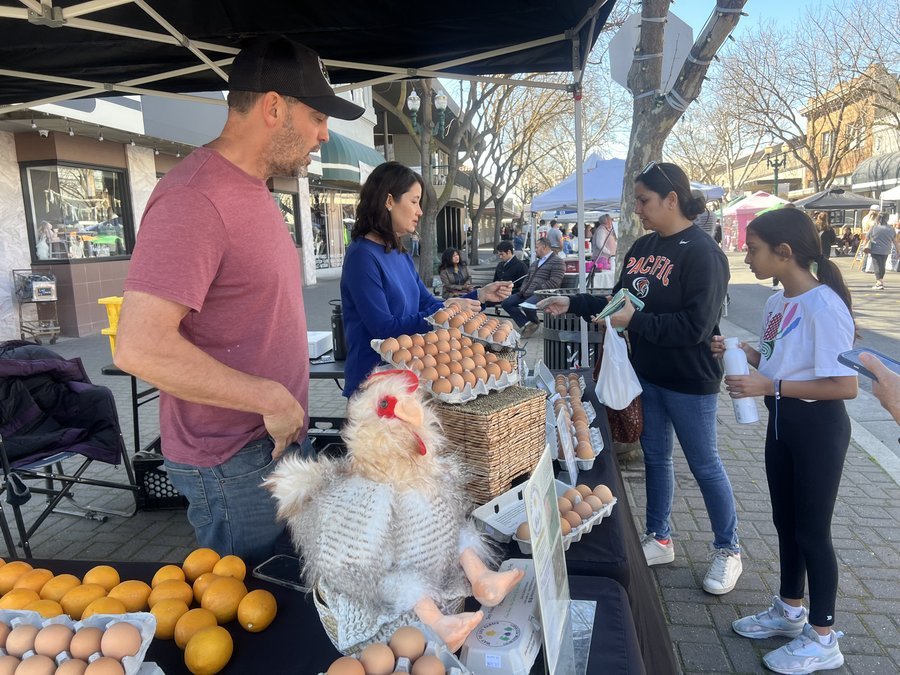
The Turlock City Council on Tuesday will consider amending the municipal code to establish a framework for sidewalk vendors.
Earlier this month, the council adopted a resolution to comply with state Senate Bill 946, which limits local regulations of sidewalk vendors. The bill stipulated that any regulations must be based on health, safety and welfare standards.
The legislation aims to protect street vendors' sensitive personal information – collected during local permitting processes – from being accessed by federal immigration enforcement agencies. It provides safeguards for immigrant entrepreneurs and small business owners across California.
The city utilized the option in state law to adopt the sidewalk vendor regulations by resolution instead of ordinance, since additional changes were expected to be made in Sacramento. Those changes were adopted in Senate Bill 635 – known as the Street Vendor Protection Act and signed by Gov. Gavin Newsom on Oct. 7, 2025 – and went into effect on Jan. 1, 2026.
"Street vendors are a cornerstone of our communities and contribute significantly to California’s vibrant culture and economy," said the bill’s author, state Sen. María Elena Durazo (D-Los Angeles). "SB 635 ensures that these hardworking entrepreneurs can operate their businesses without fear that their personal information will be turned over to immigration authorities. This law affirms California’s commitment to protect immigrant families, support small business owners, and ensure that our limited state and local resources are not used for federal immigration enforcement.”
Turlock’s proposed ordinance creates two distinct regulatory guidelines. One governs itinerant vendors and mostly retains the city’s existing permitting structure – application requirements, background review, operational standards, enforcement provisions – intended to address traditional door-to-door solicitation and transient commercial activity on private property, where the city retains broader regulatory authority.
The other establishes a new framework for sidewalk vendors that complies with state law. It limits time, place, and manner restrictions that are directly tied to health and safety concerns, proximity to schools, driveways, and traffic areas, requirements to maintain ADA-compliant pedestrian access, operational limitations to reduce conflicts with vehicular traffic, and sanitation requirements to address litter, food waste, and stormwater impacts.
Further, it clarifies key definitions, including “sidewalk vendor,” “roaming sidewalk vendor,” “stationary sidewalk vendor,” and “private property,” to ensure consistency with state law and to reduce any gray areas in enforcement. It also establishes clear operational standards, including location restrictions, spacing requirements, hours of operation, and prohibitions on certain sales (tobacco, alcohol, and cannabis products).