A new report finds that the top three health issues facing residents of Stanislaus County are access to care, behavioral health and chronic disease.
The 2025 Community Health Improvement Plan, released by the Stanislaus County Health Services Agency and the Stanislaus County Health Coalition, outlines a shared roadmap for action to address important health issues affecting Stanislaus County residents over the next three years.
The CHIP was developed through a collaborative, community-driven process led by HSA and the SCHC Steering Committee, with active engagement from Behavioral Health and Recovery Services, Medi-Cal managed care plans, community-based organizations, healthcare providers, and residents. It builds upon the findings of the 2025 Community Health Assessment, which identified key local health needs and factors that influence overall well-being.
The 2025–2028 CHIP focuses on three priority areas:
• Access to Care: Lack of health insurance is one of the primary barriers to access to healthcare services, the assessment found. In 2022, only 8.8% of adults in Stanislaus County were uninsured. However, there are census tracts in the county where nearly one in four residents is uninsured.
One in two (47.8%) Stanislaus County residents have public health insurance according to the 2022 American Community Survey, which is defined as Medicaid (Medi-Cal, Medicare, CHIP, and VA coverage). There is currently some uncertainty with the stability of MediCal due to federal changes. Stanislaus County has a provider shortage, which may lead to long wait times for many residents for most provider types. In 2022, there were 93 primary care physicians per 100,000 people, which is less than the provider rates for California (102) and the United States (110). Additionally, community members indicated that having providers who represent the diversity of the county population is important to them.
Strategies outlined in the Community Health Improvement Plan to address Access to Care include: Implementing community health worker (CHW) models to improve care coordination and outreach in underserved communities; Developing regional healthcare workforce pipeline programs with schools, colleges, and universities — with an emphasis on future physicians and behavioral health professionals; and ensuring early identification, timely referral, and adequate access to care for children with developmental delays through a universal screening tool, efficient referral pathways, and an expanded network of qualified providers.
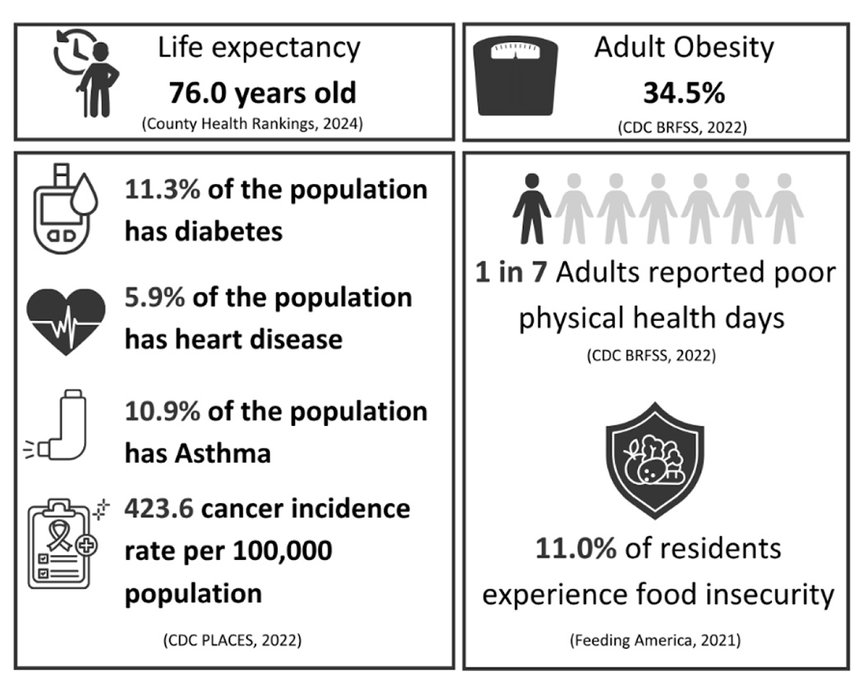
• Behavioral Health: Stanislaus County residents have a life expectancy of 76 years, which is lower than California (79.9 years) and the United States (77.6 years). The county has the 11th highest age-adjusted death rate (889.5 per 100,000 people) in California. The leading causes of death in Stanislaus County are Alzheimer’s disease, ischemic heart disease, stroke, and drug overdose. One in five adults (19.8%) in Stanislaus County have self-reported their health as ‘fair’ or ‘poor.’ Nearly one in 10 (11.3%) of adults have diabetes and 5.9% have heart disease. Stanislaus County has a slightly higher cancer incidence rate (423.6 per 100,000 people) compared to California (397.4 per 100,000 people). Marginalized groups in Stanislaus County, following national trends, have higher incidence rates for chronic disease compared to other communities.
Nutritious food is essential for the health of individuals and communities. One in nine (11.0%) Stanislaus County residents are considered food insecure. The rate is even higher for children (15.2%). Data from the USDA Food Atlas shows that there are many food deserts throughout Stanislaus County.
Some of the strategies outlined in the Community Health Improvement Plan to address Behavioral Health include: Expand youth preventative and mild/moderate behavioral health services on school campus; and building mental health promoting capacity within families, neighborhoods, workplaces, and faith-based communities.
• Chronic Disease Prevention and Management: Stanislaus County adult residents have self-reported their mental health as poor at slightly higher rates than in California and the United States. This may indicate that adults in the county need access to mental health providers. While the suicide rate in Stanislaus County is below the national rate, it is slightly higher than in California, indicating that individuals may be struggling with their mental health and need adequate access to care. Substance use is also a challenge in Stanislaus County. Many community residents have indicated that substance use services are limited and difficult to access.
Each priority area includes specific goals, strategies, and performance measures to help partners track progress and coordinate efforts across the county. The strategies were shaped by the Action Work Groups, which are made up of local leaders, content experts, and community stakeholders committed to improving health systems and outcomes.
“The CHIP represents a powerful step forward for our county,” said Ashley Worley, Health Initiative Manager at HSA. “It brings partners together under a shared vision and lays out real, actionable steps we can take to improve access to care, strengthen behavioral health supports, and better manage chronic disease. Most importantly, this is a plan built by the community, for the community.”
Some of the strategies outlined in the Community Health Improvement Plan to address Chronic Disease include: Promoting chronic disease management by expanding supportive food programs and nutrition education that improve access to and consumption of healthy foods; implementing culturally appropriate, community-based chronic disease education programs (diabetes and hypertension); and creating community health/wellness clubs promoting outdoor recreation and walking across Stanislaus County.
Community members from the county also support this CHIP.
“This Community Health Improvement Plan is very important to me because it shows that our community is being heard. I'm glad to see so many leaders gathered together working for the good of all, and it gives me hope that more families will be able to receive care without so many barriers and that little by little we will have more equitable opportunities to take care of our health,” said Mirna Macedo, Health Equity Champion from Patterson.
Avelina Peraza, another Health Equity Champion from Patterson, added, “It is an honor and a great opportunity for me to represent my community and participate in this great health project for our county. I hope that this action plan, on which we have worked to achieve a healthier community, will produce better opportunities for all."
The CHIP will serve as a key guide for programs, partnerships, and planning efforts across Stanislaus County. It supports alignment between local partners and broader state and federal initiatives such as California Advancing and Innovating Medi-Cal (CalAIM) and the Population Health Management strategy.
Both the 2025 Community Health Assessment and the 2025–2028 Community Health Improvement Plan are available online at schsa.org/CHR