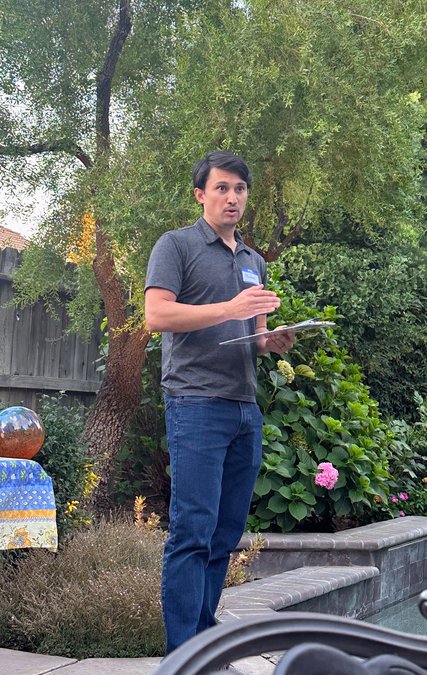
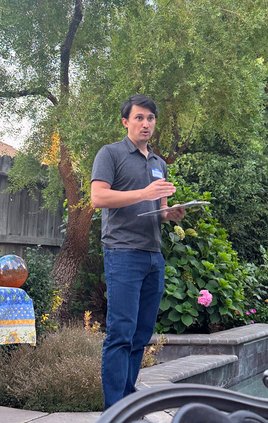
Local Democrat Michael Masuda has announced that he’s a candidate for the 5th Congressional District seat currently held by Rep. Tom McClintock (R-El Dorado Hills). With just about 14 months until the midterm elections in 2026, Masuda’s campaign apparatus is in full swing. So much so, the former U.S. State Department employee issued a press release commenting on the potential for Texas and California to revamp their congressional district maps in a political game of chicken.
“The voice of the people is the foundation of our democracy,” Masuda said. “And any attempt to manipulate that voice through gerrymandering is a moral and ethical failure. In California, we have led the way with an independent redistricting commission designed to take this power out of the hands of politicians. We cannot, and must not, regress to a system where politicians choose their voters instead of the other way around.”
Recently, Turlock Journal reporter Joe Cortez sat down with the soon-to-be 37-year-old candidate to discuss his background and why he decided to jump into politics.
Joe Cortez: Please tell me a little bit about yourself.
Michael Masuda: Well, I was born in Green Bay, Wisc., but I grew up in Amador County. I graduated from Amador High School, and then I went to Cal Poly and majored in electrical engineering. I’ve worked at the Johns Hopkins University Applied Physics Lab (Laurel, Md.) and at General Dynamics in the Bay Area. When my girlfriend — who’s now my wife — graduated from Sacramento State, we decided we wanted to do something new. So, we went to the DC area and started our careers.
My wife’s name is Brittany and we have two kids: a 3-year-old boy named Grayson and a 16-month-old girl named Marigold. We call her Goldie. I picked out that name.
JC: That’s a beautiful name! Nice going. So, most recently, Grayson and Goldie’s dad was working for the U.S. State Department. Why did you decide to leave the State Department and get into politics?
MM: There were a number of reasons. I was working at the State Department in the Biden administration as a civil servant, and was really enjoying my job there. We were doing a lot of work in terms of building partnerships with other countries around the world. And I think the most important part was that we had a vision for what America and its foreign policy would be, and that those partnerships would lead to a more prosperous world and allow the United States to be a leader in that world. And then, with the Trump administration, foreign policy took a 180 degree turn. The ethos of the department really changed. There was a lot of concern not only about people’s jobs and their livelihoods, but also about whether you could trust other people that were coming into the federal government as political appointees. Could you be candid? Could you really explore ideas? And if you had ideas that might be controversial or contradict policy, was your job at risk? So, that was one of the big reasons I decided to leave the department.
JC: And in terms of running for a congressional seat, why did that seem like the next logical step for you?
MM: It was really just an acknowledgement of the moment that we’re in and the country being at a crossroads. Donald Trump is really consolidating power. We are seeing a rise of these authoritarian practices within this administration. So, this is an attempt to fight back against that. But fighting back against Donald Trump is not enough. Donald Trump is one person who has ideas, but there are people surrounding him that have ideas. The push is not just to get Donald Trump out of office or to stop him this election cycle. The goal is to put forth a different path forward for the country. One where we are tackling our problems, where we are being honest about what is happening in our country. We need to be honest about the grip that money has on our politics and politicians and elections, about the debt situation that we have in this country, and the fiscal policies that have led us to very large deficits and growing debt. It’s an acknowledgement that our systems for health care, housing, immigration, are simply not keeping up. They have not changed with the times and aren’t really working for people. And maybe you could argue that a lot of them have never really worked for people. But, certainly, we can’t have the same politicians doing the same thing year after year and not actually addressing the problems that we're having. We’re at a breaking point.
JC: Had you thought about elected office before?
MM: I had thought it might be something I’d want to do in the future. I was doing engineering work at Johns Hopkins. I was doing research into what new capabilities we can develop, and how we can use what we have more effectively in terms of national defense. It was really great. But I also saw there were a lot of other problems out there. And as an engineer, I try to break down problems and figure out solutions. I thought maybe there was another path that I could take in public service.
JC: I hate to point out the obvious, but you’re challenging a nine-term incumbent in a red district. You face a very difficult task. Did those factors give you pause as you were making your decision?
MM: Definitely. This district, by the registration numbers, is a very red district, and having to face a long-term incumbent, who’s also a senior member of Congress, definitely gave me pause. But I think people want change right now. They want something new, and they want people who are going to acknowledge the problems that we face, and aren't going to just sit by. The fact that we can do all this fundraising and there’s all this dark money floating around is really great if you're an incumbent. It’s really great if you have those connections. It’s not great for voters. And I think there are a lot of people who are acknowledging that, and feel like the system is broken. In a lot of cases, they’re not even going to vote. And if they do vote, they don’t expect any change to happen. And I think that’s a big part of why we are here now, in this divisiveness, because the system encourages people to become more extreme and encourages our politicians to dig in like a tick. And how do you do that? Well, you leverage the voters that you have, and you in this case, in a very red district, all you have to do is divide people enough, and you can win the district, often very easily. But it takes a lot more work to come in and say, “I want to talk to the other side,” and “I want to earn your vote.” It takes a lot more work to come in and do that, but that's how we get better leaders.
JC: What do you see as your opponent’s shortcomings?
MM: Everybody that I’ve spoken to, Democrat or Republican, either hasn’t heard of him, doesn’t know anything he’s done for the district, or say he's never around. You need to hear from the people, and I think not being around is his biggest shortcoming. I also think that he's just a typical politician in that if the system works for him and allows him to continue being elected… he’s not going to rock the boat, he’s not going to change things, he’s not going to go after the hard problems, because that might piss off some people.
JC: OK, I’ve heard you knock McClintock. Now, tell me what Michael Masuda has to offer.
MM: I think the big thing is: I care. I grew up in part of this district, in Amador County. My parents still live here. My brother and his kids still live here. And second, I’m not coming from the political world. I have a background that, if my political career falls apart, will allow me to go back into engineering. And I'm OK with that. But if I have the opportunity to get into office, even if it turns out to be a brief period of time, I am going to go hard, I'm going to show up, and I'm going to work on the issues that are hitting people day in and day out.
You can learn more about Masuda at his website: VoteMasuda.com.