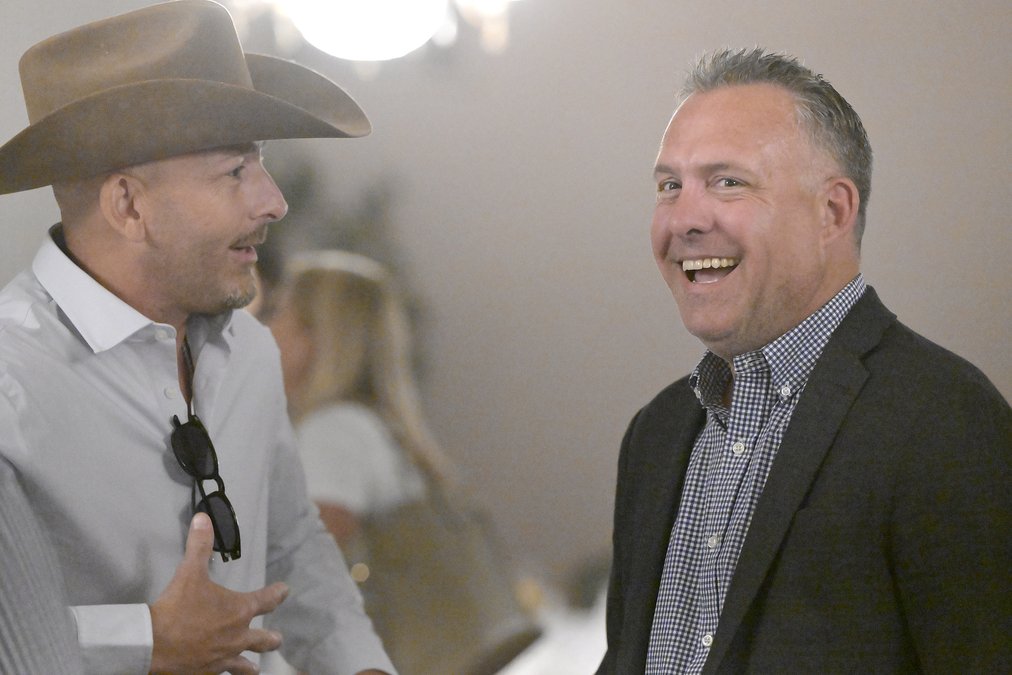
In a discussion ranging from water storage to immigration to the existential threat of pests, Rep. Adam Gray brought together 50 of the Valley’s agricultural leaders in Los Banos as part of his Agriculture and Water advisory committee.
“We are the best agricultural Valley in the world, and we ought to be treated that way,” Gray told the assembled growers, producers, processors and water officials. California is the nation’s farming leader, generating $54 billion a year – nearly twice as much as the next-leading state. Gray convened the meeting to both fill in the ag community on what’s happening in Washington and to learn of their priorities.
Gray was elected in November to represent one of California’s most far-flung districts, stretching from Coalinga in southern Fresno County to Lathrop in the middle of the Sacramento-San Joaquin Delta, 160 miles north. In between lies the most productive farmland and the most proficient farmers in the world.
Many of those farmers attended Wednesday’s meeting.
Ben Moore, who created The Ugly Co. in Farmersville, asked about Gray’s Dignity Act and its impact on ending labor shortages.
“Dignity is a starting point,” said Gray, who described a deeply divided House of Representatives in which it is almost impossible for contentious legislation to pass. That doesn’t mean solutions developed in the Dignity Act aren’t important. Even unpassable bills are analyzed by members of both parties – some of whom are just as anxious as Gray to resolve the issues.
“I don’t care how they become law or whose name is on it,” said Gray, “just as long as we’re doing something.”
In answering a question from Firebaugh grower Joe Del Bosque, Gray said the solution to California’s worsening labor problems is in President Donald Trump’s hands. Until his administration’s immigration enforcement raids start detaining more criminals instead of workers, any bills – authored by Democrats or Republicans – will be “going to sit in print,” unable to pass.
Gray told Del Bosque he has supported legislation just so he has a seat at the table. “I signed onto bills that aren’t perfect – that I know aren’t perfect – just to be moving the needle. To keep the conversation going,” said Gray.
Turlock Irrigation District board member Becky Arellano noted that relicensing to make electricity at Don Pedro Dam is in its 16th year with no end in sight.
“That’s come up a lot,” said Gray. “I’ve personally brought up the entire (section) 401-certification process over and over again. And we’ll keep bringing it up.” He said other elected officials are equally frustrated.
Clayton Smith of the California Fresh Fruit Association asked about the prospects for a new Farm Bill, which has been delayed since 2019.
“If it was up to the Ag Committee to do the Farm Bill, we would have been done in January,” said Gray, who sits on both the Ag and Natural Resources committees. He said Chairman Glenn Thompson, a Pennsylvania Republican, “is a pretty good guy,” but “there’s so much division in Washington, nothing is going to get done.”
Roger Isom, who leads the Cotton Ginners and California Tree Nut associations, was alarmed that the Plant Protection & Quarantine programs that safeguard agriculture from pests and disease have been cut by 25 percent. Cuts in the U.S. Department of Agriculture (USDA) have disrupted research into fixes for the spread of navel orangeworm and New World Screwworm.
“We’re sitting on the verge of catastrophe with the research dollars we’ve lost,” said Isom as many in the room nodded in agreement.
“The cuts to research are not always proportional or intentional,” Gray told the growers. “It’s different now because a lot of this – it doesn’t come up in Congress.”
Instead, cuts to research are made by executive-branch decrees through the Department of Government Efficiency (DOGE) and the Department of Health & Human Services. DOGE slashed 15,500 research programs totaling $44 billion in federal grants this year, including hundreds of studies being done on ag-related issues.
According to Western Farm Press, DOGE cut 18 USDA contracts related directly to so-called “specialty crop research.” DOGE also “accidentally” laid off every federal researcher studying bird flu, though some were subsequently rehired.
Robert F. Kennedy Jr., who leads HHS, fired some 3,500 employees, ending research into human and animal diseases. An anti-vaccine crusader, he ended research into a vaccine for bird flu.
Variants of H5N1 have led to the destruction of more than 100 million commercial chickens, turkeys and ducks; the disease has jumped to dairy cattle, infecting nearly 800 California dairies and sickening at least 70 dairy workers.
Gray said Democrats need help convincing the administration that such research must be a top priority. “You know me,” he told the growers, “I don’t give a damn what they think when I say what I believe needs to be said. But on the other side, they’re afraid. We need the Valadaos and Fongs (Representatives David and Vince, who represent the South Valley) to be a lot more vocal and public” on this issue.
Bill Lyons, the former California Secretary of Agriculture and cattle rancher, called such threats existential to farming, saying, “This is going to affect every community, every producer in this room.”
Gray promised to reconvene the group at least twice more this year. He said he wants to bring both the California Department of Food & Agriculture and USDA into the room so they can hear concerns directly from growers.
“The key,” said Gray, “is that we are participating. We are at the table. We are in the water meetings, we are in the crop meetings.” That, he said, is the key to finding solutions.