BY JOE COREZ AND KRISTINA HACKER
Turlock Journal
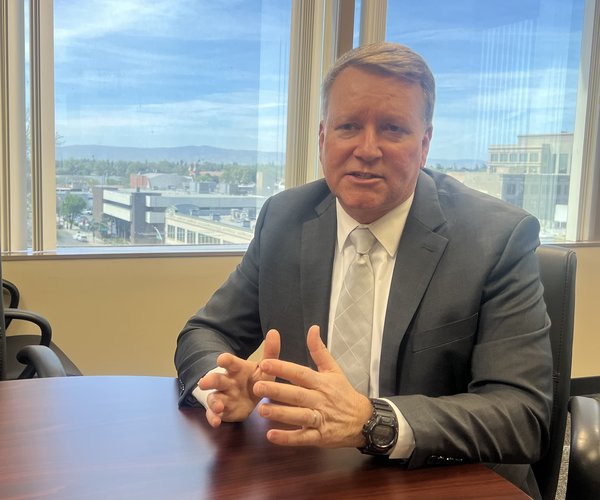
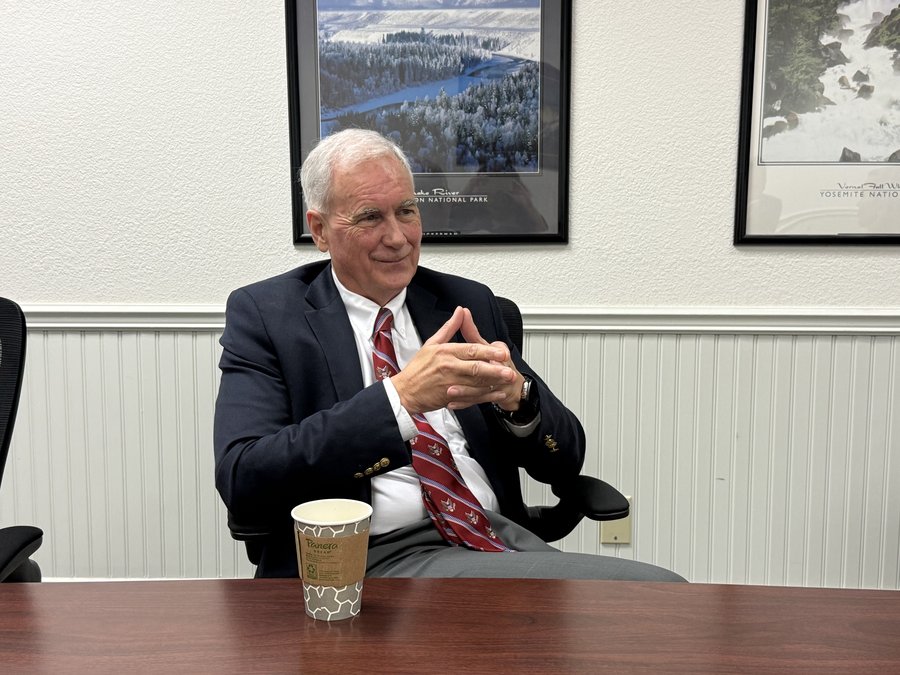
Last month, Rep. Tom McClintock’s office reached out to the Turlock Journal to set up an interview. The Journal submitted an outline of topics to be covered, retaining the right to ask follow-ups and travel down side roads as the conversation dictated. McClintock, whose 5th Congressional District includes a portion of Turlock, readily agreed to the format. Following a visit to Pitman High School and before visiting with the Turlock Rotary Club, the nine-term Congressman met with Journal Editor Kristina Hacker and reporter Joe Cortez earlier this week at Turlock City Hall.
After exchanging pleasantries, the Journal dived right in to the issues important to local residents.
JC: Congressman, why did I pay five and a half dollars per gallon at the gas station the other day?
McClintock: Well, you're referring to the situation in Iran, and it’s because oil is a globally traded product that has been disrupted rather dramatically through the Strait of Hormuz. I don't expect that to last very long, and the economists that I've read are predicting that once the strait is reopened, we could see the global price of petroleum go from over $100 barrel to between $40 and $60 a barrel. That's going to make a tremendous difference. Now, that doesn't necessarily mean price relief for California, because of a lot of very specific California policies have taken the number of our refineries from 41 in 1980 down to nine last year and seven this year. And now Chevron's talking about closing its refinery. That's a separate issue. But, as I said, I'm very confident that the spike in oil prices is going to be short-lived.
JC: I paid $4.19 a gallon on Feb. 27, the day before the war in Iran started. I paid $5.69 the other day, but I didn’t bargain shop. I was on double-E and had to pull into the first station I could find.
McClintock: I paid $5.25 yesterday.
JC: Did you pay with cash or credit?
McClintock: Credit.
JC: Right. Who uses cash anymore? Congressman, was this operation in Iran essential?
McClintock: Well, I can tell you what I've been told, and that is that the Iranian government was within weeks of being able to produce about 460 kilograms of enhanced uranium. That's enough for 11 Hiroshima bombs. They've been increasing their drone production at about a rate of 400 a week, I believe. And the Israeli intelligence had assessed that the window was closing on being able to do something about it – that the stock of armaments that Iran had compiled were so vast that the window was closing on their ability to deal with the nuclear mass, and they concluded that they had to act.
American intelligence assessed that Iran's response was already planned, and that would have been a massive first strike against U.S. military bases throughout the region with an overwhelming arsenal of missiles. Rather than absorb that first blow, President Trump decided to act preemptively, and that's where we are.
JC: With all due respect, Congressman, I've been hearing that Iran is two weeks away from this capability since I was in junior high school.
McClintock: Well, this was coming directly from them. In negotiations with (U.S. envoy) Steve Witkoff, they were boasting about it.
JC: Do you think the president should go before a national television audience and talk to the American people about what we're doing? Because, apparently, we obliterated this capability under Operation Midnight Hammer back in June.
McClintock: We buried much of their stockpile and their production facility. That's true. And again, I don't have the details on where this extra 460 kilograms of uranium was, but they were quite adamant about claiming that they intended to proceed with it.
JC: Would you like to see the president go on national TV?
McClintock: Yes, I would. I think the explanation that I received in briefing was pretty convincing. And I think the American people would have a far better appreciation for the choices the president had when he made that decision, if he would explain it clearly.
KH: OK, I'm going to move on to the DHS funding. It's your committee, right? You're the chair of the subcommittee.
McClintock: Well, I don't do the appropriation side. My subcommittee does the immigration law. We don't do enforcement; we don't do appropriations.
KH: My specific question is you recently criticized Senate Democrats for proposing zero dollars for ICE funding. Basically, the bill they sent over was to completely defund ICE and Customs and Border Patrol. So, what do you think is the minimum level of enforcement funding you need to secure the borders?
McClintock: Well, the borders have been secured. The question is whether we're going to now enforce our immigration law. That's the purpose of ICE, in particular. And zeroing out their budget – basically defunding them – is simply not acceptable. What that says is we will no longer enforce our immigration laws. If we can't enforce our immigration laws, we have no immigration laws. If we have no immigration laws, we have no borders. If we have no borders, we have no country. The ICE badges were all funded through the Big Beautiful Bill. But their entire support staff depends on the appropriations bill, so their support staff hasn't been paid since February, and they were. I have seen a number of posts from these employees saying, “We're being left behind.” Also, the administrative staff isn't able to do its job. The ICE officers, who are funded through the Big Beautiful Bill, can't do their job. So, it's the same thing as defunding ICE.
JC: But didn't Sens. John Kennedy and Ted Cruz come up with a two-step solution that the President nixed?
McClintock: Yeah, but that requires the use of the reconciliation bill for that process, and that's a very lengthy process. It requires a budget resolution that we still have not produced; we're almost a year behind in producing the budget resolution for the current year. And then on top of that, we have the April 15 deadline for the budget year.
JC: But more pointedly, the President said, “No deals with the Democrats.” So, shouldn't your ire be directed toward the White House?
McClintock: He didn’t say no deals with the Democrats. He said we're not going to defund ICE; he said that deal is unacceptable. What he has offered is to go more than halfway on several reforms the Democrats have requested, including body cameras for all ICE officers. I strongly support that. I would also support – and I think the president agreed – identification names and badge numbers. So, he made a number of concessions, but the one concession he is not willing to make, and I'm not willing to make, is to defund ICE. That was the bill they sent to us.
McClintock’s District Director Kimberly Pruett: Congressman, I just want to point out, too, that recently there was an historic drug bust in our district – in Turlock, Modesto and Valley Springs – and the five individuals that were apprehended were cartel. They were all illegal Mexican nationals. It's been all over the news, and the local law enforcement actually did turn them over because it became a federal case, and that was just like a couple of weeks ago. So that's just one example in our district.
KH: Well, that leads into the Shut Down Sanctuary Policies Act. Your bill. How exactly does this law compel sanctuary jurisdictions to cooperate with ICE?
McClintock: It preempts laws that would interfere with local law enforcement entering into agreements with the federal government to enforce immigration law; it would divert federal law enforcement grants from those jurisdictions that are refusing to enforce federal law to those that do want to. As I've said, every sheriff that I've talked within this district – and we have meetings with them every so often – wants to cooperate with ICE. I think you mentioned (Stanislaus County Sheriff Jeff) Dirkse being an exception. He wasn't present at that meeting. He was invited but just didn't attend.
JC: One thing Sheriff Dirkse told me, though, is that he was trying to get cooperation from ICE.
McClintock: I saw the article on DHS. I have that inquiry into DHS. The problem is they're shut down.
JC: Are you referring to the article about the 400 legitimate ICE holds and only 35 having been picked up over the past four years?
McClintock: Yeah, I put that inquiry into DHS, but they're closed down right now, so I can't get an answer yet.
JC: But that would be a logical place to start, yes? As opposed to kicking down doors and smashing car windows?
McClintock: I'd like to hear the full story about the 400, yes.
KH: Are there legal protections for local officers who decide to cooperate with ICE even though they work in a sanctuary city?
McClintock: Among other things, any lawsuits brought against them would be taken over by the federal government. In other words, the federal government would stand in as the defendant in those cases, and it preempts the state laws that would prevent them from cooperating with federal authorities to enforce immigration requests.
JC: Congressman, the president has made political hay about affordability being a hoax. That certainly wasn't his tune on the campaign trail. What say you?
McClintock: I think what he's referring to is that the affordability issues are largely government generated, and I believe that be the case. I mean, these are policy questions. If you look at the 10 most affordable states in the country, they are all Republican strongholds. If you look at the 10 most unaffordable states, they're all Democratic strongholds. There's a policy aspect to that. You can see that very clearly in California: when something is scarce, it is expensive; when it's plentiful, it's cheap. We have made electricity scarce by choice in California; we've made water scarce by choice in California; we've made housing scarce by choice in California. That drives up the price of all of those necessities. You realize there were more building permits issued in Dallas and Houston last year than were issued in the entire state of California. The median price of a home in Texas is $360,000; the median price of a home in California is $900,000. I suspect that's probably what the president was alluding to.
The Rosetta Stone was unearthed by a reporter or a commentator who said that President Trump should be taken very seriously, but he shouldn't be taken literally. Words aren't his thing.
JC: You mentioned Democratic states and the Republican states. Nevertheless, Democratic constituents and Republican constituents both are suffering in this district.
McClintock: Yes, but their suffering is because of specific policies enacted largely at the state level. Again, housing and electricity. We paid one of the highest electricity prices in the country. I remember the 1960s when a lot of communities, including Sacramento, didn't have residential water meters. You paid a subscription, and you used whatever you wanted, because water was so plentiful in those days. There was serious discussion as to whether electricity meters made any sense, because we were bringing the cost of electricity down so dramatically with our nuclear plants and our hydroelectric plants. All of that was called off during the (Gov. Jerry) Brown administration – the first Brown administration. We stopped building highways, we stopped building power plants, and so these blue states bear the heaviest tax burdens in the country, which has a direct impact on the affordability. And, so, people are leaving in record numbers. One and a half million more people moved out of California than moved in during the (Gov. Gavin) Newsom administration. It’s often said that California Republicans are still winning the vote; the problem is people are now voting with their feet and leaving. But these are policy choices. They're all choices within our power to change.
JC: But we're paying more at the pump, more at the grocery store, and the president campaigned on the promise that grocery bills would be halved under a second Trump administration. That may eventually be the case, but at this point, it's going the opposite direction.
McClintock: I see what you're saying. Look, I've often said you can't spin the economy. Everybody knows in their own lives exactly how well they're doing. You trying to tell them otherwise, and it just ends up making you look foolish. What I can tell you is this: I remember the Reagan recovery, when the tax cuts took effect, you could feel the difference. There was a palpable change in everybody's mood. They had more money in their pockets; more opportunities were presenting themselves. Jobs were growing; economic growth was expanding dramatically. I can tell you that the policies in the Big Beautiful Bill are Reaganomics on steroids. It takes about a year for them to work through the economy. We were starting before the Iran crisis; we were starting to see that in the economic figures. They are not reaching people's lives yet, but I am still very confident that when Iran is behind us, we are going to see a fairly dramatic improvement in the national economy. We're now producing more petroleum than Saudi Arabia. This is the direct result of the regulatory relief that we've won through the Big Beautiful Bill, the President's own executive orders, and the Congressional review authority resolutions that we've adopted this past year.
KH: Let’s talk about tariffs, which are the exact opposite of Reaganomics.
McClintock: They're a big mistake. The president insists that they're necessary to give him the leverage to negotiate more favorable trade agreements for the country. As long as he's doing that, I'm not going to get in his way. But I'm not going to pretend that somehow the tariffs are helping the economy. I don't believe that for a moment. I think they're hurting the economy. I think the regulatory and tax relief that we've got in place is going to vastly eclipse the damage from the tariffs. But there's no doubt in my mind that the tariffs are creating damage, and as I've often said, “When you're trying to accelerate, it doesn't make any sense to keep tapping the brakes,” and that's essentially what the tariffs are doing. I've had this discussion for over an hour with (U.S. Trade Representative) Jamieson Greer, one on one, and I'm not going to change his mind; he's not going to change his mind. This is a debate that's actually been going on for many hundreds of years. And part of their position is that the tariffs are necessary to give them negotiating leverage. OK, I'll go along with that for a while, as long as we're getting good trade agreements as a result. But I'm not going to pretend that they're helping the economy.
KH: So, you'd would support the bill to bring the power of tariffs back to Congress?
McClintock: Let's call it the Constitution.
KH: Yeah, isn’t Congress attempting to stop the president from instituting tariffs without Congressional approval?
McClintock: Well, first of all, the Supreme Court made some major contribution in that direction with its recent decision. But as I said, as long as you know they're using that for leverage, for trade, for better trade agreements for this country, I'm not going to get in their way. But I'm not going to pretend that this is helping.
JC: I hate to be the Doomsayer, but regardless of which poll you look at, the president's numbers are not great. Are you concerned for your party's well-being in the midterms?
McClintock: Again, I remember the Reagan years, the tax cuts that were delayed by two years. They were enacted in ’81, but they didn't take effect until ’82 in the midterms. We took a terrible drubbing because people were struggling with the aftereffects of the (President Jimmy) Carter economy, and they were blaming Reagan. The next year they took effect, and as we approached the 1984 elections, that's where the economic recovery occurred. Reagan ran an iconic ad. It was called “Morning in America.” Well, you're not old enough to remember.
JC: Oh, sure I remember. I was 17 during that election year.
McClintock: OK. Well, that resonated. And it resonated because that's what people were feeling in their own lives. And the result was one of the biggest Republican landslides in history in the 1984 elections. The Big Beautiful Bill was enacted in time to have its effect on the economy before the midterms, and I still think that it will. So, I believe we're going to be in a very different political landscape in a few months than we are right now, assuming that Iran is behind us, and the tax cuts and regulatory reforms have the desired effect. I think it’s going to be a very, very different and very much happier summer than we've had in quite a while.
JC: Do you think Iran will be behind us by then? We've just sent how many more thousands of troops over there?
McClintock: Nobody can predict what twists and turns a war will take. Obviously, this is being done without congressional authority, therefore the War Powers Act is applicable. In that respect, the president has 60 days, with about 30 now behind us. So, at that point, without congressional authority, he's got to withdraw. And I think that every statement out of the administration has made it clear that they're planning to do that. I think what is most likely to happen is there'll be a triggering event. I don't know what, but something is going to happen that will trigger the resistance within Iran to go after what remains of that regime. You know, I chair the Iran Caucus in the House of Representatives, along with Rep. Steve Cohen of Tennessee, a very liberal Democrat. But we agree on Iran and the Iranian expatriates, particularly the NCR, basically, MEK active resistance cells. This is French underground type stuff. They're small cells, five to 15 people, but 20,000 of them in all 31 provinces. In addition to that, you've got 2,500 combat-ready veterans in Albania Camp Ashraf 3 – it's the remains of the old Iran Liberation Army of MEK that was disbanded in the 19 2000 2003 I think so. And then on top of that, you've got the Kurdish militias that are stirring. So, I think there will come a point fairly soon where there will be a popular uprising, and you will have hundreds of thousands of combatants within Iran rise up and dismantle what remains of that regime. That's what I would like to see happen.
JC: You're likely aware that we have a very large Assyrian community here in Turlock, and many seem adamant that they would like to see the Shah of Iran's son Reza Pahlavi return to power. And our local Assyrians have told us that from what they're hearing from home, that is the prevailing sentiment in Iran, as well. Are you comfortable with that scenario?
McClintock: I don't know. There are two major factions: the monarchists that are behind Pahlavi, and they're the Democrats that are behind Rajavi. Mary Razavi of the National Council for Resistance in Iran, NCRI, was originally MEK. They actually participated in toppling the Shah, but then they broke from the Islamic extremists and have been fighting them ever since. Who's more popular in Iran? I don't know. That's why we have elections, and we have to get to that point again. My assessment, just looking at the broad picture, is that NCRI probably has much more popular support within Iran. The monarchists claim they have much more support. Well, let's take out the mullahs and then have an election and find out.
JC: OK, dealer’s choice. Is there anything you’d care to address?
McClintock: I think we’ve hit all the main points: the economy, Iran, and immigration. Those are what's occupying about 90 percent of my time.
JC: What about the other 10 percent? Is there anything else you're working on?
McClintock: Well, I mean, I'm very focused right now on our sanctuaries bill, but I think we're involved with some negotiations among members from New York who are concerned about the fiscal impact on New York withdrawing law enforcement funds as long as they are a sanctuary jurisdiction. So, we're still negotiating that bill within the House. I'm hoping we'll be able to get it out within the next month or so. The Senate is going to be much heavier lift because of the 60-vote threshold. But that's one of my big focuses. The other, you know, continues to be the forest management issues. We were able to get the Tamarack Fire bill and the fix the Tahoe provisions. I've talked to you about those before. The Tahoe provision streamlined the NEPA process. Provide a categorical exclusion from NEPA for forest thinning projects. The Tamarack fire bill, I call it that. It was inspired by the Tamarack fire. It simply instructs as a matter of law, the Forest Service, No. 1, cannot impede local firefighters who are trying to put out a blaze on federal lands. And No. 2, requires them to themselves aggressively attack any fires on the first spotting of them before they can get out of control. That's now been put into the Farm Bill, which is a must-pass piece of legislation, and so that will be coming up fairly soon. I'm very excited about that. If we get those two provisions in, get the Tahoe provisions expanded throughout the National Forest System, and restore the 10 a.m. Rule – put out a fire soon as you spot it – that's going to make a major, major difference, I think, in getting our forest back to proper management. The only other thing I tell folks, I'm on natural resources committee because it's essential to our district. I'm on budget because it's essential to our country, and I'm on judiciary because it's a lot of fun. We talked about immigration, which is my principal focus on judiciary, and then we have the budget issues, which are continuing to be a very big challenge and a very big threat to our country. And I cannot report, outside of the Big Beautiful Bill, a lot of progress. We were behind in our responsibility to produce a budget resolution to follow the Budget Act. I made a little rant on that subject and budget committee this past week, as a matter of fact, which I don't think the chairman (Rep. Jodey Arrington R-Texas) appreciated, but it made me feel better.
JC: Am I correct? Will you turn 70 this summer?
McClintock: That's impossible. Your math must be off.
JC: Well, I’ll be 60 on my next birthday, so maybe my math is off.
McClintock: I was at my 50th high school reunion a few years ago, and it was really weird: I was the only young person there.
JC: Do you still love the job?
McClintock: Very much.
JC: How much longer do you think you'd like to do this?
McClintock: Well, somebody once asked Winston Churchill that question and his response was, “I fight for my corner, and I leave when the pub closes. “And I think it was a newspaper editor that put that question to him. And I think that you put that question to me once before. Same answer.