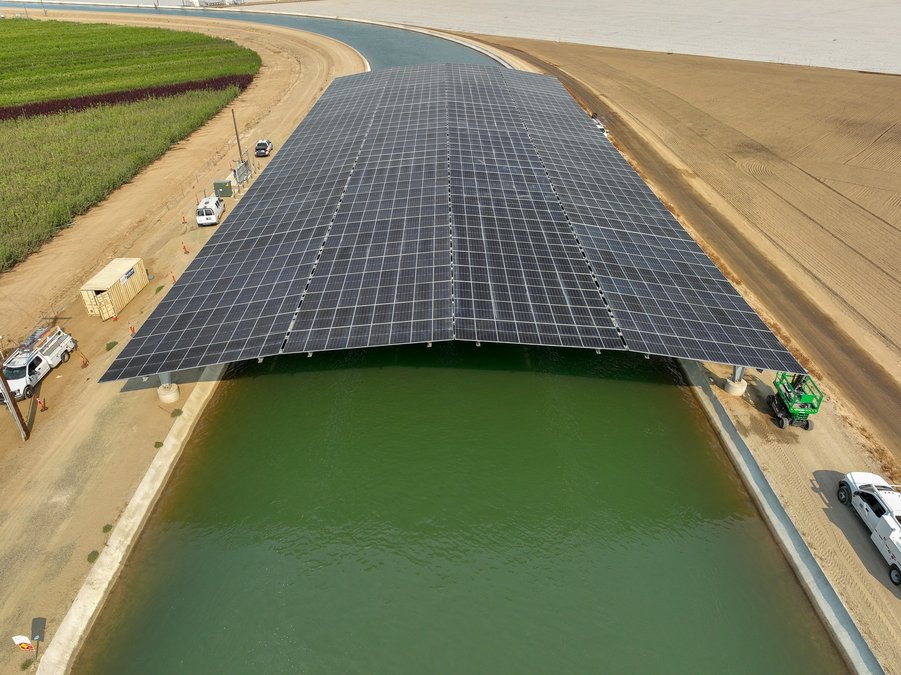
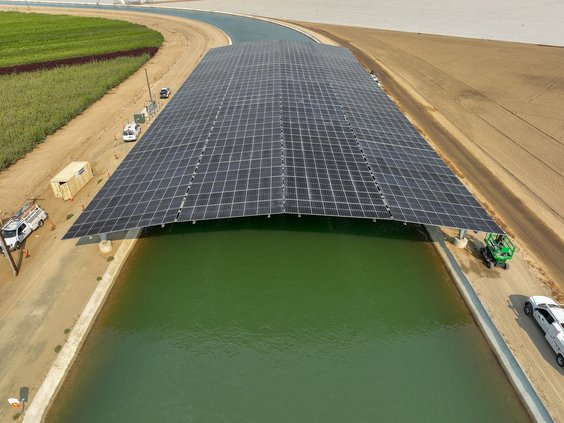
The first solar-over-canal project in California, built over Turlock Irrigation District canals, is now complete.
Project Nexus, an initiative led by seven top California research universities, aims to accelerate the deployment of solar panels over California’s extensive canal network.
Work at the 115-foot wide canal began in February with the installation of concrete footings and was completed and energized at the end of August. Project Nexus has a generation capacity of 1.6 MW between the wide-span and narrow-span—which was completed in March—all of which is integrated into TID’s generation portfolio.
According to a UC Merced study that was published in “Nature Sustainability,” covering large sections of the state’s 4,000 miles of canals with solar panels could help conserve water, reduce air pollution, save land, and generate clean energy using existing land and infrastructure.
Project Nexus is utilizing TID canals to test the theory. The pilot program is funded by the state of California and is a public-private-academic partnership between TID, Solar AquaGrid, UC Merced and the California Department of Water Resources.
Led by the University of Southern California’s Dornsife Public Exchange, and independent advisor Solar AquaGrid, CSCI researchers will collaborate with state agencies to extend the solar network.
“California is leading the way in exploring innovative solutions to tackle climate change and strengthen our water and energy resilience,” said California Natural Resource Agency Secretary Wade Crowfoot. “We are excited to see top research institutions come together to help deploy solar panels over water canals — a big idea with great potential..”
While not all canals are suitable for solar installations, the UC Merced study estimated that covering all 4,000 miles of California’s exposed canals with solar panels could generate enough electricity to power about 2 million homes each year, conserve enough water to supply up to 2 million homes annually, and reduce land use by placing solar arrays on developed land.
The study indicated that covering significant portions of canals could provide benefits beyond power and water, including conserving up to 50,000 acres of land and habitat by placing solar arrays over existing infrastructure; lowering maintenance costs by shading the canals, which reduces weed and algae growth in the canals; enhancing the efficiency of the solar panels due to the cooling effect of the water below; and creating local jobs to install and maintain the systems.
Although California experienced multiple episodes of intense rainfall and flooding emergencies in the past two years, scientists predict the state will continue to swing between intense rainfall and prolonged droughts, emphasizing the need to conserve water and reduce greenhouse gas emissions while meeting the state’s increasing energy needs.