BY RACHEL LIVINAL
CV Journalism Collaborative
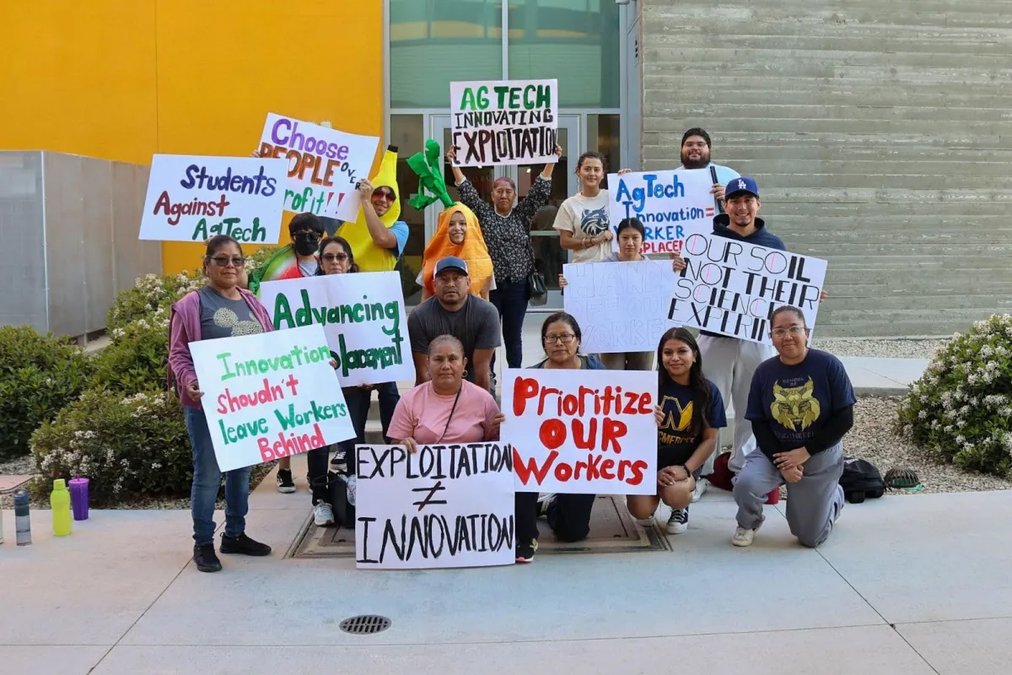
While a group of global leaders gathered at UC Merced Friday for a private event about investments in AgTech, over a dozen farmworkers and UC Merced students protested the idea that machines could replace human workers.
Protesters held signs that said “Our soil is not their science experiment,” and some wore fruit costumes. They hoped to change the conversation around investments in agriculture technology.
“They intend to bring in machinery to do the work,” said a Madera-based farmworker, Emelia Guzman, in Spanish. “We are asking them not to do that, but rather to let the people continue working, and to give opportunities to those who work in the fields.”
Guzman, a member of the Central California Environmental Justice Network, said she’s seen fewer work opportunities after technology started picking up on farms. She also worries about the environmental impacts of the machinery.
The Governor’s Office of Business and Economic Development teamed up with the regional economic-driven coalition North Valley Thrive to convene the private event, which took place over the course of two days. It featured site visits to Merced College’s AgTech innovation center and UC Merced’s Agricultural Smart Farm as well as AgTech companies operating in California.
“This mission is designed for international AgTech companies interested in expanding into California – the largest producer and exporter of agricultural products in the United States,” an event sign-up page stated.
But farmworkers and those close to them fear the technology these programs hope to produce will replace jobs and further ignore the farmworker movement for justice.
State, protesters hold differing views
Gov. Gavin Newsom’s big push for agriculture technology began last year when the state allocated more than $9 million to the Community Foundation of Merced County. The money was set to be funneled to Merced College and UC Merced infrastructure developments in the sector.
The grant was part of a wider effort by the state to provide more jobs that are region-specific. But protesters last week said the effort will do the opposite, arguing it will take jobs from those who have worked in the fields for decades.
They also said the farmworker justice movement is far from over because farms don’t always abide by employment standards, and Ag-Tech tools are not as good as the state portrays them to be.
“With the new technology they want to introduce, the land gets damaged as well,” Fresno farmworker Hortensa Antonio, 49, said in Spanish. “It is not the same as having the workers tend to it. Using one’s hands is not the same as using technology. It damages the trees and the land as well.”
Antonio said she worked in agriculture fields for more than 20 years, just like most of the other farmworkers who attended the protest.
Students at the event also were quick to point to the recent news that the late Cesar Chavez, known for leading the farmworker movement in the 1960s and ‘70s, should not stop progress of the movement’s core beliefs.
An investigation by the New York Times revealed last week Chavez sexually abused girls as young as 12 and 13, as well as another pivotal figure in the movement, Dolores Huerta. Since the news broke, state leaders and local institutions alike are calling for monuments and other tributes in Chavez’s name to be taken down and renamed.
Amid the upheaval, the protest organizers last week said their actions were more important than ever — to show the farmworker movement is alive and well, even in the midst of controversy over one of its historical figures.
The group said they chanted and talked with attendees on Thursday at Merced College and showed their presence and signs on Friday at UC Merced.