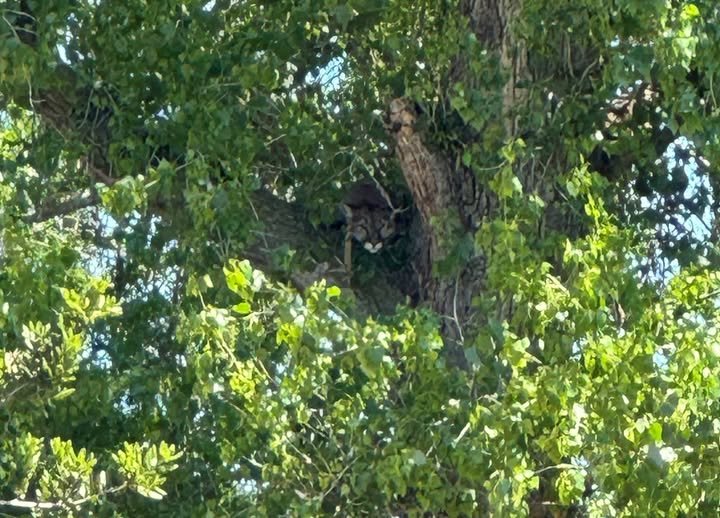
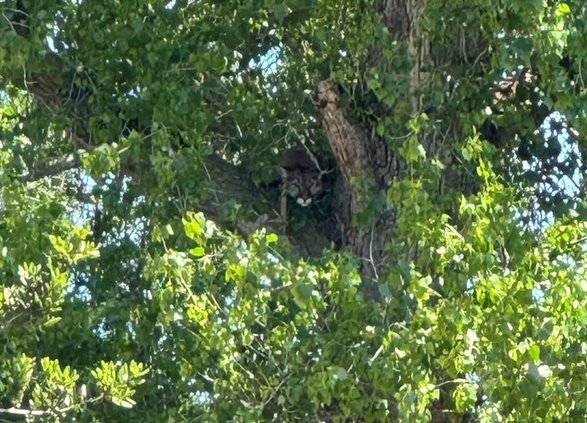
GUSTINE — A mountain lion spotted in a tree along Cottonwood Creek in north Merced on April 3 was safely tranquilized and relocated by state wildlife officials, but biologists say the animal is likely not the same lion recorded on home security cameras in Gustine late last month.
Merced police said a resident reported the sighting around midday, prompting officers to contact the California Department of Fish and Wildlife. CDFW personnel responded, tranquilized the lion and secured it for transport back to its natural mountain habitat.
“We appreciate the quick response and coordination to ensure the safety of both the community and the animal,” Merced police said in a statement.
CDFW Wildlife Management Unit Biologist Chinnu Xiong, who oversees Merced and western Stanislaus counties, said the Merced lion does not match the behavior or circumstances of the Gustine sighting.
“This is likely not the same lion,” Xiong said. “I’m hoping the Gustine lion has left the area, but our staff and wardens are still keeping an eye out.”
The Gustine sighting occurred March 22 on Hartley Court, where two home security cameras captured what appeared to be an adult mountain lion — and possibly a juvenile — moving through residential yards around 3 a.m. Xiong said that footage remains the only confirmed evidence of a lion in the area despite several unverified reports circulating on social media in the days that followed.
“Typically, I like to have first-hand reports from witnesses and, if possible, clear photos or videos with time and date stamps,” Xiong said. “The best evidence is still from the surveillance video on Sunday.”
CDFW has classified the Gustine incident as a “green” sighting, meaning the animal has shown no aggressive behavior. No physical evidence has been found since the initial report, and no livestock predation or depredation incidents have been confirmed.
Some residents have asked whether the Gustine lion could be trapped and relocated, but Xiong said such action requires approval from CDFW’s Response Guidance Team, which evaluates risk and determines whether relocation is appropriate. He said the current situation does not meet those criteria.
Xiong said the lion’s movements in the video appear consistent with an animal exploring new territory. While rumors of a cub have circulated, no photos or videos have surfaced. He cautioned residents not to approach a cub if one is seen, noting that mothers often stash their young while hunting.
Though more commonly associated with foothill and coastal habitats, mountain lions do occasionally move through the Central Valley. Xiong said the region typically sees one or two reports a year, often linked to natural travel corridors such as dry canal beds, greenbelts and riverbanks. He said the Gustine lion may have come from nearby wildlife refuges or duck clubs.
The March 22 sighting startled residents on Hartley Court, where one video showed a lion crossing a driveway and another showed a larger animal pacing along a fence line. Gustine Police Chief Ruben Chavez urged residents to keep their distance.
“If anyone sees the mountain lion(s) they should stay away and report it to the police department,” Chavez said. “Don’t try and touch it and definitely don’t do anything to antagonize it. Don’t try and take a selfie with it.”
CDFW encourages residents to secure pets at night, use motion‑activated lighting and report any new sightings. Xiong said the Gustine lion may have already moved on, but wardens will continue monitoring the area.
“Wildlife can occasionally make its way into our neighborhoods,” Merced police said. “If you encounter or spot wildlife, please report it to the California Department of Fish and Wildlife.”