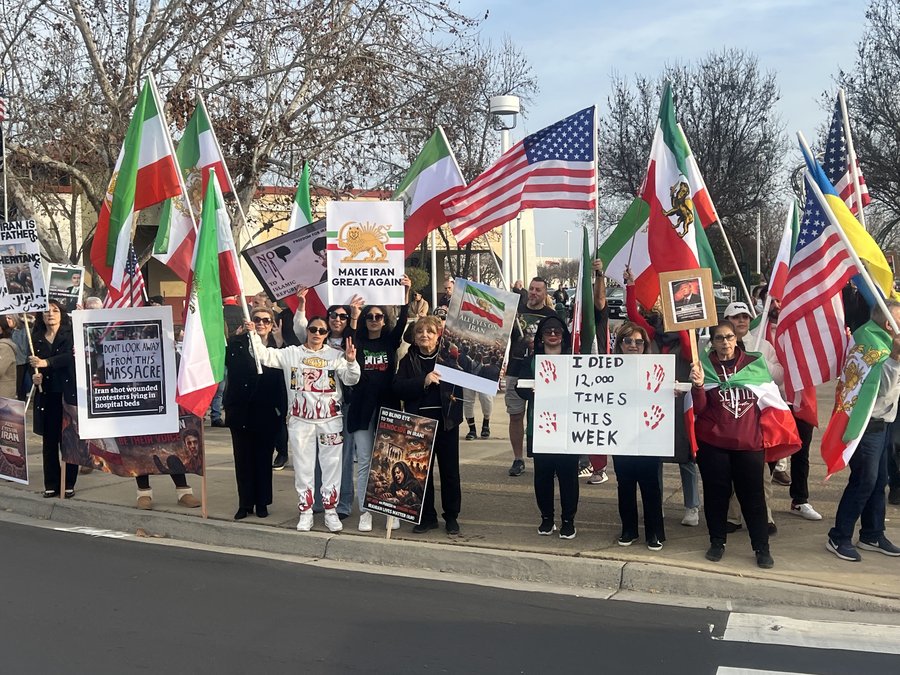
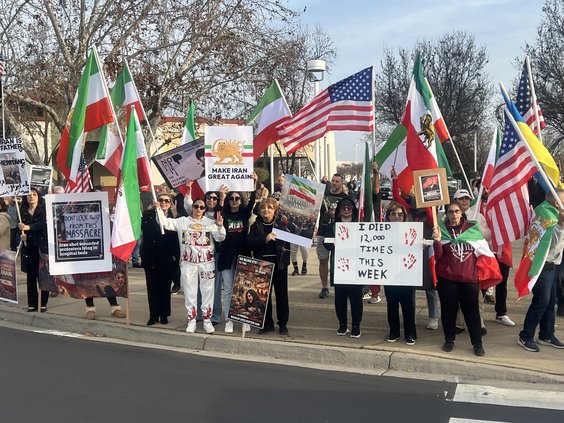
About 80 protesters lined the southeast corner of Monte Vista Avenue and Countryside Drive for a third consecutive weekend on Sunday, showing their support for protesters in Iran who are being suppressed by the Islamic Republic government there.
Demonstrations in Iran, which began on Dec. 28, have become a serious challenge to nation’s theocracy. The government crackdown against the Iranian protests have resulted in at least 6,000 people killed, while many others are feared dead, activists reported Tuesday.
Those new figures come from the U.S.-based Human Rights Activists News Agency. The group said the 6,159 dead included at least 5,804 protesters, 214 government-affiliated forces, 92 children, and 49 civilians who weren’t demonstrating. There have been more than 42,200 arrests, it added.
But protesters in Turlock, with friends and family still in Iran, paint a far more harrowing picture.
“When I spoke to my friend (Saturday), he told me that it’s over 60,000 that have been killed,” said Turlock’s Raymon Galavan, who came to the U.S. from Iran in 2006. “People are protesting for freedom with nothing in their hands, and they’re being killed with (military-grade) bullets. And the people who are in hospitals, they take them out and they kill them on the street, and bury them in mass graves. This is the reality. This is not out of a movie.”
Edvin Farhad, a native of Tehran, said he has a friend in the capital city who was wounded by gunfire.
“What they’re telling me right now is that there are absolutely two or three families in each street, and in each alley, that have had someone killed,” said Farhad. “The estimated number of killed in two nights is more than 40,000. Whoever says different … forget about it. It’s a massacre.”
Robert David, who co-organized the local protest with Charles Sharlou, added to those disturbing totals.
“The numbers we’re getting are more than 800,000 injured and over 300,000 who have been arrested by the regime,” said David, also a native of Tehran. “There is no freedom in Iran. Whatever the regime wants, they do in the name of Islam, and everybody is expected to follow.”
Iran has threatened to drag the entire region into conflict. Iranian-backed militias have signaled their willingness to launch new attacks after President Donald Trump threatened military action over the killing of peaceful protesters.
The USS Abraham Lincoln aircraft carrier and guided missile destroyers accompanying it have arrived in the Middle East to lead any American military response to the crisis.
“We have a massive fleet heading in that direction, and maybe we won’t have to use it,” Trump said.
American isolationism has long been a part of Trump’s political identity, and his campaigns have focused on rejecting U.S. entanglements abroad. That position seemed to be upended earlier this month with the overthrow of Venezuelan President, Nicolas Maduro. The move drew criticism from Democrats and Republicans alike, and it’s unclear how committed Trump will be to toppling another foreign regime.
It’s clear, however, that protesters here would like to see the U.S. intervene to stop what they say is genocide.
“I have family in Iran, I have friends in Iran,” said Charles Sharlou, who was born in Urmeh, Iran, and fought for his country in the Iran-Iraq war. “President Trump promised that he would help them, and they need our help at this moment. I am 63, but if they need me, I would help the U.S. Army because we need regime change there. I love this country, and I love being here, but I also love Iran. It’s part of me.”
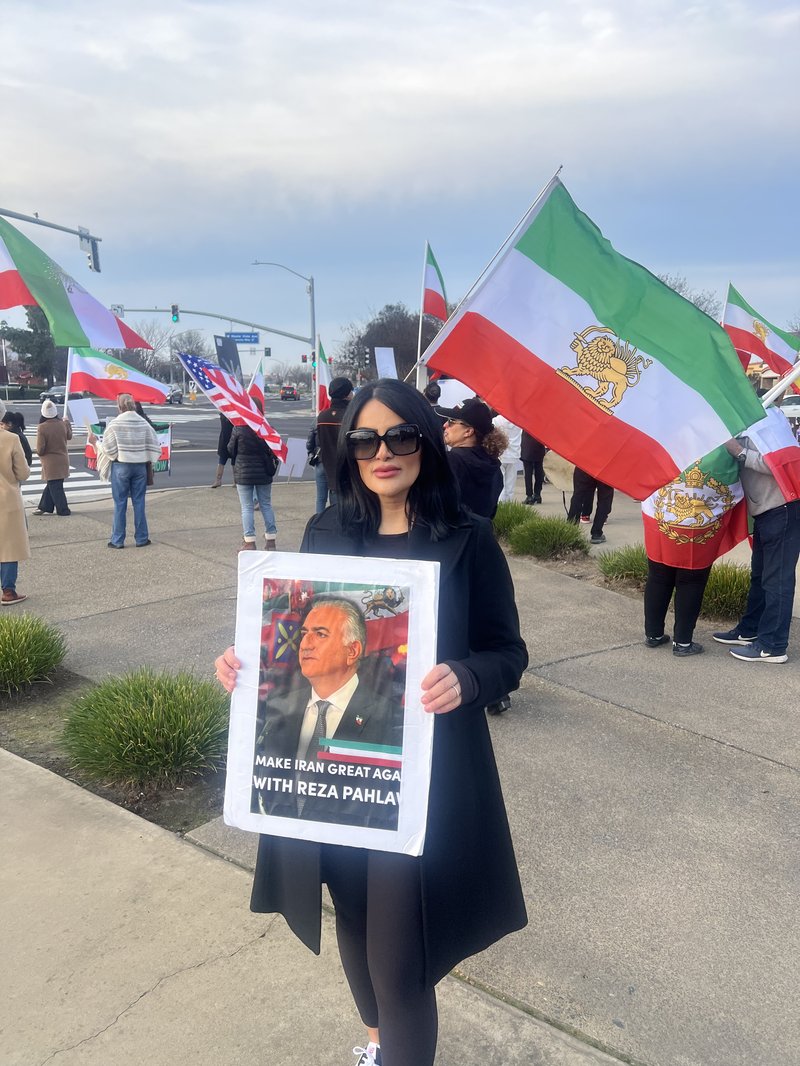
Many at Sunday’s protest wore T-shirts, carried signs or waved banners with the image of Iran’s crown prince, Reza Pahlavi, whose father — Mohammad Reza Pahlavi — was the Shah of Iran. The shah was overthrown in 1979 in an Islamic revolution led by Ruhollah Khomeini, and lived in exile until his death in 1980. The shah himself rose to power after the U.S.-led coup of Prime Minister Mohammad Mosaddegh in 1953.
The 65-year-old crown prince has been in exile for nearly 50 years. Nevertheless, he appears to be seeking a role in homeland’s future. What remains unknown is how much support Pahlavi has in his homeland. Do protesters want a return of the Peacock Throne, as his father’s reign was known? Or are the protesters simply looking for anything that is not a Shiite theocracy? Iran’s currency, the rial, has fallen to a record low of 1.5 million to $1.
“Now, they are calling for Ravi Pahlavi and they want him back, because they realize what they did with the shah,” said David. “The shah was not unpopular with the people when he was exiled in 1979.”
The scale of the crackdown by Iran’s theocracy is only now starting to come into focus as the country has faced more than two weeks of internet blackout.
“That’s why we’re here today,” said Farhad. “We went to raise awareness and elevate the conversation about what is happening in Iran.”
The Associated Press contributed to this story.