BY VICKY BOYD
AgAlert
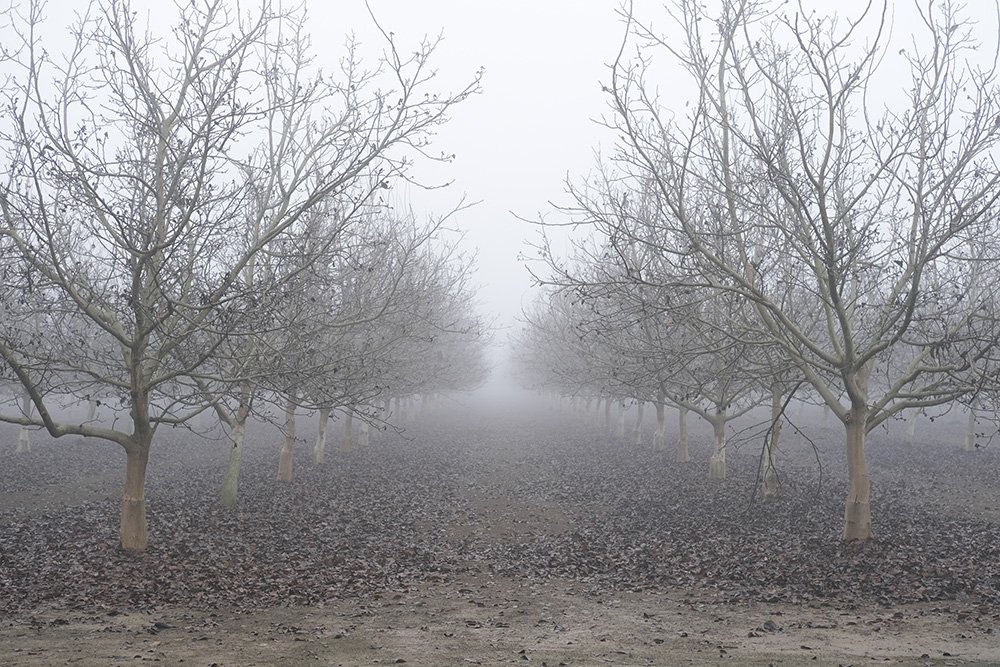
Cold temperatures, which put trees into deep winter dormancy, may have been late to arrive last fall. But prolonged periods of tule fog during the winter made up for it by depressing temperatures, likely resulting in adequate chilling.
“I do believe that the chill may have been more effective this year because of so many days with fog,” said Ted De Jong, a University of California, Davis, pomology professor emeritus. Around Davis, he said, “this has been one of the foggiest years since the ‘90s.”
NASA described a tule fog blanket stretching 400 miles from Redding to Bakersfield from Nov. 24-Dec. 9, 2025, as “unrelenting.” The dense fog returned in January for several more days. It was caused by low-level humidity from rain-saturated soils that was capped by an inversion layer and overlaying stable high-pressure system, according to NASA.
De Jong pointed to the Utah model—a way of monitoring cold temperature accumulation—to back his observation that the persistent fog likely aided orchard dormancy. The model calculates chill units by weighting specific temperature ranges and subtracts hours above 65 degrees Fahrenheit because of their adverse effect on tree dormancy. This year, he said the fog probably decreased the hours of negating warmer temperatures.
If fruit and nut trees don’t accumulate enough chilling during the winter, they may end up having delayed or erratic bloom and leaf-out in the spring, causing the trees to set a lighter crop often of poorer quality. Chilling requirements vary widely among different species and even among varieties within a species.
For almonds, chill hours are commonly measured using a simple running tabulation of each 60-minute period below 45 degrees Fahrenheit from November through February. Almonds typically need about 500-600 chill hours, depending on variety, to put them into deep dormancy and set them up for a strong bloom, adequate pollinizer overlap and good nut set, said Mel Machado, chief agricultural officer at Blue Diamond Growers.
Part of what set the 2025-26 winter apart from recent years was the unusually warm November, he said. Chill hours didn’t begin to accumulate in earnest until late November. Since then, the cumulative cold periods have caught up to historic levels in large part because of the fog.
“Are we fat with chill hours? No, but we’re OK for almonds,” Machado said. “In almonds, we’re fortunate we don’t need as much chilling as some other crops.”
Take the Modesto CIMIS weather station, for example. Machado found 783 chill hours as of Jan. 27. As he scrolled through the past six years of records, he noted that 2022—the year of the big freeze—provided 1,055 chill hours as of Jan. 27 while the remaining years were similar to 2025-26.
Like other parts of the Central Valley, chilling didn’t begin to really accumulate in the northern Sacramento Valley until late November, said Franz Niederholzer, a UC orchard systems adviser for Yuba, Sutter and Colusa counties. Even then, a couple of cold, foggy weeks in early December were followed by several days in the upper 40s and lower 50s when chill hours didn’t accumulate.
He said it’s hard to predict how the inconsistent temperatures may affect this year’s almond bloom.
“The chill sets you up, but you have to consider the different weather patterns at bloom time as well,” Niederholzer said.
Bob Beede, a UC Cooperative Extension farm adviser emeritus in Kings County, said he saw a similar weather pattern in the southern San Joaquin Valley, with a late November start to more prolonged cold weather.
“The delay in significant chill accumulation that occurred this winter has been compensated for by having these extended periods of cold, foggy weather, which increased the amount of chilling that accumulated each day,” he said.
The fog also had an added benefit. It helped protect trees from direct sunlight and the accompanying radiant heat that can begin to break dormancy prematurely, Beede said. On a 65-degree day, for example, buds and shoots could be as warm as 75 degrees, pushing them to respire at a higher rate. That can lead them to tap energy stores early.
Many cherry, prune and pistachio growers have moved away from measuring chill hours and now use a dynamic chill portion model to better reflect wider winter temperature fluctuations, he said.
Beginning Nov. 1, the dynamic system subtracts warm temperatures above 55 degrees from cumulative portions. Between 32 and 55 degrees, different temperatures are assigned different chill values, with 43-47 degrees having the highest.
In addition, the dynamic model is more complex and breaks chill accumulation into portions, which reset after each warm period.
“The chill portion model is attempting to give us a better estimate of current weather conditions, which are much different than those we experienced from 1940-1980 when the fog and the winter temperatures were fairly consistent,” Beede said. “There was no need to try to compensate for the number of warm days that occurred back in the day.”
Jim Ferrari, who grows cherries and walnuts near Linden, said he closely monitors chill portion accumulation to time dormancy breaking sprays for his cherries. By applying the materials when chill portions reach a minimum threshold—usually about 30 days before anticipated bud break—cherry producers can push the trees to bloom about 10-13 days earlier. That, in theory, should mean harvesting an earlier crop and getting them into grocery stores before the strong Memorial Day weekend market, he said.
Describing this winter’s dense fog as weather he hadn’t seen in years, Ferrari said it helped keep temperatures cooler on many days.
“The fog actually has been beneficial if it hangs around most of the day and you don’t get reversal of the numbers,” he said.
Donny Hicks, a Hughson-area almond grower, said he moved to the dynamic chill portion model to account for warm-ups during the winter.
“On a day like today, it was cold this morning, and then you’re gaining some portions,” he said Feb. 2. “When it gets warm later in the day, you’re taking some of those away.”
Compared to the previous winter, Hicks said not as many chill portions accumulated this winter, but he believed they should still satisfy almond trees’ requirements.
Whether models measure chill hours or chill portions, Beede said they’re still just estimates of what to expect for early season tree performance. Trees also need the correct amount of nonstructural carbohydrates, primarily sugars and starches, in storage to drive what he described as the “grand period of growth” during the spring.
— Courtesy of the California Farm Bureau.