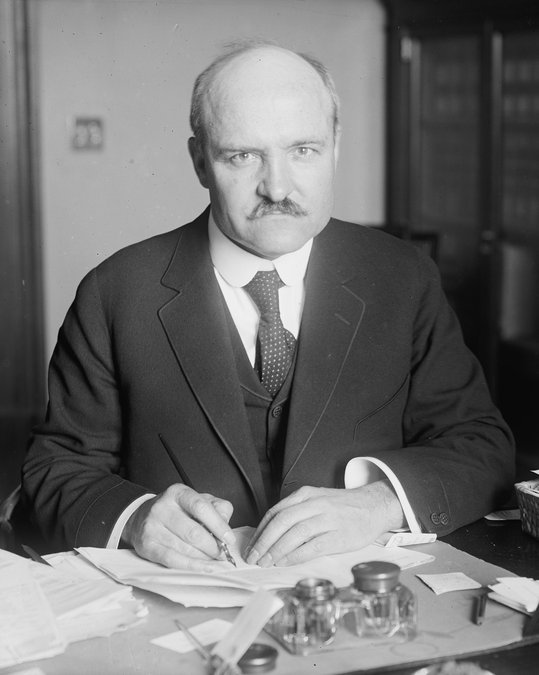
Take a look at the man depicted in the photo accompanying this column.
You probably have no inkling who he is but he’s in your head twice a year.
He was the sponsor of what many dubbed the Calder Act of 1918.
It is better known today as the Daylight Savings Time Act of 1918.
Look at the photo again.
Senator William M. Calder is a tad stern looking.
Maybe the photo was taken on the first Sunday in March of 1918 when the United States switched to Daylight Savings Time for the first time ever.
“Springing forward” for an hour, that whimsical seasonal shorthand for turning clocks ahead an hour by Uncle Sam, can put you in a grouchy mood for a few days trying to adjust to that lost hour of sleep.
What brings this up is the approach of the first Sunday in November.
That’s when Daylight Savings Time officially ends and we all fall back an hour at 2 a.m. on Nov. 1 except for Arizona and Hawaii that got an act of Congress to be exempted from the law that is now 107 years old.
The funny thing is the history books makes it seem Daylight Savings Time was an afterthought of sorts.
If not that, it’s a classic case of members of Congress either not reading or not bothering to understand what they are for voting on.
Calder’s legislation to its core was aimed at cleaning up a hodgepodge of time-related issues.
The law first and foremost created a federal standard for time,
It established that standard time in the United States would be divided into five time zones.
The time zones were created by the Interstate Commerce Commission reflecting time zones previously established by the national railroad system.
The reason for having the Daylight Savings Time provision in the bill was to, drum roll, save fuel.
Supporters of the bill contended it would result in massive fuel savings.
They touted as a way to keep up with the Joneses, in this case, European allies and enemies that were knee deep in World War I along with the United States. Daylight Savings was a ploy they used to try and save fuel.
There was opposition, but they didn’t view the bill as being serious legislation when it came to the Daylight Savings Time part.
Basically, they believed it would cause logistical issues with railroads plus some saw it as a ridiculous attempt to change the forces of nature.
The final vote in the House of Representatives was 253 in favor, 40 against it, 6 voting present and 133 not voting.
Yes, on what many view as one of the most intrusive laws Congress has ever adopted, almost 25 percent of the duly elected representatives of the people didn’t bother to weigh in.
The first time change occurred within two weeks of it being signed into law by President Woodward Wilson.
Just over a year later, Congress voted to repeal the Daylight Savings Time as many people they represented weren’t thrilled by it.
Wilson vetoed the repeal.
Congress made another run at the repeal. Wilson vetoed the second repeal try, but the veto was overridden by Congress.
That led to Daylight Savings Time being used in many locales across the nation but a long way from the majority.
The War Time Act during World War II had the entire nation go to uniform Daylight Savings Time. The law expired in 1945.
The Uniform Time Act in 1966 created the time we are having now.
Since then, there have been attempts in Congress — and semi-end runs in states — to either get rid of Daylight Savings Time or switch to it year round. End runs in the states because Congress still has the final call.
Voters in California weighed in during the 2018 election by passage of Proposition 7.
Almost 60 percent voted for a change, including the majority in San Joaquin County.
What they voted for was to empower the California Legislature to change the dates and times of daylight savings time by a two thirds votes with the provision that it be in compliance with federal law.
Assemblymember Kansen Chu, who led the ballot measure, submitted a bill after its passage to “eliminate the biannual clock change in California and set the state on daylight savings time year-round pending federal authorization.”
The bill died in committee.
Efforts to change how we treat time bubbles up twice a year thanks to the clock changing ritual.
Rest assured the “bubbling” will reach a crescendo in the coming days.
In case you are wondering, Trump has already weighed in as only Trump can.
In a post in December 2024 on Truth Social, Trump stated, “The Republican Party will use its best efforts to eliminate daylight savings time, which has a small but strong constituency, but shouldn’t. Daylight saving time is inconvenient and very costly to our nation.”
But in March of this year Trump changed his tune.
“This should be the easiest one of all, but it’s a 50-50 issue. If something’s a 50-50 issue, it’s hard to get excited. I assume people would like to have more light later, but some people want to have more light earlier, because they don’t want to take their kids to school in the dark.”
“A lot of people like it one way, a lot of people like it the it the other way, it’s very even. And usually I find when that’s the case — what else do we have to do.”
There is a kernel of truth in what Trump said.
Various polls have shown 49 percent of respondents would like to see daylight savings time made permanent. And 43 percent want year-round standard time.
That leaves 8 percent that favor the status quo of gaining an hour of sleep in the fall and losing an hour in the sleep.
The bottom line is upwards of 92 percent don’t like the present back and forth
Of course, you never know what Trump will say next or try to decree via executive order.
But given Congress would have to agree on a change to the status quo, enjoy your extra hour of sleep next weekend.
Keep the feeling of the extra snoozing in mind in March when you’re grouchy after losing an hour of sleep.