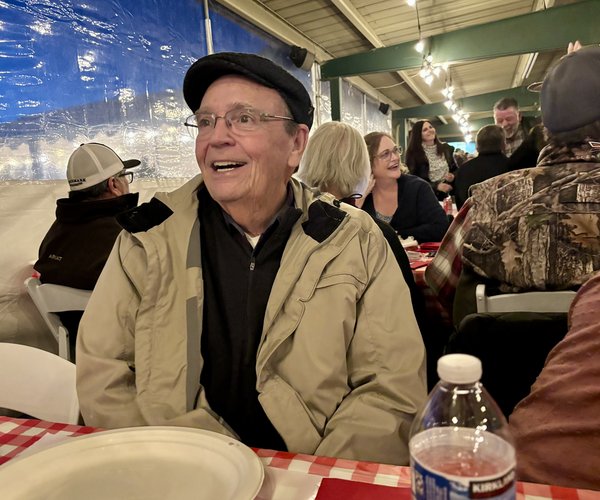
Good-bye, channeling Mr. Magoo.
Hello, the wonderful world of vibrant color.
It’s a world, by the way, where the skies are no longer cloudy all day.
I can see clearly, well almost distance wise and relatively close to the mark in terms of reading distance with the strongest store bought readers.
It’s light years away before 9 a.m. a week ago, which despite my reaching the edge of what corrective lenses could do for me was 10 times better than where I was at as a 5 year-old.
I constantly ran into things as a kid, misjudging steps and corners.
I had everything you could possibly have when it comes to run-of-the-mill eye issues — astigmatism, short distance vision issues, lazy eye, and long distance vision issues.
My natural hand eye coordination clearly had much to be desired as I am more klutz than graceful. Toss in vision issues and I was the last person in the world you’d want on your Little League team roster.
But between modern optometry and more than 14 months with an eye patch, I ended up being in an accelerated reading program as a first grader at Cirby School in Roseville.
A lot of that had to do with our next door neighbor and Vernon Street School teacher, Catherine Gates.
She was the first to suggest to my mom that I might have a vision problem instead of being simply a klutz.
She also taught me to read the summer before I entered kindergarten and then after school when I was in kindergarten using the front pages of the Roseville Press-Tribune, Sacramento Bee, and Sacramento Union.
It goes to say, one of my biggest fears — if not the biggest — was never being able to see.
I’m not staying I was an unhappy kid pre-glasses, but I do remember things would get frustrating at times not to mention the bruises and such I racked up from my world which was a complete blur with a little bit of being off-centered thanks to the lazy eye.
So what happened last Thursday?
A modern miracle like many every day modern miracles that too many of us take for granted.
The miracle is arguably the surgery that is the safest, most effective, and experiences the least complications of all — cataract surgery.
I still have three weeks to complete the recovery period so I can have an eye exam to get prescription glasses.
Last Thursday, I was one of 75,000 people each day worldwide that undergo cataract surgery. There are 28 million people a year that undergo the procedure worldwide.
The surgery took place at Kaiser in Stockton under the skillful hands of ophthalmologist Dr. Erold Jean-Francois MD and the outpatient surgical staff.
It was a two-for-one. Both eyes,
Between check in and being taken to the car in a wheelchair, less than three hours passed.
Cataract “surgery,” per se, has been around longer than the oldest California redwood which is a good 3,200 years.
It was called “couching” back in 2498 BC during the Fifth Dynasty of Egypt when the practice first took place.
By the 1960s two decades after the advent of replacement lenses, cataract surgery became more common. Laser surgery techniques advanced the procedure even further.
Today, laser surgery has a 95 percent success rate in terms of improved vision.
As for complications, they are less than 2 percent.
There are 8.8 billion people in the world.
Of those, 2.2 billion have some type of vision issue.
Among those 2.2 billion eye issues, 80 percent can be addressed by corrective lenses and cataract surgery.
People do go blind from cataracts.
Yet, research shows 36 percent of American adults — despite being made aware of the procedure and its effectiveness — still don’t like the idea of having cataract surgery.
My optometrist sensed I had apprehensions about it.
She suggested I wait until I was comfortable with the idea.
Rest assured, it didn’t take me all that long to get comfortable.
It could have been the halos around the lights at night.
Or it may have been the increased blurriness — beyond what I had been used to for nearly 70 years.
The glare did get worse.
As did the faded colors.
Fortunately, I didn’t experience double vision that can come with cataracts. But then again, I may not have realized I had double vision because of the blurriness.
Was there pain with the surgery?
No, I was fortunate not to have an issue with having any pain or discomfort. That is exactly what I was told would likely be what would happen — little to no pain.
The recovery is still underway.
It includes for the first week to take two sets of eye drops every four hours. After that, I stop taking one and continue with the other for three weeks.
The pharmacist, when she gave me the eye drops, advised me that I shouldn’t worry about interrupting my sleep to do so.
All I could think — but refrained from saying — that wouldn’t be a problem given one of the “advantages” of getting older seems to be waking up every four hours. The pharmacist was clearly a long way from being 69 years old.
I can’t overemphasize the high regard I have for ophthalmologists and optometrists.
I do not remember the name of my kindergarten or even first and second grade teachers. And the farthest back I can remember was the first and last name of a teacher was my fourth grade instructor, Mildred Hayward.
But I remember the first and last name of the ophthalmologist that I saw between the ages of 5 and 8, Dr. Clinton Pace. I can say the same thing for the optometrists since and now on my second go around with an ophthalmologist, Dr. Erod Jean Francois.
Issues of accessibility and price aside, we are fortunate to have well-rounded and robust medical care in this country.
It isn’t perfect, but then again they are dealing with humans that bring different issues, DNA, and such to the table as opposed to diagnosing and “repairing” mass-produced Honda Civics.