BY CALEB SPROUS
CV Journalism Collaborative
Ron Cook joined a crowd of protestors on M Street in front of Merced’s Courthouse Park at the end of July. Much like previous protests, the demonstrators held pro-democracy signs, as well as messages decrying ICE, President Donald Trump, and the war in Iran.
But there was a specific topic on Cook’s mind that day. He marched down M Street, sign in hand, to the office of California District 13 Rep. Adam Gray, D-Merced. Cook wanted accountability, he said, but most of all, he wanted an explanation for Gray’s vote on the 2027 National Defense Authorization Act (NDAA).
“I think he just takes us for granted,” Cook told Gray’s staffer, Karthik Prasad. “And I mean, we will vote for him. What choice do we have?”
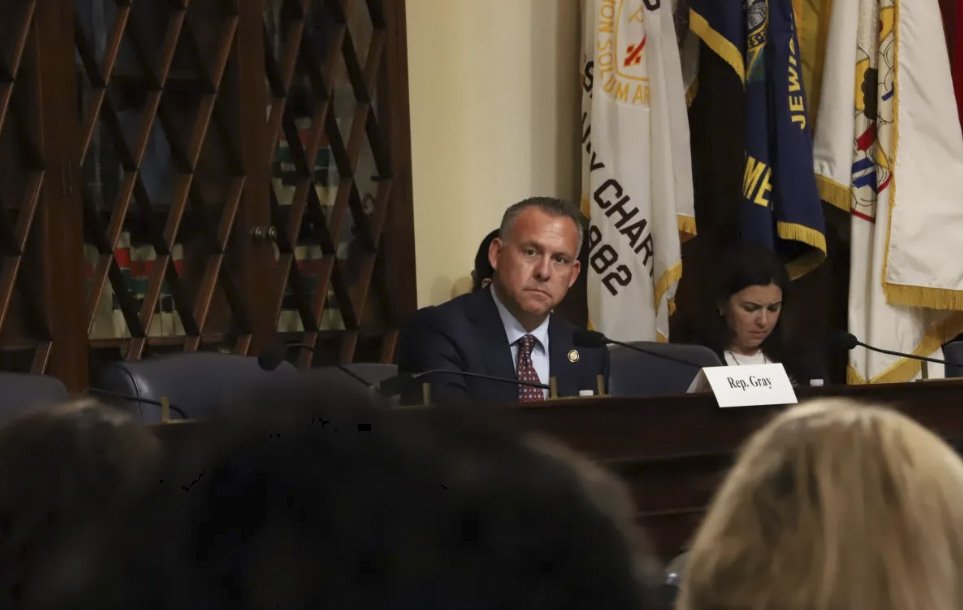
Only nine days earlier, Gray cast his vote in favor of the NDAA, which narrowly passed the House of Representatives 216-212. Gray was the only California House Democrat, and one of just six House Democrats, to vote in favor of the NDAA.
Central Valley representatives and their views of the NDAA
The House version of the 2027 NDAA drew controversy for its $1.15 trillion cost and a section of the bill establishing the “United States-Israel Defense Technology Cooperation Initiative.” The later fusion of the SAVE America Act into the NDAA also faced opposition in Congress.
The price tag for the NDAA makes it the most expensive defense bill in history. If passed, it would mark the first time a NDAA has exceeded $1 trillion. Plus, the provision related to U.S.-Israel cooperation raised questions from critics about U.S. sovereignty, as well as concerns regarding Israeli human rights abuses in Gaza during the Israel-Hamas War.
There are two other House Democrats representing constituents in the Central Valley, Rep. Josh Harder and Rep. Jim Costa, both of whom voted against the NDAA. Harder has not spoken about his no vote, but Costa has.
“The Department of Defense, the only federal agency to fail six consecutive audits, is asking Congress to approve a $1.1 trillion defense budget, a $250 billion increase over last year, despite the Department still sitting on $150 billion in unspent taxpayer funds,” Costa said in a Facebook post.
Cook brought similar concerns directly to Gray’s office during his July 31 protest.
“Even if he did vote just for the NDAA, number one, where is all this money coming from? He has no concerns of the national debt?” Cook asked Prasad, Gray’s staffer. “And you know, Republicans are going to be wanting to cut other programs to pay for this, eventually, somewhere down the line.”
Gray did not immediately provide an explanation for his vote, which isolated him from an overwhelming majority of House Democrats, until being pressed by The Merced Focus and facing growing criticism from local Democrats in his district.
After 17 days, multiple emails, a phone call declining an interview, visits to his office, an attempt to attend his local campaign event – as well as local criticisms over transparency and access – Gray’s office finally sent a statement explaining his vote and responding to the criticism.
“I voted for the National Defense Authorization Act because it funds our military, supports servicemembers and their families, and strengthens our national security,” Gray said in the statement. “The bill includes a 5% to 7% pay raise for servicemembers, increased leave, investments in military housing, and expanded childcare.”
While acknowledging why he voted for the NDAA, Gray called it “not a perfect bill,” and stated he disagrees with some of its provisions.
“But with global instability increasing, I do not believe we should risk our national security or the safety of American servicemembers overseas,” he said.
Local concerns raised about Gray’s voting record and transparency
While Gray campaigned in his district during Congress’ August recess, frustration mounted among Merced Democrats.
Jose Moran, Livingston mayor and a member of the Merced County Democratic Party Central Committee, and Eliseo Gamino, president of the Central Valley Leadership Round Table, a trustee for the Firebaugh-Las Deltas Unified School District and a Democratic Party delegate, spoke with The Merced Focus about Gray and his representation in the district.
Both raised concerns about Gray’s voting record since entering office, his priorities, transparency with the public, and the lack of town halls held by Gray for the constituents of his district.
Moran directly took issue with Gray’s NDAA vote and its price tag. He also raised sovereignty concerns surrounding the Section 219 provision dealing with U.S.-Israel cooperation.
“I appreciate the concern for supporting the men and women serving our country. They deserve it,” Moran said. “However, at a time when Central Valley families are struggling with housing, healthcare, infrastructure, water, education, and the cost of living, the larger priorities expressed in a massive defense authorization bill and the ongoing expansion of military commitments overseas are concerning.”
Moran went further and said Gray’s voting record does not sit well with many groups in his district. Plus, Moran said he knows former campaign volunteers that won’t campaign for Gray anymore.
“The people that he has been neglecting might not be big potential campaign donors, but we are voters and influencers who are getting tired of how our elected officials play politics, focusing only on keeping their name on the desk,” Moran said.
Gamino emphasized accountability and the responsibility of elected officials to explain their votes. He pointed to town halls as a format for Gray to do that.
Gamino strongly challenged Gray’s 2025 “yes” vote for the first bill President Donald Trump signed during his second term, the Laken Riley Act, which Gamino and other critics believe undermined the Constitutional right to due process. Gamino also said he believes Gray’s immigration voting record has disproportionately impacted Latinos, which make up over 65% of the 13th Congressional District.
“Going into hiding only creates more doubt about his real motives, and the fact that he is abandoning the families in his congressional district, he needs to be held accountable,” Gamino said. “Host a town hall meeting, and show your face, and take responsibility for your vote.”
Gamino told The Merced Focus that the Central Valley Leadership Round Table, which includes Moran, elected officials, business leaders, and others, recently overwhelmingly passed a vote of no-confidence in Gray. The organization, Gamino said, has not notified Gray or his camp of the vote of no-confidence.
“Gray needs to take greater responsibility for addressing constituents who disagree with his decisions, particularly on immigration,” Gamino said. “We believe representatives should be willing to explain difficult votes directly to the communities affected by them.”
Still, he added: “Our vote of no confidence does not mean we are closing the door on (Gray).”
‘A problem with the democratic system’
Gray has hosted zero in-person town halls and zero telephone or virtual districtwide town halls since assuming office, The Merced Focus reporting found. Gray’s camp didn’t dispute that.
In contrast to other Central Valley House representatives, Gray and Rep. Vince Fong R-Clovis, are the only representatives to not host a public town hall. Valley Democrats Harder and Costa have held two and three town halls respectively.
While Gray faced concerns about access and transparency from some of his constituents in his district, a Democratic joint-fundraising committee known as JFW Fund boasts “quarterly Zoom ‘House Insider Briefings’ with JFW House members and other key members of the House.”
The website explicitly identifies Gray as one of six House Democrats it supports. The cost to receive the “benefit” was a minimum $5,000 donation. Campaign finance data shows JFW Fund has contributed over $100,000 to Adam Gray for Congress. JFW Fund explains on its website that the fund provides direct funding to the “most vulnerable new Democratic House members.”
The Merced Focus reached out to Thomas Holyoke, Fresno State political science professor, about Gray being a beneficiary of support from JFW Fund, amid the backdrop of holding no town halls and constituent critiques about transparency.
Holyoke called it an accountability issue.
“If your member of Congress is not engaging in any kind of dialogue or deliberation with his or her constituents, but taking the time to talk to interest group lobbyists in Washington … yeah, that’s an accountability concern,” Holyoke said.
But, Holyoke said, that’s not particularly unusual, “which is a sad thing to say.”
“… It’s a problem with the democratic system, and people are understandably cynical about the way our representative democracy works because a lot of members of Congress do not spend the time that they need to with their constituents,” he said.
Such actions contribute to the perception that members of Congress spend more time with interest groups and lobbyists than their constituents, Holyoke said.
“If political donors receive opportunities to interact directly with members of Congress, ordinary constituents should also have meaningful opportunities to question their representatives,” Gamino said.
While JFW Fund advertises insider Zoom briefings to donors, it’s not clear whether Gray has personally participated in these briefings.
Gray and his office respond to concerns
The Merced Focus reached out to Gray’s camp seeking a response to criticisms involving transparency, accessibility, absence of town halls, failure to explain the NDAA vote, and JFW Fund and donor access.
Staff with Gray’s office responded in a statement, addressing three of the six questions sent by The Merced Focus. Gray’s camp did not address questions pertaining to the JFW Fund or constituent town halls.
The response also included the following statement from Gray on the NDAA vote:
“I voted for the National Defense Authorization Act because it funds our military, supports servicemembers and their families, and strengthens our national security. The bill includes a 5% to 7% pay raise for servicemembers, increased leave, investments in military housing, and expanded childcare.
This is not a perfect bill, and I disagree with some of its provisions. But with global instability increasing, I do not believe we should risk our national security or the safety of American servicemembers overseas.
My vote for the NDAA does not mean I support President Trump’s war in Iran. I have repeatedly voted for War Powers resolutions to end the conflict and cosponsor legislation to end U.S. involvement in Iran.
I also believe America must keep its commitments to our allies, including Israel, Ukraine, Taiwan, and NATO. The Israel provisions in this bill focus on defense technology cooperation and do not authorize new military aid or give Israel authority over U.S. military decisions.
The SAVE America Act was not part of the NDAA when I voted for it. Republicans combined the two bills after the House voted on them separately. I have voted against the SAVE America Act multiple times on the House floor.”
While Gray voted against the SAVE America Act, there were indicators it would be attached to the NDAA.
The day before the NDAA vote, the House considered a rule to attach the SAVE America Act to the NDAA conditioned upon the NDAA passing the House. Gray voted against that rule, but it ultimately passed 214-211. The NDAA did not contain the SAVE America Act text when it was voted on the following day, but it was guaranteed to be combined with it if it passed the House.
Gray ultimately voted for the NDAA, and it passed the House. The combined bill was sent to the Senate.
Additionally, Gray’s camp defended his record when it came to meeting with constituents, accessibility to the people, and delivering results for the Central Valley.
“Since taking office, (Gray) has made it a priority to spend significant time in the district meeting directly with constituents, local elected officials, farmers, business owners, community organizations, and other stakeholders,” Gray’s Communications Director Kevin Porter said in an email statement.
Gray has been traveling the district, visiting communities, while making time for constituent meetings during the August recess, Porter said.
“He believes the best way to represent the Central Valley is to be there, listen to people directly, and bring their priorities back to Washington,” Porter said.
Merced protestor Ron Cook gave permission for The Merced Focus to record his interaction with Gray’s office staff. In a follow up communication, he declined to answer further questions from The Merced Focus, providing this explanation:
“I do believe it’s important that the Democrats take the House of Representatives in the next election cycle, and for that reason alone, we should support Adam Gray,” Cook said.
Gray is currently running for his second term in Congress. He will face a Trump endorsed Republican, Kevin Lincoln II, during the general election on Nov. 3.