Just about 5 miles from the Project Nexus wide-span project sits the turnoff to Meikle Road, named for Turlock Irrigation District’s first chief engineer, Roy Meikle.
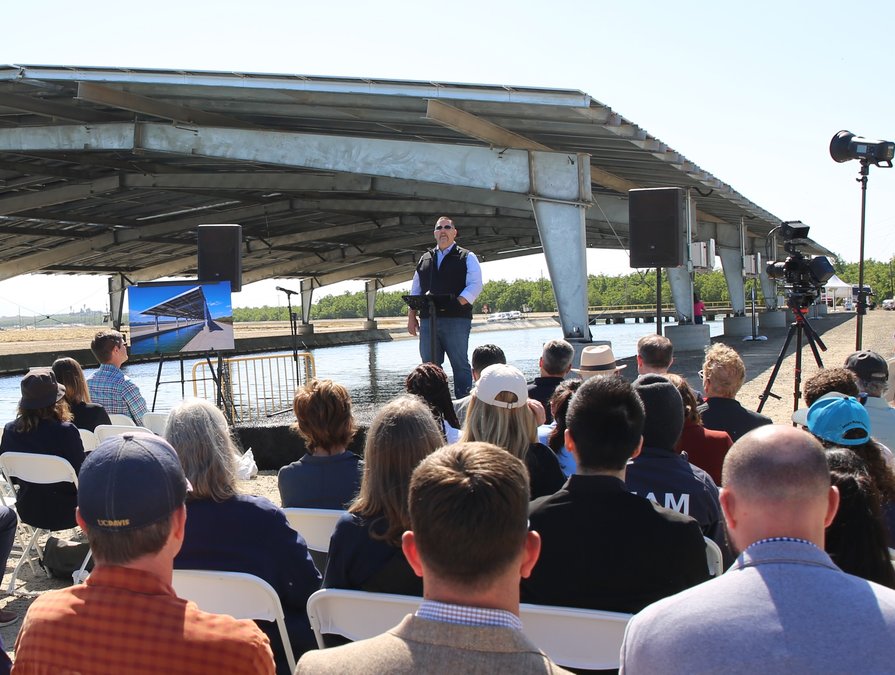
On Wednesday, state leaders gathered in Hickman – where Meikle was born and raised – to celebrate the construction of the Project Nexus pilot program, which started as a premise in a UC Merced lab and culminated with a commemoration of California's first solar canal project.
Project Nexus, launched in 2022, represents a public-private-academic collaboration between TID, UC Merced, the state’s Department of Water Resources, and Marin County-based Solar AquaGrid, LLC. The project demonstrates how covering operational irrigation canals with solar panels can help save water, generate clean energy, and conserve natural lands.
“Roy Meikle exhibited courage, he was creative, and he was committed to our customers,” said TID Director Michael Franz, who told the gathering that background on Meikle’s pioneering spirit and 59-year career at TID. “And here we are in Hickman, his birthplace, where he lived and died; I think he’d be so proud today to see each of us here.”
"We are excited this day is here," TID General Manager Brad Koehn added. "It's been a long journey."
"For the past three years our UC Merced research team – including our project manager Dr. Brandi McKuin and team members here today – has treated these canals as a living laboratory," said Roger Bales, professor emeritus of civil and environmental engineering. "We didn't just want to build a canopy to produce electricity; we wanted to quantify a 'triple win' for California: water, energy and land."
While not all canals are suitable for solar installations, a UC Merced study, commissioned by Solar AquaGrid and led by McKuin, estimated that covering all 4,000 miles of California's exposed canals with solar panels could generate enough electricity to power about 2 million homes each year, conserve enough water to supply up to 2 million homes annually and reduce land use by placing solar arrays on developed land.
"Our team at Solar AquaGrid has been on this journey for over a decade," CEO Jordan Harris said. "We wanted to see if we could use existing infrastructure to gain multiple benefits."
So far, the pilot project has proved the initial hypothesis that these kinds of structures can benefit the water below as they gather energy from the sun above.
Early results indicate substantial reductions in evaporative loss and aquatic weed growth, with the shaded canals experiencing up to 70 percent less evaporation and 85 percent less weed growth.
"This innovative project will have global impact," said UC Merced Chancellor Juan Sanchez Muñoz. "Today's milestone is a testament to how regions like ours can take the lead in addressing global solutions."
Muñoz said these types of projects should be of interest to more than just scientists and engineers.
“This project is also about students,” said Muñoz. “They’re learning, contributing, and preparing the next generation of innovation in energy, water, and environmental stewardship. And if we don’t inculcate that as part of their education, let’s not be stunned and surprised that they’re indifferent to it in the future. This has to be part of it when they’re studying math or mechanical engineering or philosophy, so they have an appreciation for why this is important. And it’s not just the students in these disciplines; it’s the students they talk to in other disciplines about the project.”
By leveraging already disturbed land, solar canals minimize the need to convert farmland or natural habitats for energy production, and support California's goals of land conservation, achieving 100 percent clean energy by 2045, and conserving 500,000 acre-feet of water annually by 2040.
And Project Nexus is only the beginning, Bales said.
The California Solar Canal Initiative research project aims to accelerate the use of solar power across the state by equipping government agencies, utilities, community members and other interested parties with data on optimal locations and identifying willing host communities.
Led by the University of Southern California Dornsife Public Exchange, CSCI researchers will collaborate with the state agencies responsible for water and land to determine the best sites for future projects.
"We don't just want to get behind more solar over canals," Bales said. "We want to build the right solar over the right canals."
Wade Crowfoot, state secretary for natural resources, said he first heard about the potential project when Gov. Gavin Newsom texted him late one night about UC Merced's study and asked, "Why not here?"
"I'm inspired but not surprised by UC Merced," Crowfoot said. "It's become an inspirational engine. I'm most impressed with what UC Merced has developed in two decades."
McKuin said her research group continues to monitor the project's energy output, as well as evaporation with sensors at the sites. Team members will also monitor algae growth with "a long-handled rake."
"We're seeing quite a lot of reductions," she said.
In a news release following Wednesday's event, Newsom lauded the public-private-academic partnership and said it provides a blueprint for future projects.
"I'm proud of California for continuing to lead with innovative, outside-the-box solutions to our climate crisis - including this first-of-its-kind solar-covered canal in the Central Valley," Newsom said. "We remain committed to investing in clean energy and developing cutting-edge technologies to address climate and water challenges. California is showing the world what's possible when innovation meets action."