BY TIM SHEEHAN
CV Journalism Collaborative
This summer, like most summers in the San Joaquin Valley, is poised to drop a hot hammer on the region, bringing dozens of days in which high daytime temperatures will top 100 degrees.
And The Old Farmers Almanac predicts that the summer of 2026 “will be hotter and drier than normal, with the hottest periods in early and late June and mid- to late August.”
But data released recently by the U.S. Census Bureau indicates that more than 10% of Valley households will confront those hot days without any air conditioning, including evaporative or “swamp” coolers.
The Census Bureau’s experimental Local Air Conditioning Estimates represent an amalgam of data from two separate agency surveys, the American Community Survey and the American Housing Survey. The data, broken down to the Census tract level, offers a look at the discrepancies between those households that have some form of air conditioning and those who do not.
The LACE data indicates that about 13,500 Valley households from San Joaquin County in the north to Kern County in the south are without air conditioning, or just over 10% of all houses and apartments in the region.
An analysis of the Census data indicates only a weak correlation between the availability of air conditioning and poverty in the region. Some Census tracts with high poverty rates, 30% to 40% or higher, have a relatively low percentage of households – 5% or lower – without air conditioning.
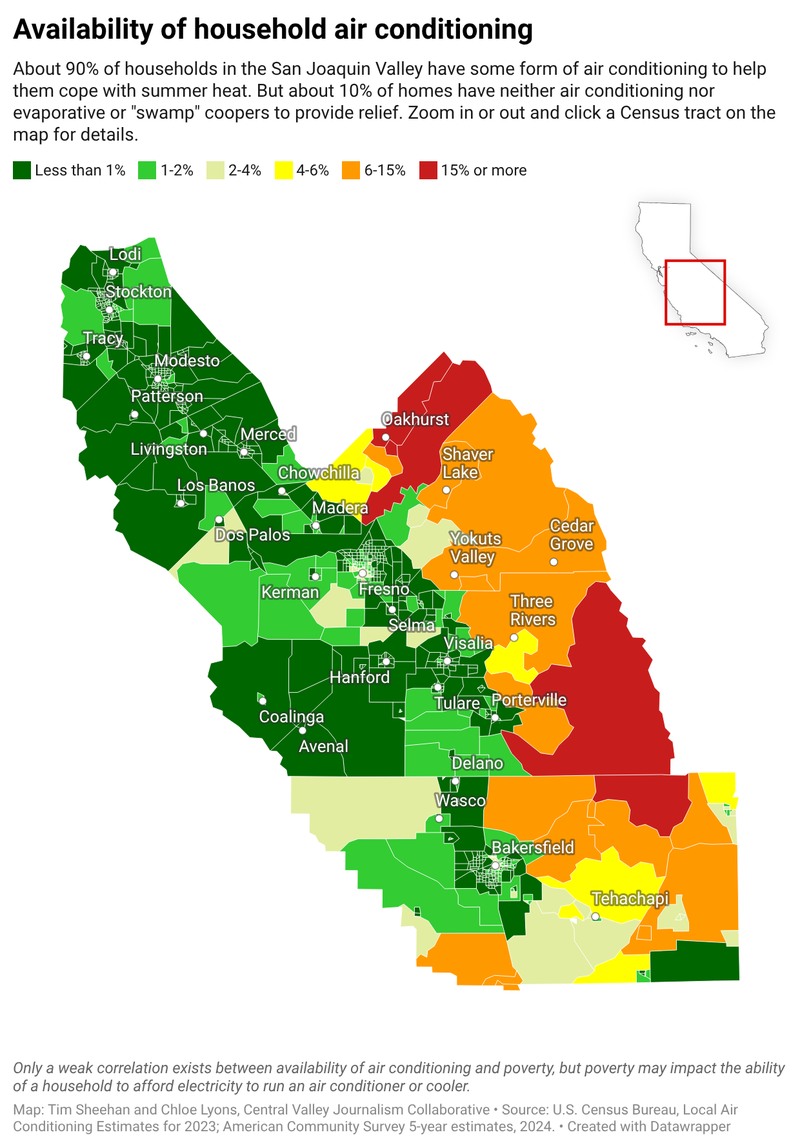
Some of those Census tracts are in foothill or mountain areas flanking the Valley, or where breezes coming through the Sacramento/San Joaquin River delta, may keep daytime temperatures a bit cooler than much of the Valley.
But the figures also don’t account for how many families living in poverty face hardship in their ability to pay for electricity to run power-hungry air-conditioning units.
Staying safe in a heat wave
California and the San Joaquin Valley don’t exactly experience much of the deadly weather that can affect other parts of the U.S., including hurricanes, tornadoes and others
But extreme heat can be a killer, deadlier than any other weather hazard, according to the state Department of Public Health. A mortality database maintained by the U.S. Centers for Disease Control and Prevention reports that since 2018, 67 people in the eight-county Valley region have died from hyperthermia, or exposure to excessive natural heat.
Children, senior citizens, people who work outside, those with chronic diseases, women who are pregnant, and the homeless are at particular risk.
Heat-related illnesses can range from heat cramps and heat exhaustion to heat stroke, with symptoms including excessive sweating, muscle cramps or weakness, nausea or vomiting, and headache or dizziness.
The California Department of Public Health advises checking in on family and neighbors who may need help, paying attention to weather forecasts, drinking plenty of water, limiting time outside in the heat and staying indoors or visiting cooling centers.
Finding a place to cool off
For people who have no access to air conditioning, cities, counties and communities across the region collectively offer almost 140 cooling centers – community centers, library branches and other locations – that are open to the public when temperatures soar.
Those locations, locally are:
Merced County
- Hilmar: Hilmar Library Branch, 20041 W. Falke St.
- Livingston: Livingston Library Branch, 1212 Main St.
- Livingston: Livingston Police Department, 1446 C St.
- Snelling: Snelling Library Branch, 15915 N. Highway 59
Stanislaus County
- Denair: Denair Public Library, 4801 Kersey Road.
- Hughson: Hughson Public Library, 2412 3rd St.
- Hughson: Hughson Senior Center, 2307 4th St.
- Turlock: Roger K. Fall Transit Center, 1418 N. Golden State Blvd.
- Turlock: Turlock Public Library, 550 Minaret Ave.
— Tim Sheehan is the Health Care Reporting Fellow at the nonprofit Central Valley Journalism Collaborative. The fellowship is supported by a grant from the Fresno State Institute for Media and Public Trust. CVJC research assistant Chloe Lyons contributed to this report. Contact Sheehan at tim@cvlocaljournalism.org