BY LASHERICA THORNTON
EdSource
In late July at UC Merced, a classroom of middle school students split into teams for a game of Jeopardy. One problem: if the base of a 12-foot ladder rests 3 feet from a wall, how high up the wall does the ladder reach?
After the teacher sketched a triangle, students immediately recognized the concept.
“This is giving Pythagorean Theorem,” one student exclaimed.
Armed with miniature whiteboards, students drew the triangle, wrote the formula and worked through the problem together. The room filled with laughter and debate as students caught each other’s mistakes, justified their methods and challenged the instructor over whether the answer should be exact or rounded.
The students were attending UC Merced’s Summer Math Academy, a four-week program where rising middle and high schoolers spent their days immersed in math. The camp aims to strengthen students’ foundational skills and prepare them for more advanced course work — an approach that educators say is helping students succeed in a subject that has become a concern for policymakers.
After years of focusing on reading, California and national lawmakers are turning their attention to math. Students are reportedly entering college not knowing middle school math; just a quarter of eighth graders were proficient in the subject in 2024, according to the Nation’s Report Card. And student achievement remains below prepandemic standards. About 37.3% of California students scored proficient or advanced in math in 2025, lagging a prepandemic proficiency rate of 39.7%.
Using proven tactics to address math proficiency, the math camp may be showing results. At El Nido Elementary School in rural Merced County, where most middle school students have participated in the summer program, preliminary 2026 state assessment scores show math proficiency exceeding the prepandemic levels. Students at El Nido Elementary improved their overall math scores by 12 percentage points last year.
“Last year, (35.92%) met or exceeded in math,” said Paula Heupel, superintendent of the El Nido Elementary School District. “Now we’re going to be somewhere between 41% and 44%. You don’t usually jump and then jump again like that.”
Because El Nido Elementary is a small, rural TK-8 district with about 150 students, Heupel can easily track what’s leading to gains for her middle schoolers. One factor, she believes, is the summer math academy, where students are discovering that math can be fun.
“This is 3 o’clock in the afternoon, and they’re having fun,” she said. “They’re talking about math like it’s a regular conversation.”
Math all day, every day
The UC Merced Summer Math Academy is part of the federally funded TRIO program Talent Search, which helps first-generation and low-income students access higher education. The academy provides intensive math instruction for students who need extra support, are preparing for a new course or simply want to advance their skills. The camp runs for seven hours a day, five days a week, for four weeks. Classes of about 20 students are taught by middle and high school teachers from nearby communities and assisted by a college student, creating a small interactive learning environment.
Camp makeup
More than 60 students were in the 2026 UC Merced Summer Math Academy.
- 20 from El Nido Elementary
- 20 from Livingston Middle School in Merced County
- 26 from Weaver Middle School in Merced County
This summer was Livington’s fifth year participating in the math camp, El Nido’s second year and Weaver’s first.
“To ask a student to do math for four weeks in the summer is hard,” said Ruben Reyes, project director of the program.
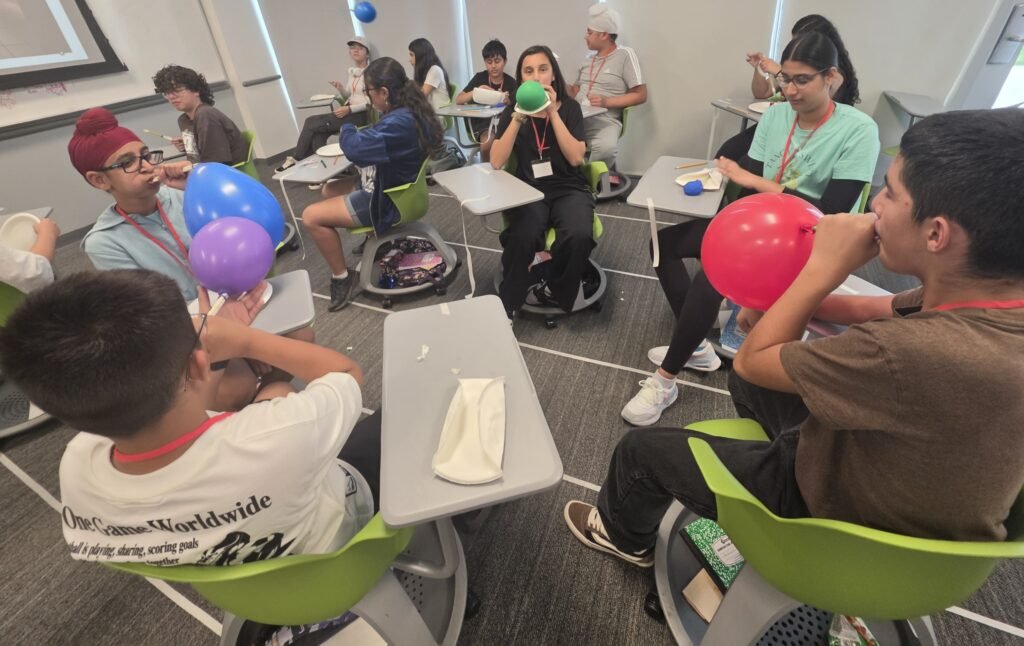
So, students are “up out of their seat,” Reyes said, solving problems on whiteboards that line the classroom walls. Students this summer built balloon-powered cars, determining distance and speed, and headed to the basketball court to calculate angles.
Sonia Medina saw her children’s enthusiasm firsthand. Each day, she asked what they had learned from Monday’s pretests on unfamiliar material to Friday’s post tests that measured their progress.
“At the end, they’re showing they’re paying attention and giving it their all,” Medina said.
She got to see that play out during Family Day in late July. She participated in one of the students’ favorite games — Jeopardy for seventh grade math — and her daughter, Hope, a rising seventh grader, “kicked my butt.”
The academy incorporates instructional practices used by Compton Unified, one of 108 districts identified by researchers as improving faster in math than demographically similar districts. Those strategies include the camp’s weekly quizzes and an emphasis on math vocabulary. The camp also uses engagement and prioritizes student justification, standards in California’s math framework.
Getting students to and above grade-level standards
Beyond the games, the camp helps students return to school with greater confidence, said Heupel, the El Nido superintendent. That confidence allows educators to begin instruction at or above grade level for students who know the material. Even if students don’t yet know all the prerequisite skills, they have built enough confidence to learn them rather than shut down, she said.
That’s one reason why Heupel started sending El Nido students to the camp. The other reason: “statistically, Merced County, the Valley, there’s still a disproportionate number of students who are not prepared to be successful in Math 1 as they’re coming into high school,” she said, referring to a freshmen math course.
Heupel said the results have been drastic. Before participating in the academy, about half of El Nido’s students were prepared to enroll in Math 1. Now, she said, all students are ready for Math 1, and nearly 80% qualify for Math 2, typically for sophomores, or higher.
Program data shows similar results. Out of 80 former UC Merced math camp participants who’ve started high school, 75 students could’ve started in Math 1, and 48 could’ve started in Math 2 or higher.
Starting high school in grade-level math or higher can have long-term benefits. Students who begin in Math 2 have room in their schedules to take advanced mathematics in high school and avoid remedial classes once in college.
While nearly 88% of California students graduated from high school in 2025, 46% did not complete their A-G course requirements, the set of high school courses students must take to be eligible to enter either the California State University or University of California systems. That’s at least three math classes to even apply to the CSU or UC systems.
A cultural shift in college-going culture
For many students, the camp’s biggest impact extends beyond math. By spending four weeks on the UC Merced campus, many are seeing college – and themselves – differently.
The camp introduced 12-year-old Pedro Jr. to a higher education institution — something his father, who never made it into a college, desires for him. Even if he isn’t thinking about it yet, both his parents want him to go to college.
“Maybe he can see that he is capable of going to a university so he can continue his education,” Maria Solorio, Pedro Jr.’s mom, said.
Medina’s 14-year-old Isaac’s perception of college changed after being on campus, as well. Although he still isn’t sure whether he wants to attend college, spending time at UC Merced and “seeing adults walking to their classes, seeing (them) have a lot of freedom,” has made higher education more real, he said.
Heupel said the camp has contributed to a culture shift.
Many El Nido students rarely venture out beyond their rural, agricultural community. At the academy, they not only experience life on a university campus, but also learn the math they’ll encounter in high school, what it takes to graduate and the courses they’ll need to be eligible for college, she said.
“We want them to go and do whatever they want to do,” Heupel said. “It goes back to that confidence, not just in math but all subjects. They can be successful in high school — that’s that launching pad into they can (also) be successful in college; they can be successful in life. It sets them up.”