BY KRISTINA HACKER AND JOE CORTEZ
Turlock Journal
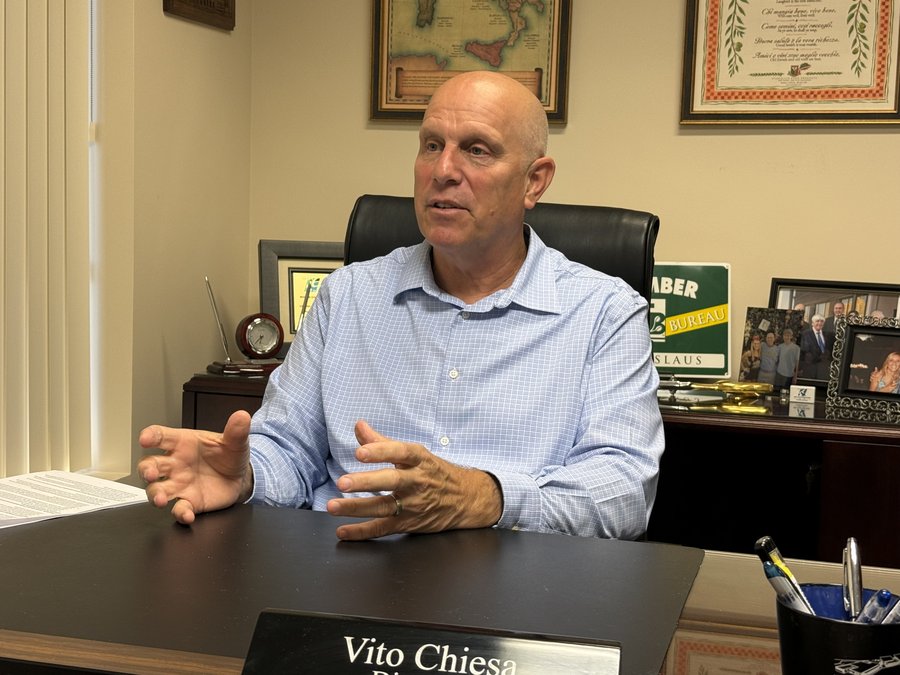
The Turlock Journal recently sat down with Stanislaus County District 2 Supervisor and Board Chairman Vito Chiesa. He talked about his upcoming State of the County address — set for July 14 at 9 a.m. in the Board Chambers, 1010 10th St. — along with updates on the county’s ARPA spending, the state’s rail plan, the county’s mental health plan and more. This is Part 2 of that discussion. Check out TurlockJournal.com for Part 1 of the interview.
Turlock Journal: The supervisors recently approved the new mental health plan that addresses the state goals, which included access to care, reductions, homelessness, judicial involvement, children, etc. You noted the public pushback against new behavioral health facilities like the Alamo Health facility on Colorado Avenue in Turlock. How can the county bridge the gap between providing state-mandated mental health housing and addressing those safety concerns?
Vito Chiesa: So, first of all, this was voter-approved. I just want the public to understand that this went on the ballot to change the paradigm of how the county deals with services. It's not bad, because there's an accountability that there never was before. We used to write numbers – how many people we treated – and we would farm a lot of it out. Now, we're going to be responsible for the outcomes. Accountability is something that's been lacking in the system. But again, it's a paradigm shift. We're going to have to do a lot more reporting, so we're actually hiring statistician-type folks who are going to have to track all of this, and it's making us do more. Referring back to what was Las Palmas, which is now Alamo, it's our job as a county to make sure who gets sited there. … I think people will come to accept it, because if you have someone on the street having a mental health breakdown, whether they're in a neighborhood or in an industrial complex, I think most people would say it's better to have them housed where they can receive their medication and treatment. I think it's more about having a dialog with the community, and not putting too many people – like, hundreds of people – in one spot. If you have a low-barrier shelter, there are fewer locations to site something like that. … We’ve got a couple hundred people over here on Ninth Street (in Modesto), and that might be too big, but again I'm excited from an accountability standpoint because we never could tell exactly how we were doing. We saw 1,000 people, and we say that's good, and this year we saw 1,100 people, so things must be better. Well, that's not always the case.
How many people did you move out of the low barrier shelter into some stable housing like Dignity Village (in Modesto), receiving treatment? And then, how long did they stay there before we got them into the Kansas House? And you're moving them through the system to become independent, not to be reliant just on the county.
TJ: The state now has funding toward this, too. Aspiranet just opened recently in Turlock ...
Chiesa: Hope Forward, that was the first phase. The next phase, the important one, is out on Youngstown (Road). The school out on Youngstown. Aspiranet also operates that. There’s $30-40 million in construction out there, and every juvenile in Stanislaus County that ever needed high-acuity level of care, meaning potentially starting in a locked facility and then working their way down through the system, went out of county for placement. One hundred percent of them. Now, Aspiranet received a state grant, and it's going to have a locked facility and a step-down unit and, I want to say, board and care. I'm not sure that's the right word, but you have your own bedroom, you're in a house, and there's four of you in there. That's been sorely lacking. The good news is that San Joaquin, Stanislaus and Merced counties are going to do their placements there, so it's actually benefiting three counties. Right now, we’re doing out of county placements that might be L.A., and Kern County. You want the family to have access to these kids, and it makes it where a lot of people don't have the ability, so that's one of the more exciting things.
TJ: You mentioned Modesto’ Dignity Village. It’s been a little more than a year since that opened. What have you heard? How is it doing?
Chiesa: Things are going well. It's the funding that always worries me. We talk big picture: how do we deal with the acuity level? Because we're not responsible now for mild to moderate. They want us to deal with the seriously mentally ill people with co-occurring disorders, recidivism, and all those things are kind of strapped together when the (Behavioral Health and Recovery Services) has something to do with. So, we think we have money, and we typically work on a year-by-year basis. But I think we're in good shape. We’re more worried about the low-barrier shelter because funding has been cut from the state. We cobble money together with our partner. Modesto, and are constantly finding these different funding sources and trying to plug holes. It's becoming more difficult on the pure homelessness side if it's not attached to something like mental health.
TJ: Stanislaus County cut nearly 150 allocated government positions from its budget in March. What core public services are most at risk of experiencing slower response times or reduced availability?
Chiesa: So, I don't want to talk about just one department, because I think that this is going to affect all departments on a go-forward basis. We've had so many good years coming out of 2009, ’10, ’11, which were not good at all. In 2012, things kind of bottomed out, and since then – 2013 through 2025 – we've pretty much seen an increase in our budget, sales tax receipts, property tax receipts, everything. And now, the economy has softened; property tax is flat; sales tax is flat; and we've instructed most of our departments to take a look at what are their core services and start the exercise of what it would look like if they were 3 percent or 5 percent down. I think this is the beginning of a slowing of government. The preparation for 2009 wasn't there. It was so quick and cataclysmic, for lack of a better word, and our reserve levels weren't where they are today. The good news for Stanislaus County is that we've had 12 years of thinking about what it might look like if it happened again, and we're more prepared with our reserve level. So, I think we will hold open positions. I don't know that there's going to be a bunch of live bodies that would lose their job because I think we can kind of coast over the top, but I won’t be surprised if things don't improve a little bit. We have a no backfill policy here at the county. If the state or the federal government cuts a program, we cut the program. It's pretty simple. We don't run off of our limited $320 million discretionary spending; we don't pull out of that pot to run a program that's out of the $1.9 billion budget, because it would be defunct in a matter of a year or two. So, you see, HR1, The Big Beautiful Bill, has some good things in it, it's got some not so good things for the county. There are cuts on the Medicaid side. And it'll have downstream effects on county services. I count on the smart employees to let us know, but I think there'll be some tough times ahead based on state and federal funding.
TJ: Stanislaus County Sheriff Jeff Dirkse has spearheaded an effort to transition the department's emergency dispatch, records-management, and jail-management systems to a new one developed with Oracle. The push has led to disputes with the Board of Supervisors and the county's primary 911 dispatch agency. What is the status of the transition to Oracle?
Chiesa: So, I can't tell you, about the program itself, you'd have to talk to Jeff. What I can tell you is that the executive level of the county, the executive level at Modesto, as well as the sheriff, have had conversations on potential paths that they're studying, and that's fairly recent. That's what I know on where it stands right now … today. The board had certain qualifications back in March of 2025; a letter was sent to Jeff Dirkse noting things that we wanted to see before they implement. … It’s my job as a supervisor to the taxpayers of Stanislaus County to make sure we're spending our money as efficiently and effectively as possible. … I personally don't support anything that I consider degrading the system. The system of dispatch is CAD [computer-aided dispatch] to CAD working together, so that you don't call and have to repeat things to the call-taker, to the dispatcher of fire, the dispatcher of ambulance, the dispatcher of police services; that the system works together as best as possible. I know we have that today, and I don't want to degrade it from that. We only want to enhance the program, and if you can enhance the program, then the taxpayers probably could pay more money. I don't know if we're at that point yet, but it clearly states in the letter what, essentially, the hierarchy of needs are. I think that the sheriff wants Oracle. I think he's going to get Oracle. Is it going to be a standalone, which doesn't make a lot of sense; or is it in conjunction with our partner agencies, where we share call-takers, and that the system, the two CADs, work together rather than being completely separate?
TJ: You’re not up for reelection for another two years, so we’ll spare you the usual questions about your intentions to run again. But I’m curious, what led to your original decision, many moons ago, to get into politics?
Chiesa: Stanislaus County Farm Bureau … I became a board member, and it’s as simple as that. It really made an impact on me. It gave me the opportunity to step up into leadership and then do lobbying in Sacramento. And then I was put on the state Farm Bureau board representing Tuolumne and Stanislaus counties. Then I ended up in D.C. to talk about the tractor tax revision. We were one of only two states that had a tax on tractors. Then GS West brought to my attention that there was a tax on propane, which is the primary heating source for unincorporated residents and farmworkers. It was unfair because natural gas wasn't taxed, so that was included in the bill, and a few other things. And I saw that we could make a difference, as farmers, when we banded together for a common cause; that's rarer than you think, for farmers or anybody. So, it was through the Farm Bureau organization that my interests were piqued. I felt empowered to make a difference and felt I could make a difference. I think supervisor is really the one area in which you can effectuate change within the ag community. And I was lucky enough to be elected.