BY GARTH STAPLEY
CV Journalism Collaborative
Eager to draw jobs and boost the local economy, cities and counties might trip over themselves to compete in granting companies permission to do business.
That is, as long as prospective firms never publicly utter two insanely toxic words: data center.
In an era when political partisanship reigns supreme, the game-changing phrase in many cases has united people on the political left and right like few others. In opposition.
It has been true almost everywhere in the United States – regardless of President Donald Trump’s influence (he supports them, saying recently communities that reject data centers will become “backwards and poor”).
That includes Modesto, where 200 people recently urged city leaders for three hours to reject a data center project that hadn’t been officially proposed yet. And Patterson, whose city council last month enacted a moratorium on data centers.
There’s also Riverbank, whose leaders last week did the same thing – despite pleas from the firm they hired to lure companies like data centers.
The Modesto Irrigation District board last week staged a presentation designed to calm fears, assuring customers that they’ll be protected if any data centers come calling.
As of Sept. 7, 379 communities in 44 states had pushed pause with data center moratoriums, according to Interconnected Capital LLC’s US Data Center Moratorium Tracker.
All of this opposition is a relatively recent phenomenon. Townsfolk with metaphorical torches and pitchforks became more frequent in just the last year or two – now that people have learned about data centers causing noise and consuming immense amounts of water and energy, sometimes affecting neighbors’ utility bills.
“If a manufacturing plant or semiconductor fab(rication firm) moves in, people don’t have underlying dread or fear” like they do with data centers, Greg C. Wright, a UC Merced associate professor of economics, told The Modesto Focus.
“People’s relationship to AI (artificial intelligence) has become broadly pessimistic,” he continued. “It’s not just a warehouse being built; it’s also, ‘Why do I want this? It’s not creating jobs, and it may take my job.’ Data centers have become an existential threat.”
Two things about Wright: He’s from Oakdale, a few miles from the Riverbank site we’ll explore in just a bit. And he’s been studying data centers and publishing academic papers with the Brookings Institution about how data centers affect the labor force in communities where they locate.
Wright and Brookings coauthor Dany Behar analyzed 1,500 data centers in the United States for their latest study, “New evidence on data center employment effects,” first published in May and updated in August. What they found supports some people’s skepticism.
For example, although data centers do produce local jobs, they aren’t many – usually a few dozen compared to hundreds for a like-sized manufacturing plant. And a community’s average wage level doesn’t seem to rise after a data center begins operating, while nearby home prices tend to rise from 2% to 5%.
Credibility goes down when data centers sneak around
And there’s public relations harm done when data center projects are perceived as sneaky.
The Wall Street Journal’s Aug. 7 headline about a project in Gilroy, 85 miles from Modesto, says it all: “How Amazon built a data center in a California town without anyone noticing.”
Bottom of Form
Approval by Gilroy’s community development director, based on zoning criteria set 45 years ago, was enough for Amazon to escape public meetings or votes, the newspaper reported. Nondisclosure agreements (NDAs) signed by some city officials helped keep construction under wraps as well.
Newsweek blames NDAs for similar silence in several states including Pennsylvania, Virginia, Arizona, Louisiana, Wisconsin, Indiana and Tennessee.
“This national wave happening around data centers is because of some greedy or bad actors, people going into communities and doing fearful things like taking away natural resources,” said Andy Foster.
He’s president of renewable fuels in North America for Aemetis, and he’s the one who pleaded with Riverbank leaders not to do what they did when they imposed a data center moratorium on Sept. 8.
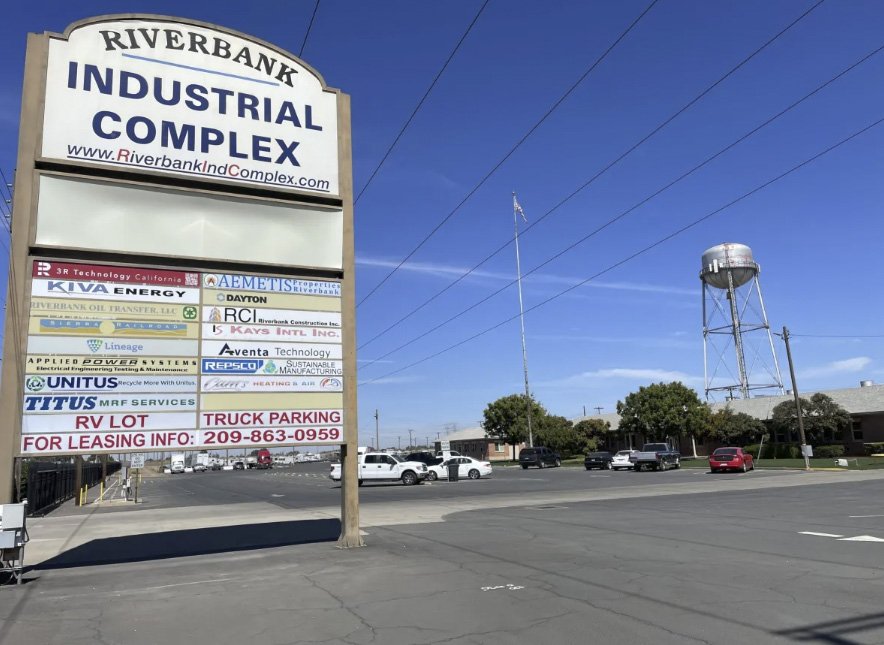
Under a longterm contract with City Hall, Aemetis is the city’s leasing agent for the Riverbank Industrial Complex along Claus Road on the city’s southeast edge, near northeast Modesto. That’s where an aluminum plant produced parts for U.S. Army munitions for a few decades during and after World War II.
The Riverbank Industrial Complex is now managed by Aemetis and has about 200 workers employed by 35 companies – with plenty of room to accommodate more. Like a data center.
The RIC, as Foster calls it, represents both a cautionary tale and a unique opportunity. The first should give shudders to any municipality naive enough to embrace data centers before thoroughly vetting them, while the second could bring wealth to city coffers like few tenants in Riverbank history.
Former bitcoin miners soak Riverbank for a half-million dollars
More than a decade ago, a fly-by-night company called Aquifer leased space in the cavernous former munitions plant and brought in rows of computer servers cooled by huge banks of industrial box fans, according to a 2018 story in the now-defunct Missoula (Montana) Independent.
“The fans kicked up dust throughout the complex, while the whole setup sounded like a jet engine running nonstop in an airplane hangar,” author Derek Brouwer wrote, describing the Riverbank set-up.
In Foster’s remarks to Riverbank City Council members on Sept. 8, he ever-so-briefly asked if they were aware that the repurposed munitions plant had once housed a data center. The reference to Aquifer was quickly passed over – perhaps because the council didn’t know, or maybe from embarrassment because they did.
Aquifer’s under-the-radar business was bitcoin mining, Brouwer wrote. The set-up – rows of servers cooled by loud fans – resembled a data center, with important differences.
They boil down to this: bitcoin miners earn a cash equivalent by solving complex math problems, while AI computers tackle just about anything, from writing grocery lists and suggesting an outfit to drafting codes and working on cures for diseases.
But the cryptocurrency sector was super volatile in those days. With mounting debt and vanishing resources, Aquifer soon went under, declaring bankruptcy in 2015 – and skipping out on $500,000 in unpaid rent and legal fees owed to Riverbank taxpayers, though few were aware, Brouwer said in the Independent.
With cooperation from Debbie Olson, then-executive director of the Riverbank Local Redevelopment Authority, Brouwer wrote:
A local government in a town of 25,000 people had unwittingly gambled on bitcoin, and paid a hefty price for it.
“We think, quite frankly, if we can save another community from the losses that we had to bear with this company, then we feel like that’s the right thing to do,” Olson says. “We would caution any company doing business with this particular group to be concerned, to review the records and be very concerned.”
“We’re different,” Riverbank-friendly firm insists
That whole mess had nothing in common with the current idea of bringing a new-generation 60-megawatt data center to the Riverbank complex, Foster said. For comparison, the developer inquiring about a possible data center in Modesto had in mind one from 25 to 50 megawatts.
A flyer Foster provided for the Riverbank project claims it would not be a “mega data center” and instead be a “modular, medium-sized computing facility.”
“There is an opportunity for us to separate ourselves from the national debate,” Foster said, “because what we’re talking about is a truly different set-up.”
First, Spartan Data Centers, the company working with Aemetis, envisions taking about enough water one time only to fill an olympic-size swimming pool – from on-site wells that are not connected to Riverbank’s municipal water system. They then would recycle that water, Foster said, negating the legitimate concern that first-generation AI data centers grab too much of that resource from local communities.
Second, all RIC tenants use electricity from Hetch Hetchy Power lines connecting the Yosemite-area hydropower plant directly to the site since it was cranking out missile parts for the federal government. That likewise negates the legitimate concern that AI data centers consume too much local energy – because this one would need nothing from the Modesto Irrigation District or PG&E.
“You probably can only say that about one location in California,” Foster said. “This is a unicorn kind of thing.”
Third, Spartan would build the data center entirely within already existing RIC buildings, Foster said.
“If you drive by today and look at it, and drive by again five years from now, you won’t even know it’s there,” Foster said, noting that Aquifer came and went virtually unnoticed. “When I say zero impact, I mean zero impact.”
Except that Spartan’s roughly $1 billion investment could generate $10 million a year in new tax revenue for local and state government agencies.
If true, those claims could put Spartan’s project into a league apart from most studied by Wright, the economics professor.
“(No) aesthetic (harm), existing power, not much water – this doesn’t sound too bad,” Wright said.
Data centers courting low-income, rural settings
Other studies suggest that industrial developers are increasingly on the lookout for rural areas and poor communities. Realtor.com crunched numbers and found “more data centers in lower-income communities” than in previous years.
In Stanislaus County, a potentially inviting spot for a data center is The Landing – the county’s rebranding name for the long ago-abandoned naval air base near tiny Crows Landing, on the county’s west side.
County officials have hoped for two decades to lure industry there, with no success so far. But its remote location seems in line with sites sought for other data center projects – as does the Beard Industrial District, in county jurisdiction on Modesto’s southeast fringe.
County CEO Jody Hayes said Friday that developers have brought forward no such plans.
Turlock’s Regional Industrial Park – also on the edge of town away from subdivisions, while still blessed with water and power services – could be attractive as well.
Its city leaders recently took the unusual step of responding to rumors spread on social media. No data center operates in the county’s second-largest city, the post said, and Turlock “has not received any applications or permit requests for a data center, nor has the city engaged in any discussions or negotiations,” the notice read.
The regional uproar started when The Modesto Focus revealed that NorthPoint Development, with a portfolio of 37 data centers in 18 states, was quietly lobbying Modesto councilmembers for one at 1200 Graphics Dr., along Highway 99 north of Kansas Avenue. City officials have been shopping that site – where the former FMC barium plant once stood – to industrial developers for decades, hoping to lure new jobs.
Modesto officials said no plans have been submitted, and the City Council listened to three hours of mostly one-sided opposition during the open-mic public comment portion of a meeting whose agenda did not include data centers.
The irrigation board, in contrast, held two meetings on data centers inviting public comment and drawing very little.
Maybe that’s because both MID agendas cited “large-load users” without clarifying verbiage on agendas making it clear to lay people who don’t know that’s code for data centers, suggested board member Janice Keating during a presentation last week.
“It’s disingenuous language,” Keating said, “so anyone who was concerned about data centers would have no clue we’re talking about it right now.”
She repeated her earlier recommendations that MID create a new pricing tier charging data centers three times the normal rate, and prohibit anyone connected with MID from signing the NDAs that keep some prospective data centers out of public view.
Neither idea seemed to get traction with her colleagues on the board. General Manager Jimi Netniss said NDAs can protect both negotiating sides, allowing the district to study companies’ financial records that would otherwise be impossible to see.
MID policy requires prospective large-load users like data centers to pay up front for studies assessing impact, presenters explained, emboldening officials to guarantee that existing customers won’t be harmed.
One huge power user – data center? – eyes this area, Modesto Focus learns
Although large-load prospects have eyed the region since 2018, only one had advanced to the stage of paying for these studies, MID confirmed to The Modesto Focus. But the district refused to discuss details.
Although MID won’t identify its large-load prospect or a potential location, and Modesto, Turlock and county leaders say they aren’t actively negotiating with a data center developer, public pressure seems to have an effect. Some elected leaders with each have publicly stated either opposition to data centers or willingness to push pause with moratoriums.
“Turlock is a very precious breadbasket, with the best farmland in the world,” Councilmember Rebecka Monez said on Aug. 11 in just one example. “I don’t want data centers anywhere near it.”