BY ALMA VILLEGAS
CV Journalism Collaborative
Homelessness is up in Merced County, the latest numbers in an annual survey of sheltered and unsheltered residents show.
What the 2026 Point-In-Time Count report, published last Friday, doesn’t explicitly show is that shelter capacity is also up – and in urgent demand.
“One of the biggest things that I can say is we are lacking a lot in shelter,” Victoria Taylor, the program manager for Merced City and County Continuum of Care, said in April, as she shared preliminary report numbers with attendants during a regional 2026 Housing Summit conference.
In the last five years, more than 100 beds have been created to shelter unhoused residents in Merced County– but officials and stakeholders say the demand outweighs the supply.
“Yes, we have restricted, affordable housing units– we don’t have enough,” Jewel Wise with the Human Services Agency said about last year’s report. “The need exceeds the demand.”
The Human Services Agency acts as the administrative entity for Merced CoC, which is the coalition of government, nonprofit and community volunteers who conduct the annual survey in January and publish the report.
Homelessness in Merced County increased by 4.3% in 2026, a large contrast to the 14.3% dip during last year’s count in 2025.
The majority of unhoused people, 73.8%, lived in the city of Merced, according to the report.
“The most important number is the number of unsheltered people,” Merced Mayor Matthew Serratto told The Merced FOCUS about this year’s report. That number, which represents every resident countywide who slept in a car, park, sidewalk, abandoned building or any other place not made for habitation, was down by one in 2026.
The number of sheltered residents in Merced County increased from 371 in 2025 to 403 in 2026, contributing to the overall increase of homelessness. The number of unsheltered residents stayed virtually the same, 346 people last year compared to 345 this year.
Of the 748 total homeless residents counted in 2026, 346 adults and 57 children were sheltered, while 344 adults and one child were unsheltered.
Taylor said the county is always in need of shelter beds and partners who volunteer their resources to support unhoused residents.
The PIT count and survey follows guidelines set by the federal department of Housing and Urban Development (HUD), which requires state and local governments to conduct a count of unsheltered residents every other year, and an annual count of sheltered residents.
Merced CoC conducts and publishes both reports annually.
The data in the report comes at a time where more unhoused people are dying every year across the country, a 2024 research study by the University of Pennsylvania concluded.
Shelter capacity and demand for growth
The number of sheltered people in the county, or those living in emergency shelters and transitional housing programs, increased by 8.6%. That means 32 more people in Merced County were housed in shelters in 2026. Of that number, half were children.
More than half of all sheltered adults and children in Merced County in 2026 were housed by Rescue Mission programs.
The faith-based organization operates the Navigation Center.
In the last five years, the nonprofit has sheltered more of Merced County’s unhoused adults and children.
In 2021, the Navigation Center opened with capacity to shelter 76 unhoused adults. In 2022, Phase One of the Rescue Mission opened with capacity to house 52 unsheltered individuals.
Together, the combined total created 128 new beds for unhoused county residents through partnerships and contracts with local agencies.
Phase Two is scheduled to open at 129 W. Cone Ave this December. It will feature 40 new studio apartments and 32 additional beds restricted as short-term housing for discharged hospital patients, according to Mike North, Merced County public information officer.
The demographics of Merced’s unhoused
The number of children under age 18 living in Merced County shelters increased by 39%, from 41 in 2025 to 57 in 2026. Most unhoused individuals counted this year were between ages 45 and 54. In addition, more than a quarter of unsheltered residents were 55 years or older.
Latinos were represented the most in this year’s count. More than half of individuals in shelters identified as Latino alone or with another race, along with 43.5% of those unsheltered.
Approximately 64.6% of Merced County residents identify as Latino, according to the U.S. Census Bureau.
In April, HUD officials proposed restricting admission by sex to federally-funded emergency shelters and transitional housing programs.
The 2026 PIT count report listed eight gender markers, including identities for woman or girl, man or boy, culturally specific, transgender, non-binary, questioning, different, or more than one gender, as options.
Of the total 403 sheltered adults and children in Merced County, 138 people identified as women or girls, 264 as men or boys and one as non-binary.
The proposed HUD guidelines would reverse federal protections under the 2016 Equal Access Rule, which requires accommodations for transgender and intersex individuals.
Homelessness by jurisdiction
City of Merced’s total unhoused population in 2026 increased by 6.2%, from 520 to 552. Both unsheltered and sheltered individuals increased to 204 unsheltered and 348 sheltered in 2026.
Los Banos, the county’s second most populated city, saw an 11.4% decrease in homelessness. The number of sheltered and unsheltered residents both went down, for a total of 101 unhoused individuals in 2026.
Last year, city planners tried an unconventional approach to support its 78 unsheltered residents.
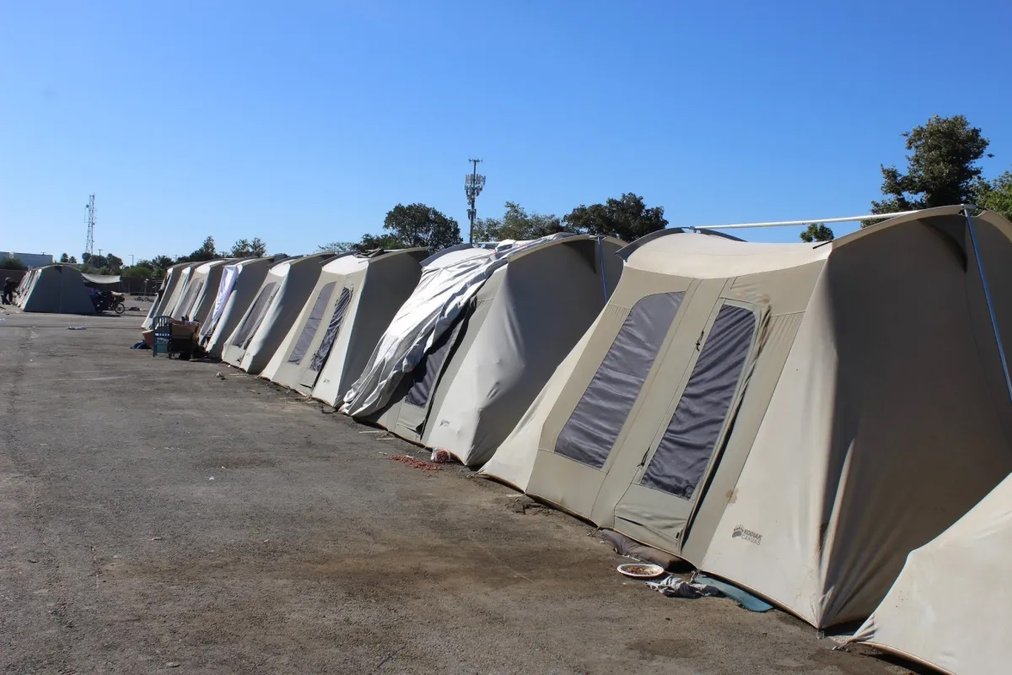
The Los Banos City Council authorized a public encampment, equipped with all-weather canvas tents, a water station and mobile health services, arranged on a vacant lot next to police headquarters.
Los Banos’ city-sanctioned public encampment is a response to Gov. Gavin Newsom’s push for local anticamping ordinances.
“The only place you can be homeless is in these encampments,” Jennifer Loa of the city’s housing division said. “Anywhere else, you can be asked to leave.”
The public encampment is not considered a shelter, and the residents who stay there are considered unsheltered.
In Livingston, a total of 13 unhoused individuals were counted.
While no sheltered residents were counted in the city of Dos Palos, there was a 75% increase in unsheltered residents, from four counted in 2025 to seven in 2026.
The unincorporated community of Santa Nella also experienced an increase in unsheltered residents, from five in 2025 to six in 2026.
No unhoused individuals were counted in the city of Gustine.
No unsheltered individuals were counted in the unincorporated areas of Cressey, Delhi, El Nido, Hilmar, Le Grand, Planada, Snelling, South Dos Palos and Stevinson.
— The Stanislaus County 2026 Point-in-Time Count was conducted on Jan. 29, but results have not yet been released.