BY CALEB HAMPTON
AgAlert
Regenerative agriculture is all the rage.
Within the past several years, multinational food retailers began touting regenerative sourcing commitments. In December, the U.S. Department of Agriculture launched a $700 million pilot program to support regenerative practices.
And as of last year, in California at least, the buzzword has an official definition: an approach to farming or ranching that is “rooted in principles of soil health, biodiversity and ecosystem resiliency.”
Proponents of the movement highlight its potential to improve farm viability and sequester carbon in healthy soils.
While accusations of greenwashing have dogged regenerative claims, which are not federally regulated, a handful of third-party certifiers emerged during the past decade with the aim of building consumer trust and driving market growth.
The number of California farms certified as regenerative has continually climbed, according to data from various certifiers. But industry experts said certification lacked tangible benefits for many farmers, possibly hindering wider adoption.
“The main point to make is there is not a premium in the market right now,” said Kelly Damewood, CEO of California Certified Organic Farmers, the state’s largest organic certifier, which also serves as a certifier for the Regenerative Organic Certified label. “What the return on investment is for most growers is not clear.”
Costs and benefits
While the regenerative movement began as a grassroots effort, farmers and industry experts said certification was increasingly being pushed from the top down—possibly without consumer demand sufficient to compensate farmers for added costs.
In 2021, Richvale-based Lundberg Family Farms, the largest organic rice company in the U.S., asked its growers to get certified as regenerative, according to Sutter County farmer Brian Park.
“They more or less told all of their growers, ‘If you want to continue sending us organic rice, you’re going to get a regenerative certification,’” Park said.
He said he understood Lundberg’s decision was aimed at keeping its products on shelves at Whole Foods Market, which has championed regenerative agriculture and in 2021 began requiring certification for products in its stores that are labeled regenerative. Park added that he didn’t fault Lundberg, and it was to his benefit for the company to secure market access.
His family’s Park Farming Organics in Meridian was already implementing regenerative practices such as crop rotation, livestock integration and cover cropping, he said. It was also fulfilling a certification requirement that employees be paid a living wage, which this year in Sutter County is about 30% higher than the minimum wage.
“We’re very passionate” about taking care of the environment and the farm’s 18 year-round employees, he said.
Since getting certified, however, Park said he had mixed feelings about the certification’s costs and benefits. He said he found the process—and yearly audits—to be “intrusive.” And he felt it was only fair that crops grown with higher production standards be priced accordingly.
“The standards are much higher,” he said. “With that, we kind of felt like maybe you should get a premium.”
On the other hand, Park said, regenerative certification provided some valuable opportunities in a difficult farm economy.
During the past few years, with prices for most of his crops at break-even or worse, he said processing tomatoes were a lifeline for the farm. While most tomato growers were getting their contracted tonnage slashed due to excess inventory at canneries, Park said he was selling more each year to supply a major processor’s line of Regenerative Organic Certified tomato soups.
For his family’s farm, the tomato sales were “key to staying in business,” Park said.
Some producers said that without a premium, they chose not to get certified.
“We have been asked by retailers if it’s something we’re planning to adopt,” said Joseph Button, vice president of sustainability and strategic impact at Petaluma-based Straus Family Creamery, whose organic dairy products are sold at Whole Foods and other retailers.
Button said that while the 13 dairies that supply Straus use regenerative practices—and the creamery uses the term on its website—the company opted not to get certified to avoid the confusion of multiple labels and to minimize uncompensated bureaucratic burdens on its farmers.
“Anything we can do to pass on premiums to them is something that we focus on doing,” he said, adding he did not believe consumers were ready to pay an additional premium for the creamery’s products.
Corporate objectives
In 2025, sales of Regenerative Organic Certified products increased 22% from the year prior, outpacing sales growth of Certified Organic and other sustainability labels, albeit at a smaller scale, according to the market research firm SPINS.
However, experts said those numbers may not directly reflect consumer demand.
Damewood, the CCOF executive, said she believed the category’s growth was being driven primarily by large retailers’ environmental, social and governance—or ESG—commitments.
A 2024 report from the NewClimate Institute, a Germany-based research firm, found more than a dozen of the world’s largest food companies—including Nestlé and PepsiCo—listed regenerative commitments as components of their climate strategies, with some crediting the sourcing commitments toward mandatory supply chain emissions reductions.
“I see the pressure (on farmers) to potentially get regenerative certified coming less from the average shopper and more from buyers and retailers and folks in the industry looking for verification and traceability for (sustainable) practices,” Damewood said.
Kristin Kiesel, an agricultural and resource economics professor at the University of California, Davis, said consolidation at the retail level in recent years meant farmers had little bargaining power when negotiating with buyers—whether on price or, in this case, on adopting certain production practices.
“Retailers can say, ‘We require our suppliers to use these practices.’ Then that gets fed through the supply chain,” Kiesel said. “Farmers are left with the choice of adopting a new practice or losing the contract.”
Supporting the movement
Even without a premium, Damewood said, there can be compelling reasons for organic farmers to get certified as regenerative, not least because many embrace regenerative agriculture’s core philosophy of farming in harmony with nature.
“It’s a value statement,” she said.
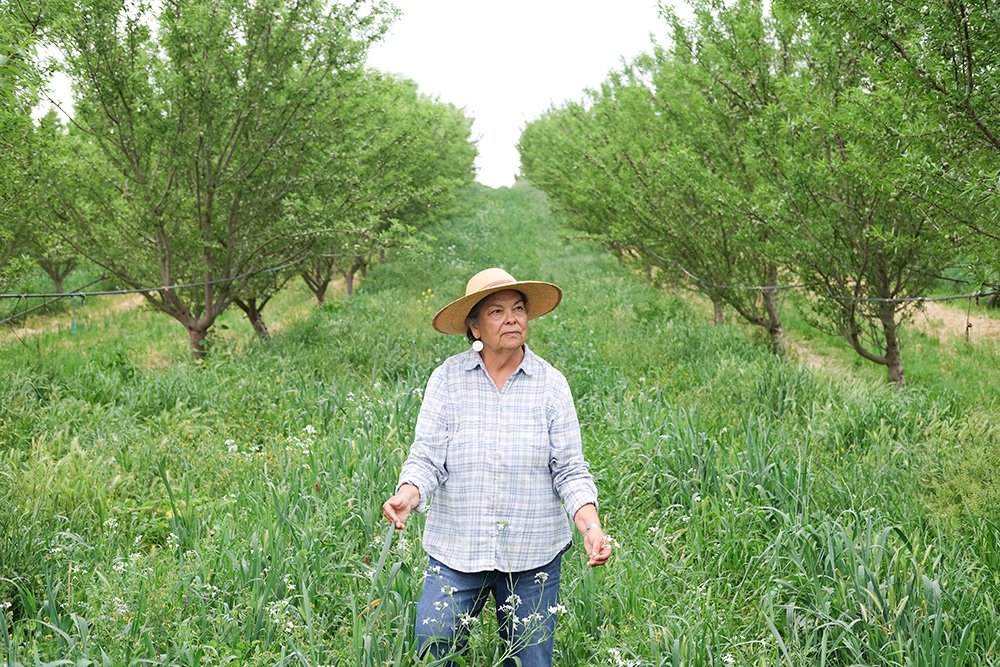
In 2022, Denair-based Burroughs Family Farms became the first Regenerative Organic Certified almond grower in the U.S.
Rosie Burroughs said the Merced County farm got certified to support practices she believes will not only restore the environment but help other farmers.
“We wanted to support the movement,” Burroughs said.
By adopting regenerative practices such as minimal tillage and cover cropping, which improved her soil health and water retention, Burroughs said the diversified farm saved money on water, fuel, fertilizer and labor. She credited the cost savings with keeping the farm in business.
“Using regenerative production saves on all the big costs,” she said.
Unlike the organic seal, Burroughs said, regenerative certification had not helped fetch higher prices for her eggs, olive oil, nut butters or other products—at least not yet. But she said it had helped market the products to Whole Foods and other stores.
“We’re just opening up that new market,” she said.
— Courtesy of the California Farm Bureau.