BY VIVIENEE AGUILAR
CV Journalism Collaborative
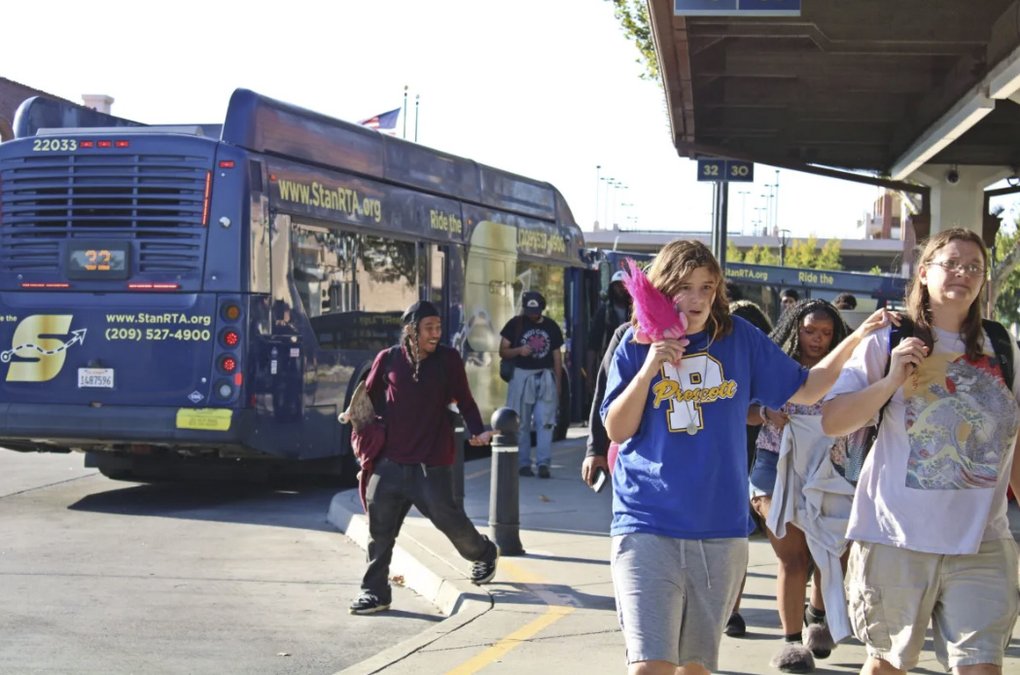
Regular bus riders may find they’ll have to walk a little further next summer when local bus routes shrink.
In an effort to maintain the free service for a significant portion of its riders, Stanislaus Regional Transit Authority (StanRTA) is moving to reduce service by 15% and address a $3 million budget shortfall through the Short Range Transit Plan.
The plan will combine, alter or cut routes that serve Modesto, Ceres, Riverbank and StanRTA’s connections to other regional providers like the Bay Area Regional Transit (BART).
Cuts to federal funds for public transportation are a main reason behind the new reduced route plan, also known as “Connect the S,” said Angela Swanson, senior transit analyst for StanRTA. The plan also takes into account the current high price of gas.
The changes will be designed to streamline the local Bus Rapid Transit corridor, which runs along McHenry Avenue, for the majority of riders and maintain free service to the most underserved communities in the region.
StanRTA is working with Kimley-Horn, a design and consulting firm, to make these changes a reality. This is not the first time StanRTA has had to change or cut bus routes due to budget constraints.
Swanson’s team took the lead on speaking with the community about the changes. They learned about the people who are going to be inconvenienced by the changes. StanRTA worked with local and regional disability rights advocates, students, health care facilities and other community leaders who spoke with them about ridership needs.
Bottom of Form
Youth, active military, veterans and Modesto Junior College students are all eligible to ride StanRTA buses for free with local funding support from Measure L. These groups make up 43% of all ridership throughout its coverage area.
“The art in making these changes is – we can’t escape them,” Swanson said. “We know at some level, people are impacted by this, and we don’t negate it. We’re trying to do it in the least harmful way, and provide the best options possible, balancing recognizing the human cost with having to provide and keep service where the most people are impacted.”
The project began in 2025 and is on track to make changes before July 1 of next year. Phase 1 was all about community outreach. Phase 2 has compiled the ridership data and includes surveys to particularly impacted groups including college students, paratransit riders and rural area residents.
Phase 2 of StanRTA’s Connect The S Project is near completion as a finalized proposal makes its way to the December board meeting.
StanRTA is finalizing the total number of routes and stops it will change or remove. Data is still coming in from various surveys.
What Swanson’s team has learned from internal ridership data highlights the lowest-performing routes that could be cut over those used the most.
The most popular, Route 22, services the McHenry corridor areas every 20 minutes, and moved 339,396 riders last year.
Popular lines that travel around Modesto Junior College carried upwards of 180,000 people to and from the college last year. On average, Routes 30, 31, 32 and 33 saw anywhere from 500 to 750 passengers per week.
Route 24, near the Riverbank Costco, is an underperforming bus line that is likely to be axed completely. Less than 250 people a week took the route last year.
Two of the three routes servicing the junior college will be impacted. That includes Route 31, which travels between the Modesto Transit Center and the Vintage Faire Mall via Ninth Street, Tully Road, Snyder Avenue, Pelandale Avenue and Sisk Road. As part of the new plan, StanRTA proposes a new shuttle to go between the campuses to keep students moving.
The first draft of proposed cuts will be presented at an upcoming StanRTA board meeting, initially scheduled for Oct. 22 but moved to Dec. 3. CEO Adam Barth said the plan will be presented for approval, the public will have an opportunity to listen and comment on the changes, and if the plan is accepted, Stan RTA will move into Phase 3.
The final phase will come with specific updates to drivers, passengers, transportation partners and even Google Maps.
Mitchell Court has been a local bus driver for four years and a familiar face for riders of Route 30, one of the lines facing changes. It travels from Sisk Road to downtown, with stops along College Avenue, Carver and Rumble roads. Many riders are students at Modesto Junior College.
“It’s a very difficult time because there are a lot of individuals who count on the routes that are provided. And to cut them, I’ve noticed it affects mostly individuals who are in kind of poverty areas,” Court said.
Rider Destiny Robinson, a psychology student at MJC, jumped at the opportunity to speak with StanRTA during one of their tabling events at the beginning of the fall semester. She learned about the changes through a peer mentor in the Umoja Community.
“The reason I went to MJC was because of the buses. I had the transport to go there,” she said, on her way home after classes split between east and west campuses.
Her alternatives would be to take a rideshare or find gas money and a friend or family member willing to drive her.
“I feel like the buses are really important for a lot of students that do not have a way to go from A to B,” she said.
She raised concerns for classmates who have recently aged out of the foster care system and don’t have the option to rely on family or community, even if they did have the funds.
Robinson’s triplet sister, Dynasti, who studies art, urged students to take the survey and tell StanRTA not to disrupt the current configuration of routes.
Swanson said while the new route plan will shorten wait times in busy areas, it will also add extra walking time between stops all across the city.
Robinson wakes up at 5 a.m. to get to classes from across the city on her busiest days. She said the longer walks would make those long days even longer.
“I feel like (Modestans) should be involved because it pertains to them and their friends and family. It’s maybe pretty detrimental for them to not say something, because it does help sometimes,” Court said.
The public can see the new plan during the upcoming meeting on Thursday, Dec. 3 from 1 to 3 p.m. at 1111 I Street, Suite 308, in Modesto.