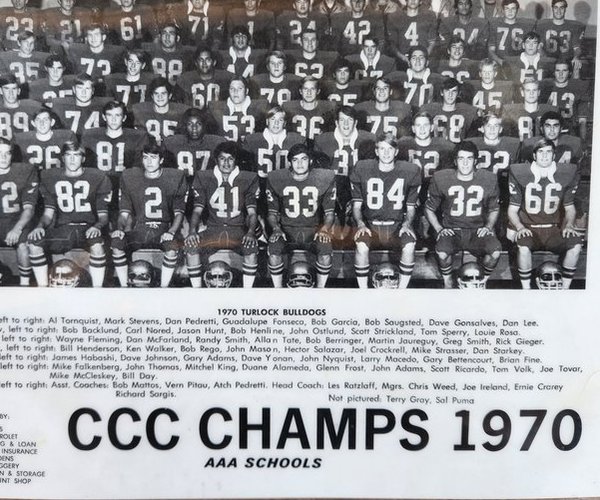
ELK GROVE — Officials from the CIF Sac-Joaquin Section met with members of the press last week for their annual media day, sharing the latest updates ahead of the 2025-26 athletic year. Among the many topics discussed was the Turlock High School football program, with commissioner Mike Garrison offering details of a three-month investigation and defending sanctions handed down by his office.
Last month, the section found Turlock High in violation of four bylaws between January and May 2025, dealing with rules on eligibility and recruitment, pre-enrollment contact and off-season activities. Sanctions included ineligibility to host a playoff game this season, being placed on two-year probation (2025-26, 2026-27) and self-imposing sanctions, while also having to submit a corrective action plan due Sept. 1. A handful of players were also deemed ineligible for the year, but some transfer rulings have been changed, though the section’s portal page has not been updated.
“There was a formal investigation done for about a three month period of time, and we came up with violations of commingling junior high and high school kids and contact with eighth graders prior to enrollment in the school,” Garrison shared.
The official announcement on July 29 read that there was "Participation of non-high school individuals with THS football team via private business organizations.” Although the private business organizations were not specified, it has been confirmed the violations revolved around the operations of “The Lock,” a non-contact 7-on-7 and 5-on-5 offseason football program — operated largely in part by Turlock High coaches — that invites players from different schools and has age levels as low as 8U.
Garrison dismissed the notion that he was too harsh on the Bulldogs, as well as critics who say the section wasn’t hard enough on them. Instead, he described the sanctions as “consistent” with how the section has handled the same violations in recent years, specifically citing a punishment of Rocklin High in 2019.
“Their sanctioning was no longer than the sanctioning Rocklin got back in ‘19. It was actually identical sanctioning to what we did to them in ‘19 when they violated the same things,” Garrison said. “I think it's consistent… I looked at previous historical data, like, what have we done in these scenarios? And it's pretty similar to what we've done in the past.
“Could we give them the death penalty? Sure, could have, (which is) probably removal from playoffs or loss of contacts… Just depends on the nature of the violation. I didn't think that violation warranted (being) removed from the playoffs, whereas we had another school this year that went through the same thing that got removed from the playoffs. So two different scenarios.”
That other school was, again, Rocklin, who was also found to have had “non-high school individuals” participate in team activities. Sanctions included the aforementioned full postseason ban this season and two years on probation. After an appeal, the Thunder are instead ineligible to host playoff games for two seasons, on a five-year probation period, and must submit of a corrective action plan.
As for what Turlock’s self-imposed sanctions entail, Garrison leaves it all up to the schools. Turlock first decided to suspend assistant coach and The Lock founder Darron Silva for the season, but later decreased the length and allowed him to return to practices. Principal Dave Kline told the Modesto Bee earlier this month that those still interested in coaching at Turlock High had to give up coaching The Lock for the 2026 season, and that the offseason program would no longer use Turlock’s facilities.
“I don't have anything to do with that,” Garrison said. “They tell me what they're going to do, we take that into consideration when we're delving out our sanctions. But as far as the corrective action plan, what we want to see is a plan. What processes, procedures have you put in place to make sure this doesn't happen again? What stop gaps? And I'll say that Turlock's administration has done a very nice job of working with them through the course of the investigation, they were very cordial. They were easy to work with, and they took ownership of the mistakes they made. And did they like the fact that they don't get to host a playoff game? I'm sure they don't like that, but they weren't argumentative or combative through the process. They worked hand in hand with us, so it's been OK.”
Proposed Playoff Format
Changes to playoff football could be on the horizon.
Assistant Commissioner Will DeBoard shared that there is a proposal with heavy momentum that would cut each playoff bracket from 12 teams to eight, thus eliminating the first round and shortening the season for all programs.
“Our football advisory committee, our playoff advisory committee, they are very interested trying to figure out a way how to shorten the length of the high school football season, which, if you start with a scrimmage and you get all the way to a state game, that's going to be 17 games for a high school kid playing tackle football,” DeBoard said.
While the eight teams across eight divisions would move forward in a three-round bracket, those seeded nine through 12, plus an additional four teams, would be matched up against one other for standalone, regional bowl games.
“It would allow anybody who is a nine through 16 to be able to play a one bowl game and then finish your season and move on, so how that would work is it would shrink the postseason from four weeks to three weeks,” added DeBoard.
The quarterfinals of each bracket would begin two weeks after the end of the regular season. The bowl games would in turn take place the week immediately after the conclusion of the regular season, a time that would typically feature first round games in the section’s current playoff format.
A vote will take place at the Board of Managers meeting in October, and would be immediately implemented if passed.
Computer Rankings in Football
For the first time, the section will be using MaxPreps computer rankings this year to determine playoff seeding in football. The change comes after longtime partner CalPreps transitioned to a subscription model.
“We didn't want to require somebody who wanted to know if their team was going to make the playoffs to pay money to do that,” DeBoard said. “Ultimately, the football playoff model kind of stays the same.”
New Flag Football Rules
Rule changes have already arrived to flag football, which enters its second year in the Central California Athletic League and the Trans-Valley League.
The newly-implemented rules, modeled after NAIA rules, eliminates run zones and adds shield blocking (like screens in basketball) and punts.
“It becomes a lot more run-oriented, a lot of sprint rolls and a lot of misdirection, versus maybe a lot of passing that you saw in the last two years,” said Associate Commissioner Jason Feuerbach. “The no-run zones no longer exist, which means you can run the ball anywhere on the field. You can rush as many as you want, from wherever you want, as long as they're one yard off the ball.”
Punts are replacing teams declaring that the ball would be turned over to the other team and automatically having starts at the opposite 20-yard line. Punts cannot be blocked, so players must stay still until the ball is kicked, like pee-wee football, as Feuerbach described it.
Academic Honors
The Pitman High baseball team and the Hilmar High girls cross country squad each earned titles of Academic Team Champions last school year. The Pride owned the top combined GPA among all of the section’s baseball teams with a 3.59 mark. The Lady ‘Jackets runners posted an even 4.0 GPA as a team.
Each school was also represented through the A. Dale Lacky Award, recognizing top student-athletes in the section for outstanding athletic performance, community service and academic success during their four years of high school. Pitman’s Elexi Pulido and Hilmar’s Lilly Brewer each won and were awarded scholarships with money raised at foundation games.
Bad Behavior Persists
The section is also exploring new ways to bench bad behavior, as ejections of student-athletes and coaches rose for a third straight year, a trend DeBoard called “disturbing.”
According to the section, ejections spiked to 856 the last school year, including 368 Category 2 ejections which involve fighting, physical assault and gross unsportsmanlike conduct, and leaving the bench during a fight. The figures were up from 248 Category 2 and 724 total ejections in 2023-24 and 170 Category 2 and 619 total ejections in 2022-23.