BY TIM HEARDEN
AgAlert
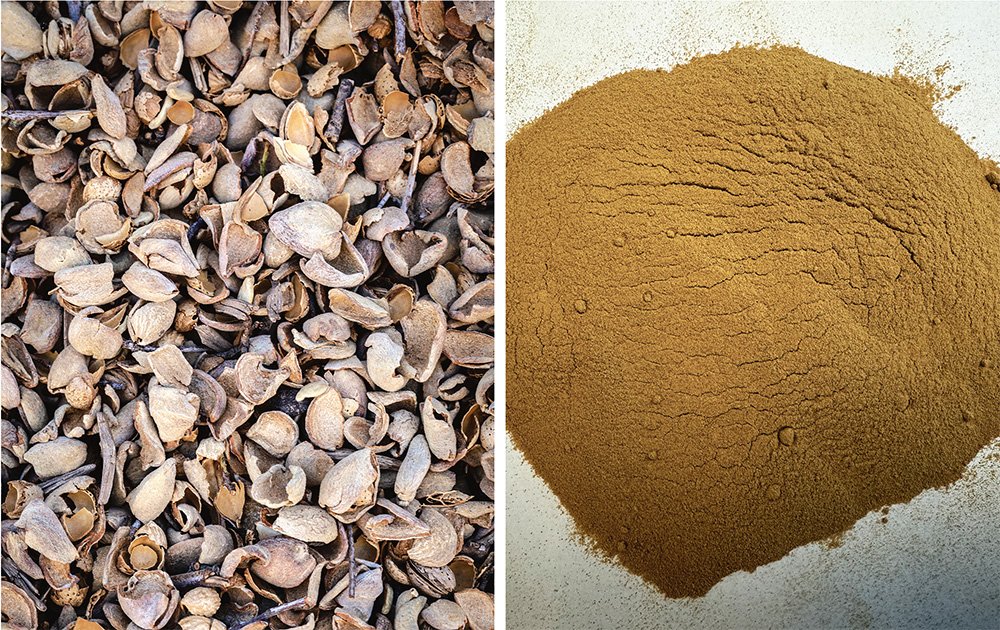
An independent review panel’s designation of almond hull powder as generally safe for human consumption represents a “major milestone” that opens the door for its use as an ingredient in granola, cereals, baked goods and other foods, a researcher at the Almond Board of California said.
The panel finalized its findings this past spring after reviewing a more than 180-page dossier covering how almond hull powder is made, how much people might eat and what happens when they do. Toxicology, genotoxicity and environmental containment exposure assessments found no safety concerns at intended use levels, the almond board announced in May.
The findings, which were submitted to the U.S. Food and Drug Administration, could be “transformational for the industry” in that they create a pathway for continuous innovation and value creation from a resource that has historically been used primarily for livestock feed, said Guangwei Huang, the almond board’s associate director of food research and technology.
Huang said the GRAS confirmation—with GRAS standing for generally recognized as safe—marks a significant breakthrough and could pave the way for “an entirely new ingredient platform for the almond industry.” Although much of the current attention is focused on almond hull powder, he emphasized that it should be viewed as only the first ingredient form to be developed, characterized and tested.
“The more significant implication is that GRAS creates a regulatory and commercial foundation for innovation across a broader range of almond hull-derived ingredients,” he said in an email.
The GRAS designation represents a key turning point for a sector that resolved nearly a decade ago to seek more uses for harvest waste materials that were discarded or, in the case of almond hulls, used to feed livestock. Hulls make up about half the almond fruit by weight but deliver relatively modest returns to growers, as their demand is tied closely to dairy and feed markets, the almond board said.
A biomass working group was formed in 2017 to explore new applications for almond co-products, and its members saw strong potential for hulls because of their high fiber content, natural sugars, phytochemicals, minerals and processing versatility.
For food innovation, almond hulls have several advantages, Huang noted. They are generated in large, stable and predictable volumes every year, providing a reliable supply of an agricultural raw material that some other emerging ingredients lack, he said. This makes hulls especially attractive to food manufacturers, he added.
“It has potential,” said Dave Thiel, general manager of the Turlock-based Cortez Growers Association, which has been working with the almond board to perfect a cleaning system for hulls.
Though it’s in the testing phase, he noted how almond hull powder is making its way into granola, with about 10% of the crunchy clusters containing hull powder.
“I just ate some, and it’s pretty darn good,” Thiel said, “so the potential for that market is there for almond hulls.”
Most existing hulling and shelling operations lack the capacity to clean almond hulls sufficiently for use in human food, which requires the material to be pasteurized, Thiel said.
“The whole point behind our system here is to remove any foreign material that dairymen wouldn’t want to see in their feed trough,” he said.
However, commercializing almond hulls wouldn’t require building an entirely new infrastructure, Huang said. Much of the existing harvesting, handling and processing equipment can be upgraded or adapted to produce food-grade ingredients safely and efficiently, he added.
“Looking ahead, relatively simple changes in postharvest logistics and material-handling practices could allow almond hulls to be managed from the outset as a high-quality agricultural raw material intended for food uses rather than as a feed co-product,” he said.
Huang compares hulls’ potential for success to that of the cocoa industry. The cocoa bean isn’t marketed as a single ingredient. Over time, innovation and market development led to multiple ingredient streams, including chocolate liquor, cocoa powder and cocoa butter, each serving a different function and supporting distinct product categories and value chains, he said.
“Similarly, almond hulls are a complex agricultural resource that may yield multiple ingredient forms with different nutritional, functional and commercial properties,” Huang said. “Almond hull powder is the first step, not necessarily the final destination.”
Huang was part of an international team of scientists who published a 2024 paper in the National Institutes of Health’s National Library of Medicine examining the suitability of almond hull material as a novel food ingredient. No evidence of toxicity or mutagenicity—the ability to cause genetic mutations in cells—was observed in tests in doses likely to be present in foods, the scientific team found.
From an economic perspective, the opportunity for almond hulls could be substantial, as their use in food could transform them from a low-value byproduct into a “portfolio of higher-value food ingredients” that helps the industry maximize value from every part of the almond crop while promoting sustainability, Huang said.
One advantage that almond hulls offer is that by adding just 10% or more of the powder to a product, it can qualify for a new third-party “upcycled” certification, the almond board said. The designation checks a box for consumers concerned about food waste.
Daniel Kurzrock, founder and CEO of Upcycled Foods Inc., said achieving GRAS status is an important step for innovative ingredients seeking acceptance from prospective customers, as companies are unlikely to invest time and money developing products around an ingredient in which regulatory approval remains uncertain. The Berkeley-based company is a business-to-business ingredient supplier and product development partner, according to its website.
The GRAS confirmation provides food companies, ingredient manufacturers and researchers with the confidence to invest in product development, Huang said. The scientist said he sees the designation not simply as approval of a single ingredient but as “the opening of a new food ingredient industry opportunity built around almond co-products.”
He said the pace of adoption will depend on demand and how quickly companies can bring products to market. More importantly, he said, the development could create new uses for almond hulls.
“In that sense, it has the potential to be transformational for the industry,” Huang said.
— Courtesy of the California Farm Bureau