BY CHRISTIAN DE JESUS BETANCOURT
CV Journalism Collaborative
Long before Antonia Sierra-Martinez knew the term “promotora de salud,” she knew what it meant to show up when somebody needed help.
She grew up in Santa María, a small farming community in Guanajuato, Mexico. There, her mother, with a young Sierra-Martinez in tow, went from house to house, helping neighbors with whatever they needed.
The mother-daughter duo helped older neighbors with their gardens and daily chores, and they even administered injections and provided medical advice.
“Siento que yo empecé como promotora, aunque no sabía que era una promotora – I feel I started as a promotora, even though I didn’t know what a promotora was,” Sierra-Martinez said in Spanish.
The promotora title, with a meaning similar to liaison, came years later, after she practiced law and worked in community programs in Mexico. That was before she moved to California to start over in agriculture.
In the Central Valley, that title of promotora, for example, translates to the work of helping someone affected by cancer understand where to turn for care, connecting a pregnant woman with diapers or food, or helping a family find counseling, health care or another service, Sierra-Martinez said.
Promotoras don’t all do the same work. Their training and experience can vary across healthcare, education, mental health and other community needs. Some develop deeper knowledge than others in certain topics.
The U.S. Bureau of Labor Statistics counted more than 8,700 people in California as community health workers in May 2023. But that title doesn’t fully capture the role promotoras play in their communities, according to experts in the field.
The role of promotoras
Sergio Aguilar-Gaxiola, founder and director of the Center for Reducing Health Disparities at UC Davis, knows the work of promotoras well, since he’s worked with them for more than 40 years.
“Promotoras are a crucial workforce supporting health promotion, resource navigation, and dissemination of evidence-based health information across diverse communities,” he said. “Promotoras can reduce the barriers to health education, health promotion, and services that are common for native-born and immigrant communities.”
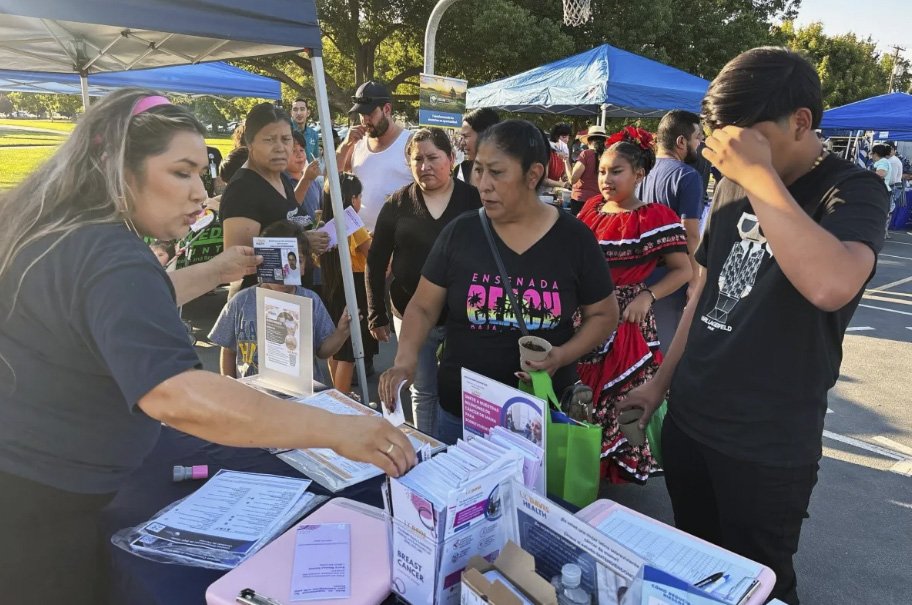
On any given day, promotoras may help someone understand a cancer diagnosis, apply for a health program, or find a clinic.
The next day, they may help a parent navigate the school system, connect a family to food, explain a government program, or help someone who’s overwhelmed figure out which problem to address first.
Most of these services do not take place in an office or clinic. Rather, they take place in churches, schools, residents’ living rooms, and even during spontaneous conversations in grocery store aisles.
The work often starts with a problem close to home. For Carmen, whom the Merced FOCUS is identifying only by her first name for safety reasons, it began with her children’s school in Dos Palos.
“Yo veía que en la escuela de mis hijos el agua salía amarilla – I saw that the water at my children’s school was yellow,” said Carmen, who immigrated with her family to the U.S. in 1999.
Parents in Dos Palos continued to press for safe drinking water at the school, and Carmen said the effort eventually helped secure funding for a water purification system.
“It took about five or six years to have that,” Carmen said. “But being persistent is something that has to be done.”
Migrant education programs gave Carmen a better understanding of the school system, and she later became a facilitator for the Parent Institute for Quality Education (PIQE), a civic education program for parents.
Among the parents who learned from Carmen was Anabel Serna, who arrived in Merced in the early 2000s with a young son and faced challenges navigating the school system.
“Yo pensaba que nada más era mandar a los niños a la escuela como allá y se iban a encargar de todo – I thought it was just sending the kids to school like back home, and they would take care of everything,” Serna said in Spanish. “But when I got involved, I said, ‘No. I’m going to start doing what Carmen is doing.’”
Now a promotora coordinator for Cultiva Central Valley, Serna followed in Carmen’s footsteps, serving as a PIQE facilitator for six years before working with organizations focused on healthcare, housing, mental health, elections and the census.
“You realize you can’t focus on just one problem because there are many,” Serna said, explaining that many promotoras follow the same pattern. “Promotoras are the heart of everything that happens in the community. They are experts.”
Bottom of Form
That community knowledge is also what makes promotoras valuable to researchers and health systems trying to reach people they have struggled to serve. For about seven years, UC Davis researcher Carlos Castañeda has worked with promotoras to deliver cancer information and research to Latino and other underserved communities.
“They are the most effective way for us to have a close and positive interaction with the community,” Castañeda said, adding that hospitals need promotoras to get that information out. “They are trusted members of the community.”
The flow of information also moves back to universities and health systems because promotoras bring residents’ concerns back to researchers, ultimately shaping what information and training gets developed, Castañeda said.
“We include a module of mental health on training and resources because the community was asking for this,” Castañeda said.
COVID-19 made the work more visible
When COVID-19 reached the Central Valley, promotoras stepped up to respond to a new set of problems.
They delivered supplies, explained public health information, helped residents find testing and vaccines and carried questions from their communities back to health officials and researchers.
The pandemic was when Sierra-Martinez first learned there was a name for the kind of community work she had done for most of her life.
After operations stopped at California Special Foods, the chocolate plant where she worked, an acquaintance active in the community asked Sierra-Martinez to help distribute food. She told Sierra-Martinez to post on a community social media page and ask families who needed groceries to send her a private message with the number of food boxes they needed. The food was brought to Sierra-Martinez’s home, where residents picked it up at scheduled times.
“We distributed about 250 food boxes here in the community,” Sierra-Martinez said.
Later, the same acquaintance told her that a promotora was needed to deliver supplies to people quarantined with COVID-19. The work required training through the Merced County Public Health Department.
“If I can help, let’s go,” Sierra-Martinez remembered saying.
After receiving training, Sierra-Martinez began delivering masks, food and other supplies. As the pandemic dragged on, her responsibilities expanded to include organizing clinics, sharing health information and coordinating with other promotoras.
Promotoras realized many of them heard similar fears and questions circulating in the community, Serna said, and people relied on responses and information from doctors and researchers.
A 2024 American Journal of Public Health report documented similar work across California through the California Alliance Against COVID-19, which included 540 promotoras and community health workers.
In Merced, the Alliance team created a vaccine appointment hotline in Spanish, Punjabi, Hmong and English. Central Valley teams also hosted online health talks where community members, many of them farmworkers, could ask questions to Spanish-speaking doctors.
Across the state, promotoras and community health workers reached more than 127,000 people through health fairs and educational outreach and more than 432,000 accounts through messaging apps such as WhatsApp, the report noted.
As schools closed and classes moved online, PIQE asked facilitators to call families and find out what they needed. The calls pulled Carmen beyond the education work she focused on before the pandemic, as parents described job losses, housing problems and children struggling with isolation and mental health.
“I cried,” Carmen said. “I cried.”
From Dos Palos, Carmen began working with leaders in other rural communities, distributing food and creating WhatsApp groups to share information directly with families. She also became involved in efforts to improve internet access and provide devices to students who suddenly depended on technology to attend school.
“I feel that before the pandemic, promotoras were situated in one area, focused on one system,” Carmen said. “But after the pandemic, we saw the need for promotoras not only to focus on one thing, but on different things.”
The pandemic also helped build more formal networks around the promotora work. Valley Onward emerged in 2020 after the Building Healthy Communities initiative ended, according to Isai Garnica-Palma, the organization’s assistant director.
One of the nonprofit’s early opportunities came through a $5,000 Sierra Health Foundation grant, which the organization used to provide stipends to promotoras who helped educate neighbors about masking, social distancing, and other COVID-19 information.
As more funding became available, the effort expanded into vaccine clinics and outreach across Merced County.
Valley Onward’s staff and network helped lead 34 vaccine clinics and connect more than 5,000 people with vaccinations, Garnica-Palma said, while also pushing to bring services to smaller communities such as Delhi, Livingston, Gustine and Winton.
California’s response also shifted toward working directly with community organizations and promotoras, Aguilar-Gaxiola said.
“Things started to get better once the state rectified that,” Aguilar-Gaxiola said.
Hospitals, universities and nonprofits relied more on promotoras, but the work still was often tied to short-term grants, stipends and unpaid hours.
Recognition and pay
That gap between the work being asked of promotoras and the actual time they are paid for shows up in ordinary visits.
Two recent home visits on Sierra-Martinez’s schedule show how quickly paid hours can fall short of the time the work requires.