BY CHRISTIAN DE JESUS BETANCOURT AND XIMENA LOEZA
CV Journalism Collaborative
When Necola Adams learned Wednesday that Dolores Huerta died, she was sitting at her computer, getting ready to check her emails.
The news appeared on her screen. Adams, a local businesswoman known for volunteering throughout the Merced community, called out to her husband, who was working from home, and told him Huerta passed away.
“I still can’t believe she’s gone,” Adams said. “I couldn’t breathe for a moment.”
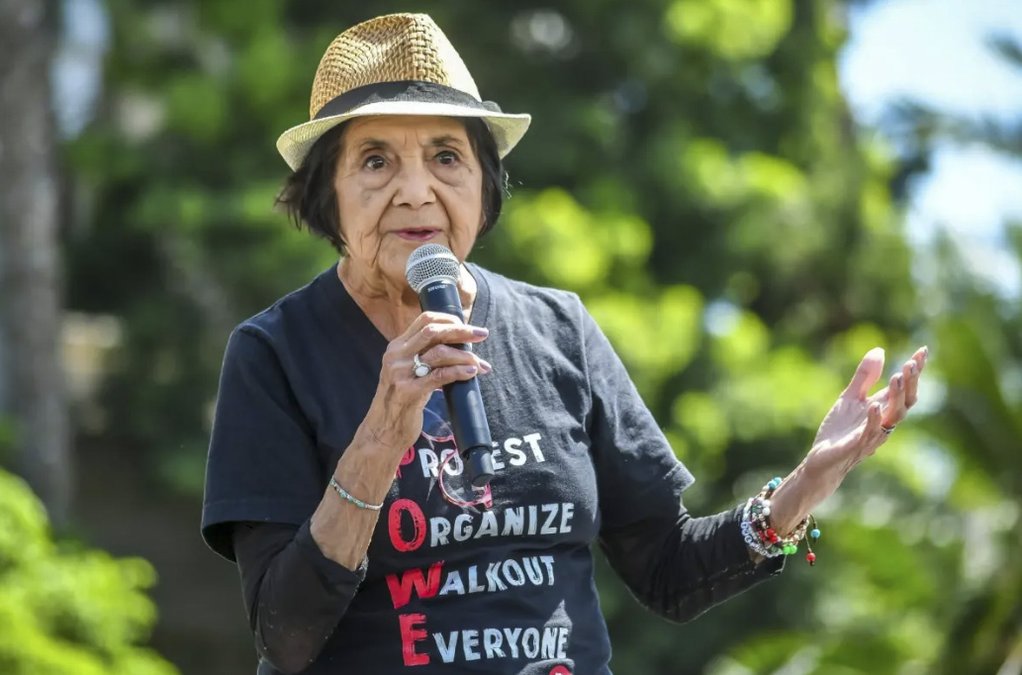
The labor and civil rights leader who co-founded the United Farm Workers union and spent more than six decades advocating for agricultural workers, women and immigrant communities, died Wednesday, Oct. 28, at her home in Bakersfield. She was 96.
Her family confirmed her death through the Dolores Huerta Foundation. A family spokesperson told The Associated Press that Huerta was surrounded by family members when she died from cancer.
Her death prompted reactions from Central Valley community organizers who knew her personally or drew inspiration from her decades of activism.
For Claudia G. Corchado, deputy executive director of Cultiva Central Valley, Huerta was someone she admired long before meeting her.
“If I had to use one word, she’s an inspiration,” Corchado said. “She paved the way for a lot of Latina women.”
Maggie Mejia, a retired volunteer organizer who has worked with the United Farm Workers since 1968, said Huerta was her mentor.
In the spring of 1966, striking farmworkers and supporters set out on a 25-day, roughly 300-mile march from Delano to the state Capitol in Sacramento. The route followed San Joaquin Valley highways and farm towns, including Merced, Modesto and Stockton, Huerta’s hometown. The union’s marches and rallies continued returning to the Valley in the years that followed, and local volunteers, such as Mejia, remember seeing Huerta when the movement came through Modesto.
Mejia, now 78, first met Huerta when she was about 18 and fresh out of high school, as the farmworker movement marched through Modesto. Huerta’s advice has stuck with her.
“She always told me that Latina women have to be luchadoras (fighters),” Mejia said. “We as women, we need to fight for our community.”
The memory with Huerta that Mejia treasures most came in 2000. She said Huerta and then-UFW President Arturo Rodríguez stayed at her home in Patterson for four days while they organized a march.
“Having her stay in my home and sleep in my guest bedroom was the biggest highlight of my life, to this day,” Mejia said. “I’m 78 now, and it’s still the biggest highlight of my life.”
Johnny Garcia, CEO of the Stanislaus Latino Chamber of Commerce, said Huerta’s work shaped his own family’s story.
Garcia, who described Huerta as a champion for the people and voice for the voiceless, grew up in the Patterson area, where he said many families were migrant workers, immigrants and farm laborers.
Bottom of Form
“Growing up, my family, my abuelos, they were all part of the farmworkers, whether it was picking apricots, or the strawberries, or the lettuce,” Garcia said. “The stuff that she did, helping out the conditions for the farmworkers, is probably one of the reasons why myself, and now my kids, have a better lifestyle.”
From the classroom to the farmworker movement
Huerta was born Dolores Clara Fernández on April 10, 1930, in Dawson, New Mexico. She grew up in Stockton, where her mother ran a hotel that offered affordable rooms to low-income workers.
Her father, Juan Fernández, was a miner and labor activist who served in the New Mexico Legislature. Her mother’s community involvement also shaped Huerta’s early interest in helping others, according to the Library of Congress.
After earning a teaching credential, Huerta worked as a schoolteacher in Stockton. Seeing children arrive at school hungry and underdressed pushed her to focus on improving their parents’ working conditions and wages.
She became involved in community organizing during the 1950s through the Community Service Organization, where she helped register voters and advocated for improvements in Latino neighborhoods.
In 1962, Huerta and César Chávez founded the National Farm Workers Association, which later became part of the United Farm Workers.
The organization gained national recognition when it joined the Filipino farmworkers-led historic grape strike in Delano in 1965, where workers demanded better wages and working conditions.
Huerta helped organize nationwide boycotts of California grapes and served as a leading union negotiator. The campaign helped secure labor contracts in 1970 that provided workers with improved wages, health benefits and other protections, according to the National Park Service.
Her efforts also extended to state and federal legislation.
Huerta played an important role in passing California’s Agricultural Labor Relations Act of 1975, which established agricultural workers’ right to organize unions and bargain collectively with their employers.
She also fought for disability insurance for farmworkers, voting rights and protections for immigrant families.
In 1972, Huerta coined the phrase “Sí, se puede,” meaning “Yes, it can be done,” while organizing against an Arizona law that restricted farmworker organizing efforts. The words became a rallying cry for labor movements and civil rights campaigns nationwide.
Jorge De Nava Jr. is the executive director of the Central Valley Opportunity Center (CVOC) This regional nonprofit provides employment, training and support services to migrant, seasonal farmworkers and low-income residents in Stanislaus, Merced and Madera counties.
After growing up in the Valley, where he saw his parents work in canneries for 30 years, De Nava said the region holds a special place in the farmworker movement.
“It originated here, it thrived here, and the marches started here on their way up to Sacramento,” he said. “The people who harvest our food are part of the foundation of our communities and the economy in the Central Valley. Dolores helped bring their struggles and their contributions into the national conversation.”
An inspiration for Latina leaders
Corchado first learned about Huerta’s accomplishments while taking a history class at Merced College.
Assigned to research a historical figure, she chose Huerta and spent weeks reading about her life and work.
Around 2002, shortly after completing the assignment, Corchado was working at CVOC when she saw a woman walk into the lobby.
At first, she thought the woman simply resembled Huerta. But after hearing her speak, Corchado realized she was standing in front of the person she just spent weeks studying.
“It’s like I manifested her through my report because there she was,” Corchado recalled. “She will be missed, but we have a lot of great memories of her to remember her by.”
Corchado introduced herself and thanked Huerta for her work, especially for helping open doors for Latina women.
Huerta’s continued advocacy into her later years is something that Corchado said she admired about her hero. She believes Huerta’s influence will continue through people and organizations working with farmworker families throughout the Central Valley.
“I think that legacy will go on for generations,” Corchado said.
Victor Chavez, lead organizer at the North Valley Labor Federation, said Huerta’s local roots are a big part of why her messages resonated with so many people. It inspires them to stand up for what they believe in and take action. Chavez was born in Turlock, raised in Patterson and still lives there.
“People definitely are inspired by local heroes. It plays a huge part in helping us recognize how much power we have when we have folks who grew up in similar environments, in the same places that we did, to look up to,” Chavez said. “We’re lucky to have that in Dolores Huerta, being from the Valley, inspiring all of us to do extraordinary things.”
That representation matters for Latino residents, he said.
“There’s a lot to be said about being Chicano or Mexican American or Latino American, and not really seeing yourself in the founding fathers or folks who are deemed as heroes of our nation,” Chavez said. “When we have people like Dolores Huerta who can show us that we are capable and we can accomplish, that’s huge for our community.”
A lifetime of advocacy
Huerta’s work extended beyond the farmworker movement.
She became an outspoken advocate for women’s rights and greater political representation, encouraging women, particularly Latinas, to run for public office and participate in civic life.
Her activism also took a personal toll. She was arrested repeatedly during protests and suffered serious injuries when a San Francisco police officer struck her during a 1988 demonstration.
In 2003, Huerta established the Dolores Huerta Foundation in the San Joaquin Valley to help residents organize around issues such as education, health, voting rights, and community participation.
In 2012, President Barack Obama awarded Huerta the Presidential Medal of Freedom, the nation’s highest civilian honor.
Huerta continued speaking at rallies, organizing events and public gatherings into her 90s.
Her visits to the Merced area included a May 2023 appearance at UC Merced, where she spoke to students during an event connected to an exhibition about the Central Valley farmworker movement.
In March 2026, Huerta publicly disclosed that Cesar Chávez had sexually assaulted her in the 1960s, sending shockwaves through the country, and especially in the Valley. She remained silent for decades, she said, because she feared the disclosure would harm the farmworker movement she had helped build. Her statement followed an investigation by The New York Times into allegations of sexual abuse involving Chávez, who died in 1993.
Remembering the woman behind the movement
Adams, who served several terms as an elected delegate to the California Democratic Party, sat on Merced’s planning commission and ran unsuccessfully for Merced mayor in 2016, said she first met Huerta through her involvement in the party.
Since childhood, she admired Huerta, and meeting her in person felt like meeting a celebrity.
But Adams said Huerta never acted as though she was above the people around her.
“She was always about the work,” Adams said.
Over the years, Adams said, they shared conversations and attended political gatherings, including California Democratic Party conventions.
Adams remembered Huerta as someone who combined a strong commitment to her beliefs with a warm and approachable personality.
“She made you feel heard,” Adams said as she recalled Huerta’s sense of humor, kind smile and the way she gave people her full attention in crowded rooms. “When you asked her a question about things, she was pretty direct in her answers. She didn’t waver, and she always imparted wisdom.
When asked how she believed people would remember Huerta, Adams described her as “a very strong-willed woman with a soft-spoken voice that was a powerhouse.”
Mejia said Huerta’s reach extended well beyond the Valley.
“There will never be another Latina woman to do as much as Dolores Huerta did, and she inspired many of us to follow in her footsteps, and I mean many throughout the United States, not just the Central Valley,” she said.
“She made many of us stronger because she was a strong woman, and she made many of us her equal,” Mejia said. “She was a very humble woman, but she was strong at the same time.”
For Victor Chavez, honoring Huerta means organizing.
“Let’s honor her legacy by doing what we know we must do: organizing and winning,” Chavez said. “We need to stick together, we need to plan, we need to act. We need to talk to our coworkers, our neighbors, our community members, and educate about how we take collective action and how we win.”