BY XIMENA LOEZA
CV Journalism Collaborative
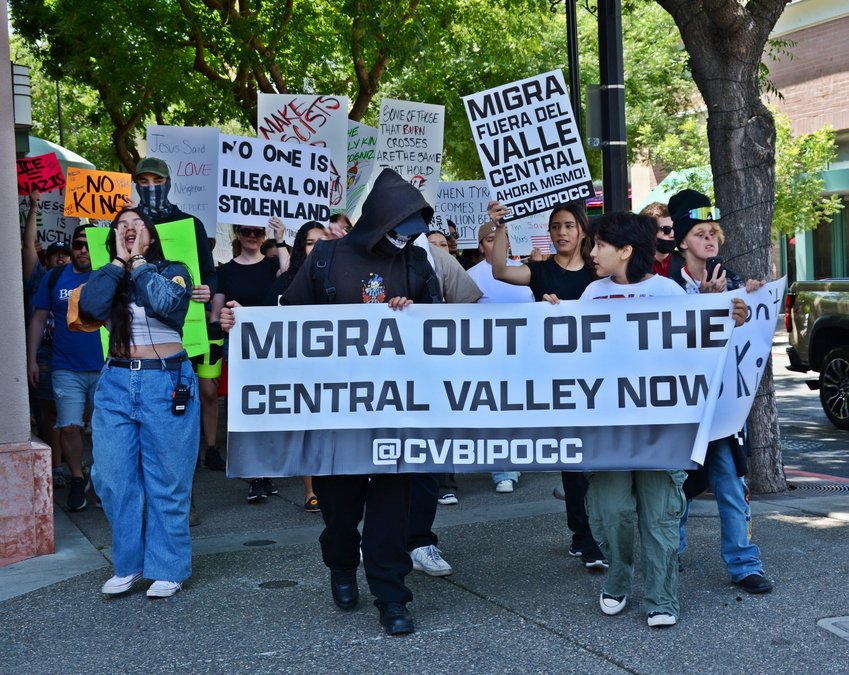
This week the powerful Ninth Circuit federal appeals court temporarily lifted an injunction that many immigration experts say has spared large swaths of California, including the Central Valley, from mass sweeps.
The ruling is adding to anxiety about a recent uptick in enforcement across Stanislaus County and the region.
On Monday, Aug. 24, the Ninth Circuit lifted a preliminary injunction with an order that had barred Border Patrol and other immigration agents from conducting large non-targeted raids in the Eastern District of California, which stretches from Bakersfield to the Oregon border.
The initial injunction went into place 16 months ago in late April 2025 after several sweeps that resulted in the detention of dozens of immigrant farmworkers in Kern County. Local immigration attorneys said while the new ruling could result in the return of immigration sweeps in the Valley, the likelihood remains low.
The federal appeals court ruled that the evidence provided did not properly justify the preliminary injunction brought by the plaintiffs in United Farm Workers. v. Noem.
In that case, the ACLU and several other groups sued the U.S. Border Patrol and the federal government for allegedly violating the U.S. Constitution by indiscriminately stopping and detaining people of color.
Ruling sends injunction back to lower court
But the lifting of the injunction is temporary, as the case was sent back to the district court with a 120-day deadline to rule.
“The ruling does leave room for Border Patrol to resume large-scale sweeps,” said Modesto-based immigration attorney, Patrick Kolasinski. “It’s a harmful ruling for immigrants. It puts people in the Valley at risk of immigration enforcement.”
The lower Eastern District of California court had said that agents involved in a three-day enforcement operation in January 2025 in the Valley acted without reasonable suspicion and arrested migrant workers without probable cause of perceived flight risk. But the Ninth Circuit appellate panel found the lower court that placed the injunction had only weighed past harm, not whether plaintiffs faced a real and immediate threat of it happening again in the future.
Bottom of Form
Because of the 120-day deadline for a new ruling, Kolasinski said, if Border Patrol were to conduct any indiscriminate raids during that time period, it would provide the evidence that UFW was missing originally to prove the threat of immediate harm to the plaintiffs.
“If they resume aggressive sweeps, they strengthen the plaintiffs’ case in the long run,” Kolasinski said. “It is awful for the people detained, but right now, this affects everybody.”
Valley mass sweeps still unlikely and unlawful, ACLU says
Mayra Joachin, a senior staff attorney with the ACLU Foundation of Southern California, said though this injunction sets back the legal process for them, the law hasn’t changed. The government must still follow the law when stopping or arresting people in California for alleged immigration violations, and they will return to court if Border Patrol acts unlawfully again.
“We are disappointed that the Ninth Circuit has returned the case to the lower court to consider whether our clients can seek relief. We will continue fighting to ensure that communities in the Eastern District are protected from Border Patrol’s unlawful policies and practices and anticipate that the district court will reaffirm the injunction,” said Joachin in an email statement.
In Stanislaus County, fear in immigrant communities has already been growing this summer, with a visible increase in Immigration and Customs Enforcement (ICE) arrests at local courthouses and unmarked vehicles.
Immigrants visiting local Stanislaus courthouses are being picked up in public, said Nora Zaragoza-Yáñez, an organizer with Faith in the Valley’s Valley Watch Network, which trains legal observers from San Joaquin to Kern counties. The last comparable wave of courthouse arrests in the region came at the end of September 2025, she said, before quieting down for months.
“Within the past month and a half, almost two months, we’ve started to see an increase in criminal courthouse arrests,” Zaragoza-Yáñez said.
Increase in ICE arrests recorded at Stanislaus courthouse
The California Judicial Council adopted a rule in April that went into effect in June to track civil arrests at courthouses made by immigration enforcement. This came after a day-long federal enforcement operation at the Oroville courthouse in Butte County that led to several arrests.
“When people avoid court facilities out of fear, the court system cannot serve them and cannot function as intended,” Butte County Court Executive Officer Sharif Elmallah stated in a press release, warning that crime victims, witnesses and litigants all suffer when people are afraid to show up.
According to data by the council, Stanislaus County has recorded eight arrests made at the county’s main courthouse since the rule went into effect in June.
“We’re seeing a lot more targeted [enforcement]… People are being detained off of technicalities – being late or missing their check-ins at their local ICE office,” Zaragoza-Yáñez said.
Despite the increase in courthouse arrests, Fernanda Pereira, director of legal services at El Concilio California, said the first rule for anyone with a pending immigration case is simple and nonchanging: show up.
“If someone has a scheduled hearing before an immigration judge and they do not attend, they will be ordered deported,” Pereira said.
Missing court doesn’t reduce risk but quite the opposite, she and her colleague Nelson Ibarra said — it can trigger a deportation order outright and forfeit any chance of relief.
“It’s important, for that reason, that they overcome their fear,” said Pereira. Her fellow El Concilio attorney Ibarra agreed.
“If you don’t go to your hearing, you’re gonna have a deeper order… you’re relinquishing any type of chance that you had at filing an application,” he said.
Rumors about unmarked cars, immigration agents abound
Concerns about increased sightings of unmarked vehicles, which could be used by immigration enforcement officers, have spread online. Zaragoza-Yáñez, who works directly with legal observers in Modesto, emphasized that misinformation on social media surrounding unmarked vehicles in the area can create more harm than good. The Valley Watch Network legal observers are trained to recognize the difference between ICE agents and others.
“Anytime that a vehicle or an agent fits a description, as a report is sharing that, we’re communicating with each other to determine the response time to head out to where the suspected activity is happening and to verify these reports,” Zaragoza-Yáñez said.
Both attorneys cautioned that California’s SB 54, the California Values Act that prevents state and local law enforcement agencies from using resources to assist federal immigration enforcement, is often misunderstood. The law does not shield immigrants from all cooperation between local law enforcement and ICE, Pereira said.
“Sometimes there is the idea that SB 54 protects immigrants in a complete form,” she said. “That is not the case. SB 54 still allows for discretionary cooperation between law enforcement and ICE in certain circumstances where individuals have been convicted of certain types of felonies.”
The felonies in question can range from driving under the influence to domestic violence.
Advocates warn against air travel, encourage planning
Immigration advocates and attorneys across the country also have warned immigrants against any air travel. Pereira said the risk extends well beyond coastal hubs. Bay Area advocates have reported more than a dozen travelers detained at airports in recent weeks, prompting attorneys to warn noncitizens, including visa holders and asylum seekers, about the risks of flying – domestically or internationally.
“Every airport is a border, and it’s something that people don’t realize,” Pereira said. “But whenever there’s an international flight landing into the United States, that means its port of entry. The fact that it may be in the middle of the country does not mean that it’s not a border.”
She says that people with prior immigration contact, no legal status, or uncertain status should avoid flying for the time being.
Both organizations pointed to family preparedness plans as the most important step immigrants can take now. Nelson recommended memorizing a point of contact in case of detention, and to provide that information to any loved ones.
Zaragoza-Yáñez urged families to gather a full name, date of birth, alien number, work permit or USCIS number, and medical information in a safe place and to designate a U.S. citizen relative to visit anyone in detention. Both El Concilio and Faith in the Valley also offer free “know your rights” workshops and legal consultations for anyone looking to assess their individual risk before taking any of these steps.