MODESTO – Stanislaus County District 2 Supervisor Vito Chiesa delivered the annual State of the County address on Tuesday, focusing on the themes of perspective and community, and the days when partisan pursuits took a back seat to getting results.
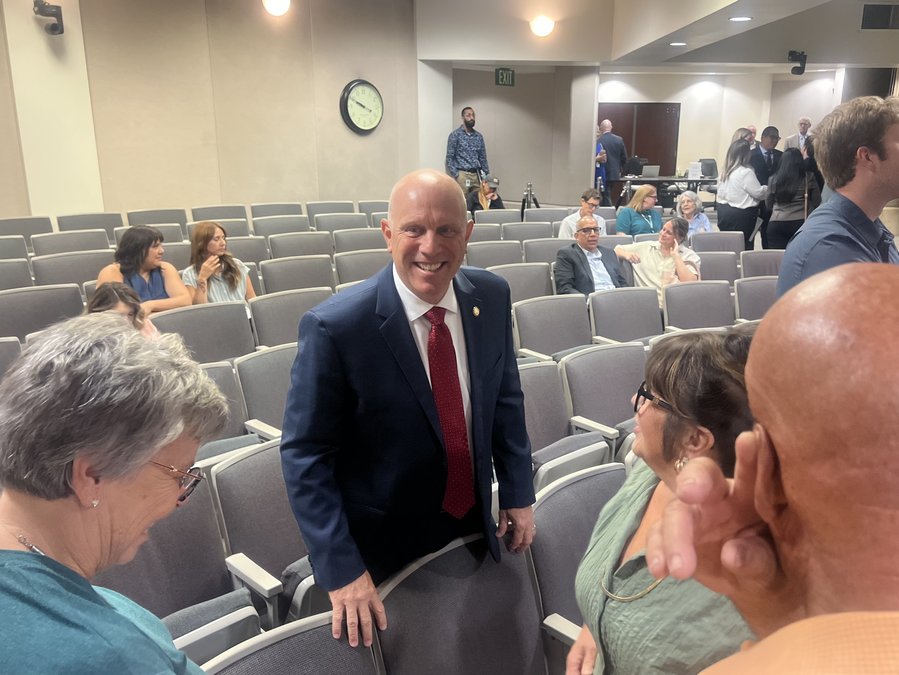
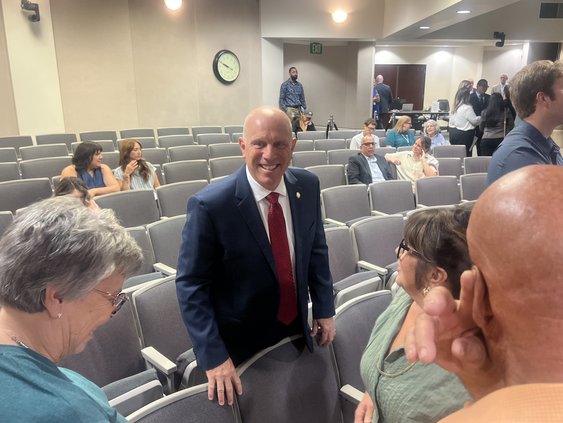
Chiesa, sporting a dark blue suit and bright red tie over a crisp white shirt, spoke for about 35 minutes in the supervisors’ basement chambers at 1010 10th St. He opened his remarks by telling the audience that he starts each morning with a walk as the sun comes up.
“As a farmer, I've always felt most connected when I’m outside; there's something about being close to the land that has a way of clearing your mind and putting things into perspective,” Chiesa said. “Our Chief Executive Officer, Jody Hayes, often says that ‘perspective is one of our greatest currencies in leadership.’ Over the years, I've learned that perspective doesn't just change how we lead, it changes how we see every challenge in front of us. It reminds us that communities are living systems: always changing, always growing, and always creating new opportunities to improve the lives of the people we serve. When the sun rises, it simply reminds us that every day is another opportunity to listen, learn, and serve.”
Chiesa thanked the mostly anonymous 5,000 employees who perform the lion’s share of work in the county before pivoting to talk about the $107 million the in American Rescue Plan Act funds.
“We could have viewed those dollars as temporary funding,” said Chiesa. “Instead, we treated them as seed money, investing in projects that would continue benefiting this community long after the federal dollars were gone.”
That vision, according to Chiesa, became the Stanislaus 2030 public-private economic development partnership.
“It was built with input from more than 200 community leaders, and it focuses on expanded access to middle class jobs, recognizing that too many hardworking families are still struggling to get ahead,” Chiesa said. “Our version of economic development goes well beyond just trying to recruit new employers to our region. It means investing in training systems that prepare our workforce for the changing demands of existing industries, today and tomorrow. It means setting a goal for Stanislaus County to be the best place in California to start and grow a new business.”
Chiesa also boasted about the partnership with First 5 Stanislaus to bring the Nurture Childcare model to the county.
“Nurture Childcare has generated 105 new childcare businesses right here in Stanislaus County, opening 840 permanent licensed childcare spaces for local families,” Chiesa said. “Think about what that means. We're giving parents opportunities to work, helping entrepreneurs build successful small businesses, helping employers find the workforce they need, and giving more children a strong start in life. That's what innovative economic development looks like.”
Another investment helping to shape the county’s future, Chiesa said, is the partnership with BEAM Circular.
A few years ago, most people had never heard of bio-industrial manufacturing or the bio-circular economy,” said Chiesa. “Through our work with Stanislaus 2030 … we recognized Stanislaus County is uniquely positioned to lead this rapidly emerging sector of the economy. … We’re turning agricultural byproducts like nut shells. orchard wood, food processing byproducts, and other biomass into new products, new businesses, and good-paying jobs.”
A native of Hughson, Chiesa was joined at the meeting by wife Jamie, mother Mary, and son Teo (daughter Caroline was unable to attend). He was first elected to the board in 2008.
“During that time, I've attended thousands of meetings and community gatherings, worked through emergencies, made difficult decisions, and watched this county continue to grow and evolve,” said Chiesa. “Over those years, one lesson has become clearer to me than any other: people still want the same basic things – safe communities, healthy families, good jobs and opportunities, reliable infrastructure, a government they can trust, and a community they're proud to call home. That's what public service is really about.
“It's easy to become consumed by the 10 percent that still needs improvement or the challenges we haven’t solved yet, but if that's all we focus on, we lose sight of the extraordinary progress represented by the other 90 percent.”
After highlighting air-quality improvements, North County Corridor and Kenwood-Starr infrastructure projects, as well as the county’s agricultural might, Chiesa closed his address by explaining how stakeholders put partisan politics aside to address a problem that vexed Stanislaus County for decades.
Proposition 13, the landmark 1978 legislation the capped increases on property taxes, had an unintended consequence – known as Negative Bailout – that cost Stanislaus County nearly $70 million over the ensuing four decades.
“Stanislaus was the largest county impacted by Negative Bailout, and starting in 1982 our community was forced to divert millions in property taxes out of the county’s general fund,” Chiesa said. “Everyone knew it was a problem. Republicans knew it. Democrats knew it. County leaders knew it. Our legislative delegation knew it.”
In 2015, state and local leaders – Democrats and Republicans alike – came together to solve the problem. Former Assemblymember Kristin Olsen and former state Sen. Anthony Cannella, who helped to solve the Negative Bailout conundrum, were in the chamber on Tuesday.
“Politics is a bloodsport, and everybody always takes credit all the time,” said Cannella. “But Vito isn’t that kind of a guy. The reality is, Vito had the biggest role in the Negative Bailout. My part was easy: I just voted for it. Vito did all the hard work.”
Olsen agreed, recalling that the negotiations were intense “up to the very last hour.”
“It could’ve gone either way, but what was so rewarding about it was that it really was a group effort,” Olsen said. “To remember that this many years later makes you realize that service really is worth it and delivering for the community in which we were born and raised was one of the most exciting times in my career.”
But the job isn’t finished, Chiesa insisted.
“(Today’s) about recognizing how far we've come, while never losing sight of the work still ahead,” said Chiesa, who grew emotional and choked back tears as he concluded. “It's about thanking the people who made that progress possible and reminding ourselves of what we can accomplish when we work together.
“Our county is guided by a simple mission statement: we build community. And I’m proud to be doing it with all of you.”