BY JIM BRUGGER AND FRED YERZY
Open Sky Outreach
Planet Parade:
Venus continues to shine brightly in the evening twilight this month and sets in the west by 10:30 p.m.
Saturn continues its ascent in the pre-dawn, morning sky. Look to the southeast, after 2 a.m. The best time to see it is between 4 and 5 a.m., when it is as high as possible before sunrise. With binoculars, Saturn looks like a bright dot. In a small telescope you should be able to make out the rings as a bulge around the middle and possibly Saturn’s largest moon, Titan.
Mars still hangs low in the eastern, pre-dawn sky all month. Slightly fainter than Saturn, look for a distinct, red dot. Don’t be fooled, though, Mars shares the sky with the red giant star Aldebaran in Taurus and is between Saturn and Mars. Hint: Stars twinkle and planets don’t.
Uranus moves into conjunction with Mars at between 4:00 and 4:30 a.m. on July 4, when they are separated by less than one degree.
Constellations and Celestial Highlights:
After sunset, the two brightest stars you will see are red giant, Arcturus, toward the west and blue-white Vega toward the east. Look for Hercules standing guard directly overhead.
The “Summer Triangle” asterism moves higher in the eastern sky. Can you trace the triangle made by Vega, in the constellation Lyra (the lyre/harp), blue super-giant Deneb, in the constellation Cygnus (the swan) and blue-white Altair, in the constellation Aquila (the eagle)?
A challenging, but interesting, area to scan with binoculars or a telescope on a moonless night is the constellation Ophiuchus, the Serpent Bearer. Look for a large box with a peaked roof about halfway between Arcturus and Altair. There are two globular clusters, M10 and M12 inside the box. Other clusters may also be visible in this region, which lies near the Milky Way.
The Perseid meteor shower, remnants of Comet Swift/Tuttle, starts on July 17 and extends through August 24. Go out after midnight on moonless nights for the best chance to see meteors streaking through the sky. Tune in next month for tips on catching the shower at its peak.
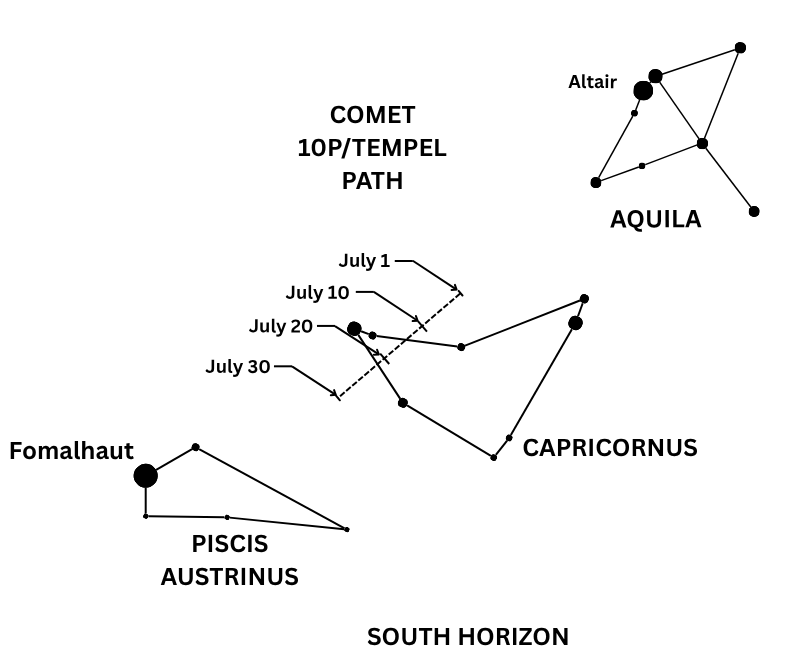
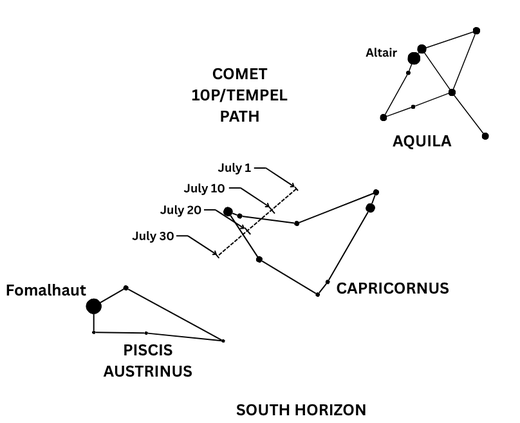
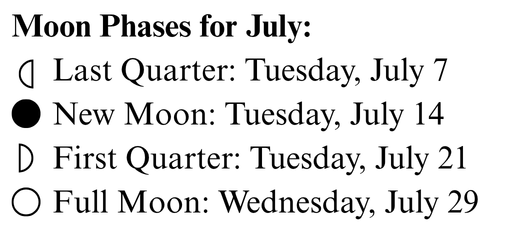
Comet 10P/Tempel 2 makes its way back through the inner solar system this month. Between midnight and 4:30 a.m., look south/southwest in the constellation Capricorn, about 30 degrees above the horizon, and halfway between two bright stars, Altair and Fomalhaut. For the first week of the month, the comet will be washed out by the glare of the waning gibbous moon. Even without the moon, at roughly magnitude 7.0, it will only be visible with binoculars or a telescope.
Did you know?
July’s full moon is called the Buck or Thunder Moon. It marks the season when buck’s antlers begin to grow and the month of frequent thunderstorms.
The Chinese Qixi festival celebrates the meeting of Vega (the Weaver Girl) and Altair (the Cowherd). According to legend, the two were deeply in love but separated by the river of the Milky Way Galaxy and only allowed to meet once a year on the seventh day of the seventh month.
Tech Talk:
Apparent Magnitude: A centuries-old scale that describes how bright a celestial object looks; not how bright it actually is. The lower the number the brighter the object and each step of one magnitude equals a brightness factor of 2.51x (e.g. Venus, at its brightest, has a magnitude of -5 and is 100x brighter than Vega, which has a magnitude of 0).
For Open Sky Outreach, Star Tours and Telescope Talks, email openskyoutreach@gmail.com.