BY JIM BRUGGER AND FRED YERZY
Special to the Journal
November, with its early sunsets, longer nights and cool, crisp fall air is a wonderful time for stargazing in the Central Valley. This is also a time for reflection, thanksgiving and connecting with friends and family. With a host of planets, star clusters and easily recognizable constellations right outside our door, why not make time to walk off the Thanksgiving food coma and share in the wonder of the cosmos.
Planet Parade:
Evening: At sunset, Saturn can be found approximately thirty degrees above the east-southeast horizon. Neptune lies about ten degrees (one fist width) to the right (west) of Saturn. Uranus rises in the east, halfway between the Pleiades Star Cluster and the red giant star Aldebaran in Taurus.
Midnight: Saturn is high in the west. Mars rises around 1 a.m. in the east at the beginning of the month with Jupiter close behind.
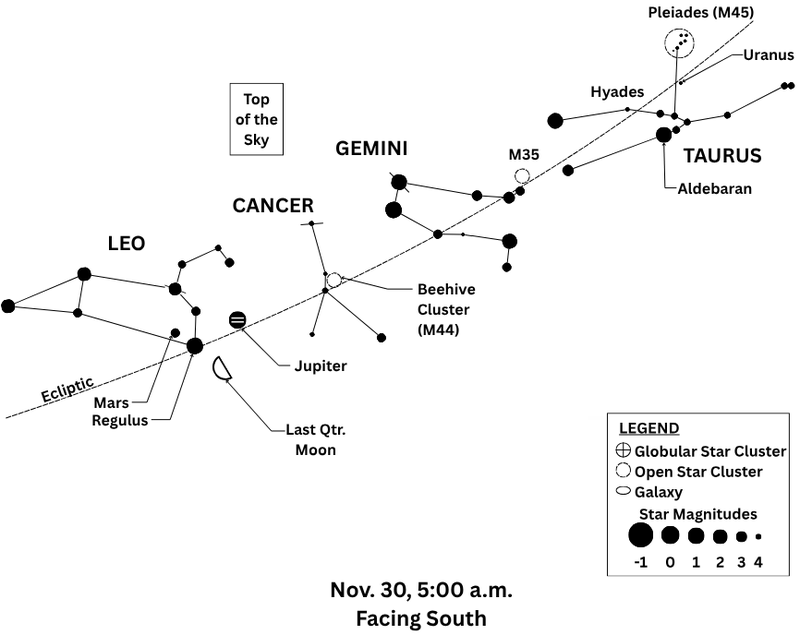
Morning: Mars and Jupiter are high in the east. Look low on the eastern horizon, just before sunrise, to catch a glimpse of Venus. After the 15th, Mercury reaches its maximum, western elongation and should be visible just before sunrise. Mars and Jupiter will have a close conjunction near blue/white Regulus, the brightest star in Leo, on the morning of the 15th. The waning, quarter moon joins the party on the 30th.
Constellations and Celestial Highlights:
Two beautiful, open star clusters in the constellation Taurus dominate the nighttime sky this month. The first, located on the bull’s shoulder, is the Pleiades (M45); a beautiful, open cluster of more than one thousand stars approximately 430 light-years from Earth. Six of the brightest stars, which resemble a mini-dipper, are readily visible to the naked eye in all but the most light-polluted areas and are commonly called “The Seven Sisters”. The second is the Hyades Cluster. At 150 light-years away, it is the closest star cluster to Earth. Look for a V-shaped group of stars below and to the left (south and east) of the Pleiades. These stars form the face of the bull. Aldebaran, the bright, red giant star sitting at the right eye of the bull, is a little less than halfway between Earth and Hyades and is not a member of the cluster.
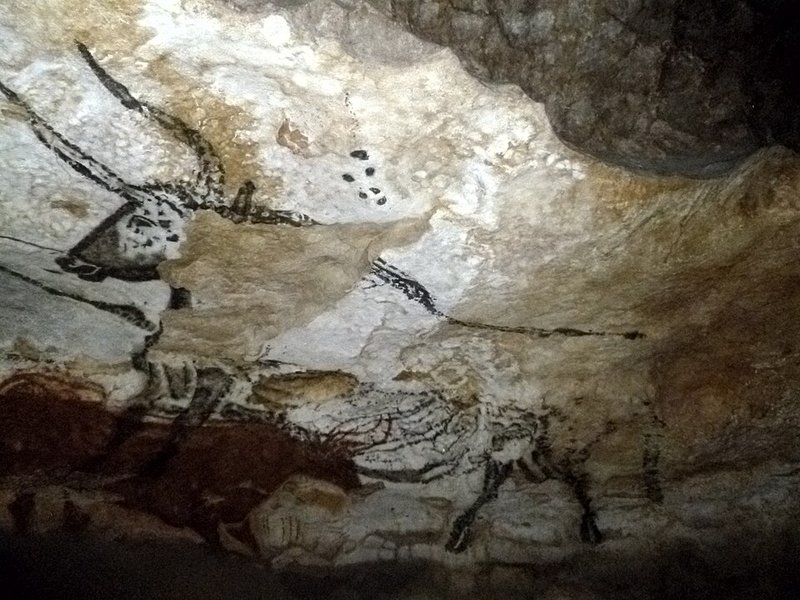
The Hyades is one of the oldest recorded star groups and the mythology of it and the Pleiades representing a bull and Seven Sisters (or young women) appears repeatedly in ancient and global cultures. In fact, prehistoric paintings in the Lascaux Caves in France show the two-star clusters superimposed with the image of a bull.
In Japanese culture the Pleiades cluster is called Subaru, or unity. Look for the familiar logo on your next road trip.
The Southern and Northern Taurid meteor showers peak on the nights of Nov. 4/5 and the 11/12, respectively. Although not as active, the Taurids can have more fireballs than other meteor showers.
The Leonid Meteor Shower peaks the night of Nov. 17/18 with up to twelve meteors per hour. Meteors can be seen in all parts of the sky but appear to radiate from the head of Leo, the lion, which looks like a sickle or backwards question mark. If you get tired of looking for meteor trails, take time to scan the region with binoculars for planets and star clusters.
Did you know?
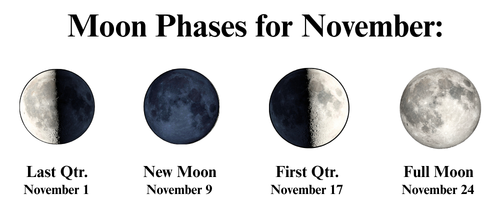
November’s full moon occurs on the 24th and is commonly called the Beaver Moon. It is the time beavers prepare their lodges for winter and, during the North American fur trade, was the time to trap beavers for their thick, winter pelts.
The light we see today from Aldebaran started its journey around the time when Alaska and Hawaii became the 49th and 50th states.
Tech Talk:
Elongation is often used to describe the distance between the sun and either Mercury or Venus as viewed from Earth. Maximum elongation is when the planet appears to be at its farthest from the sun and is usually the best time to see it in our twilight sky.
Conjunction is the term used when two celestial objects appear to be close to each other in the sky.
Local Outreach Events:
Great Valley Museum Science Night will be held from 7 p.m. to 10 p.m. Nov. 6 at the MJC West Campus, featuring a natural history museum, hands-on exhibits, planetarium shows and rooftop observatory (https://www.mjc.edu/gvm/index.html).
Open Sky Outreach will hold a solar telescope demonstration at the Turlock Farmer’s Market on Nov. 28 (weather permitting).
Do you have questions about the local nighttime sky and/or astronomy? Email us at openskyoutreach@gmail.com