BY XIMENA LOEZA
CV Journalism Collaborative
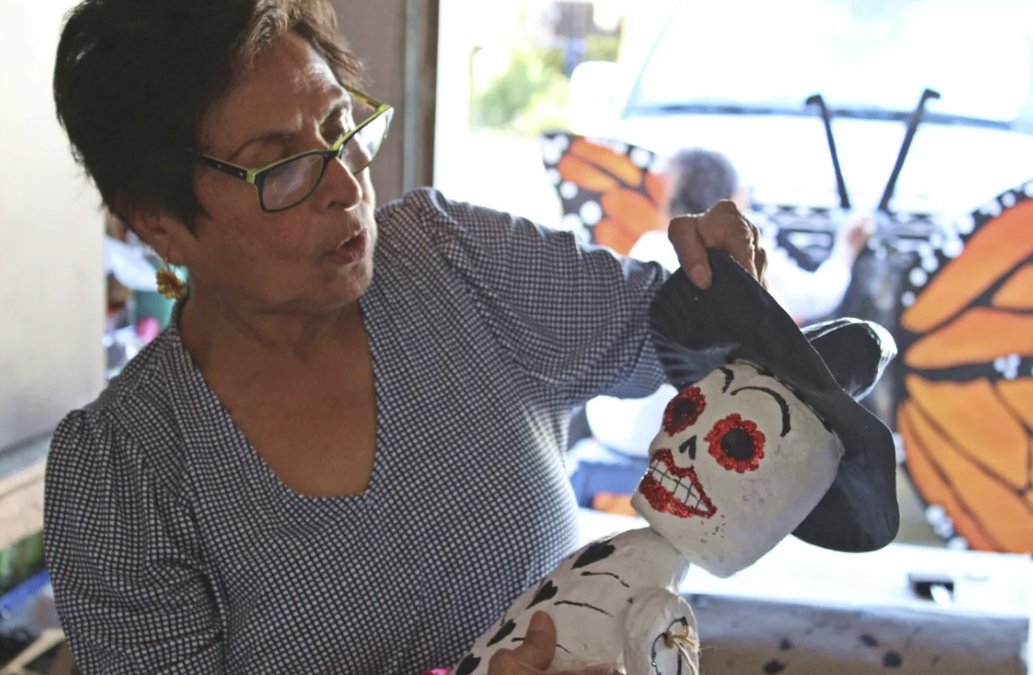
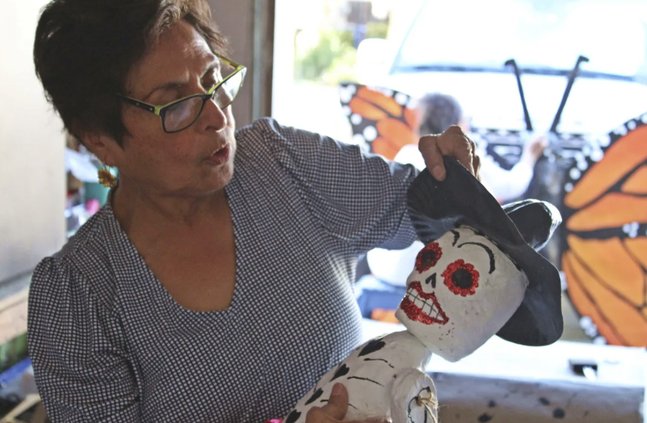
Starting in July, a garage in Modesto regularly fills with flour paste, plaster molds and old newspaper torn into strips as the sound of corridos plays softly in the background. By late October, it’s filled with catrinas – elegant skeleton figurines in braids and flower crowns, bound for Día de los Muertos altars across the Central Valley.
The women behind them call themselves Manos Mágicas, or “magic hands.” About 16 members meet at the home of founder Laura Malagon, who has been making calaveras, painted skull heads, and catrinas, elaborately decorated skeletons, for about 25 years.
Malagon, 72, has been active in the regional arts scene for decades, as founder and former director of the long-running and now nonprofit Ballet Folklorico Los Falcones dance troupe.
But creating catrinas came from a personal place. Her start came out of grief.
Her sister was killed by a drunk driver in the early 1990’s, a week after she served as the godmother at the baptism of Malagon’s daughter when she was a baby. In 1999, she read an article that the tradition of Day of the Dead altars was fading, and so she took her then 8-year-old daughter to see an exhibit at the Mexican Heritage Center & Gallery in Stockton.
“We read there that altars were set up to honor the memory of our family who had passed away,” she said in Spanish. Her daughter came home wanting to build one for her godmother who passed years ago. It became the family’s first altar.
Three thousand year-old history
Bottom of Form
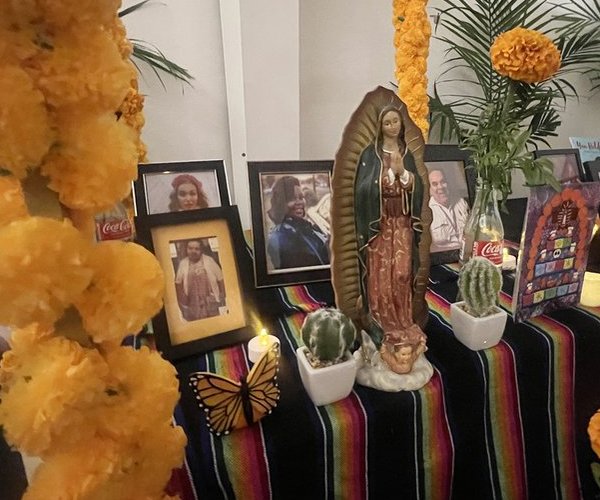
Día de los Muertos, observed Oct. 31 through Nov. 2, traces back roughly 3,000 years to rituals in pre-Columbian Mesoamerica, where the Aztecs and other Nahua peoples saw death as a natural part of life. Families welcome the souls of loved ones home with ofrendas, or altars, filled with marigolds, candles, favorite foods and pan de muerto.
Skulls and skeletons, also known as calaveras and catrinas, are the holiday’s best-known symbols, and the catrina owes her look to printmaker José Guadalupe Posada, whose 1910 etching of an elegantly dressed female skeleton inspired the tradition. At the time it was made to mock politicians and comment on revolutionary politics. She has since become a staple of the holiday, often fashioned in flowers, large skirts, and big hats.
The best-known calaveras are sugar skulls, small skulls molded from sugar and decorated with colored icing, often with a loved one’s name written across the forehead. They’re placed on altars as offerings to the dead. Manos Mágicas makes its calaveras from papier-mâché instead, so they can be reused and repainted year after year.
On a trip to Mexico after making their first ofrenda, Malagon and her daughter saw a newspaper ad for catrina and calavera classes and decided to take the two-week course in the state of Guanajuato, in central Mexico.
She came home with the technique and a skull mold she later cast in plaster, and was inspired to spread her new found knowledge with her community. The group still uses that 25-year-old mold to this day. Malagon marks her return to the U.S. after that class as the start of Manos Magicas.
Group members find energy, connection in work
Back in the garage, the work is slow. Members shape a cardboard cylinder, cut it to narrow the waist, then layer paper over it with a paste made of four cups of boiling water and one cup of flour. Skulls are formed over molds, cut in half once dry to remove the mold, glued back together and smoothed before painting. Some figures in the garage are six or seven years old and get new hair and crowns each fall.
Despite the pain from arthritis she has had for four decades, which bends her fingers, Malagon considers the work a form of gratitude.
“For me, it’s like a way of thanking God — even though it hurts and it’s uncomfortable, I can still do things,” she said. “I can still do this.”
The disease has worsened gradually. Just three weeks ago, she woke to find two of her fingers had drooped and would no longer straighten. She has had days where she struggles to perform daily tasks, and there are days where they are much easier. Yet she continues to practice and pass on the craft.
Patterson resident Guadalupe Villegas, 69, joined Manos Magicas after taking a catrina class in 2012 in south Modesto led by a neighbor. She “fell in love” with the craft, and enjoys being in community with her friends and the exchange of energy that happens doing something creative.
Her calaveras, used as planters for living plants, have won prizes at the Stanislaus County Fair. She rejects the idea that the holiday is macabre or morbid. Instead, she said, this tradition is rooted in love and respect for those who have passed.
“When we were born, we were born with this skull. If we learn to live with both (life and death), we get more out of life,” Villegas said in Spanish. “It’s like a fantasy you can touch with your hands—you can live it through your life, your breath, your conversation, your energy—you can live it just the same.”
Healing through art and tradition
Rosie Gomar, a longtime outreach worker focused on emotional health and suicide prevention, has been painting with the group for the past three years. Art runs in her family, she said, and her son is a muralist. She uses creativity in art therapy classes to help children work through their emotions.
“This is a way to show how your emotions can heal,” she said. “We never realize how many tools we have around us.”
Gomar sees the catrina workshop as one of the creative outlets for herself.
“Setting up an altar is healing,” she said. “It makes you feel good that you’re dedicating time to your loved ones who aren’t with you anymore.”
This month, Manos Mágicas has many projects in the works. The group is lending pieces to the Great Valley Museum. Members are also building an altar with the Mexican Consulate in Sacramento – their seventh year doing so, and setting up the annual altar at the Gallo Center for the Arts in downtown Modesto, which is now available for viewing. Malagon will also join a Day of the Dead panel at Stanislaus State on Oct. 28.
Malagon sees the work as a calling.
“I discovered that my mission, and the mission of all of us who are here in this world, is to help others,” she said. “What’s important is that you share that legacy.”